Transmitting service advertisements

a technology of service advertisements and transmitters, applied in the field of transmission service advertisements, can solve the problems of ineffective gps in determining an accurate position indoors

US20140355503A1Inactive Publication Date: 2014-12-04NOKIA TECHNOLOGLES OY
9 Cites 28 Cited by

Patent Information

Authority / Receiving Office
US · United States
Patent Type
Applications(United States)
Current Assignee / Owner
Publication Date
2014-12-04
Estimated Expiration
Not applicable · inactive patent

Smart Images

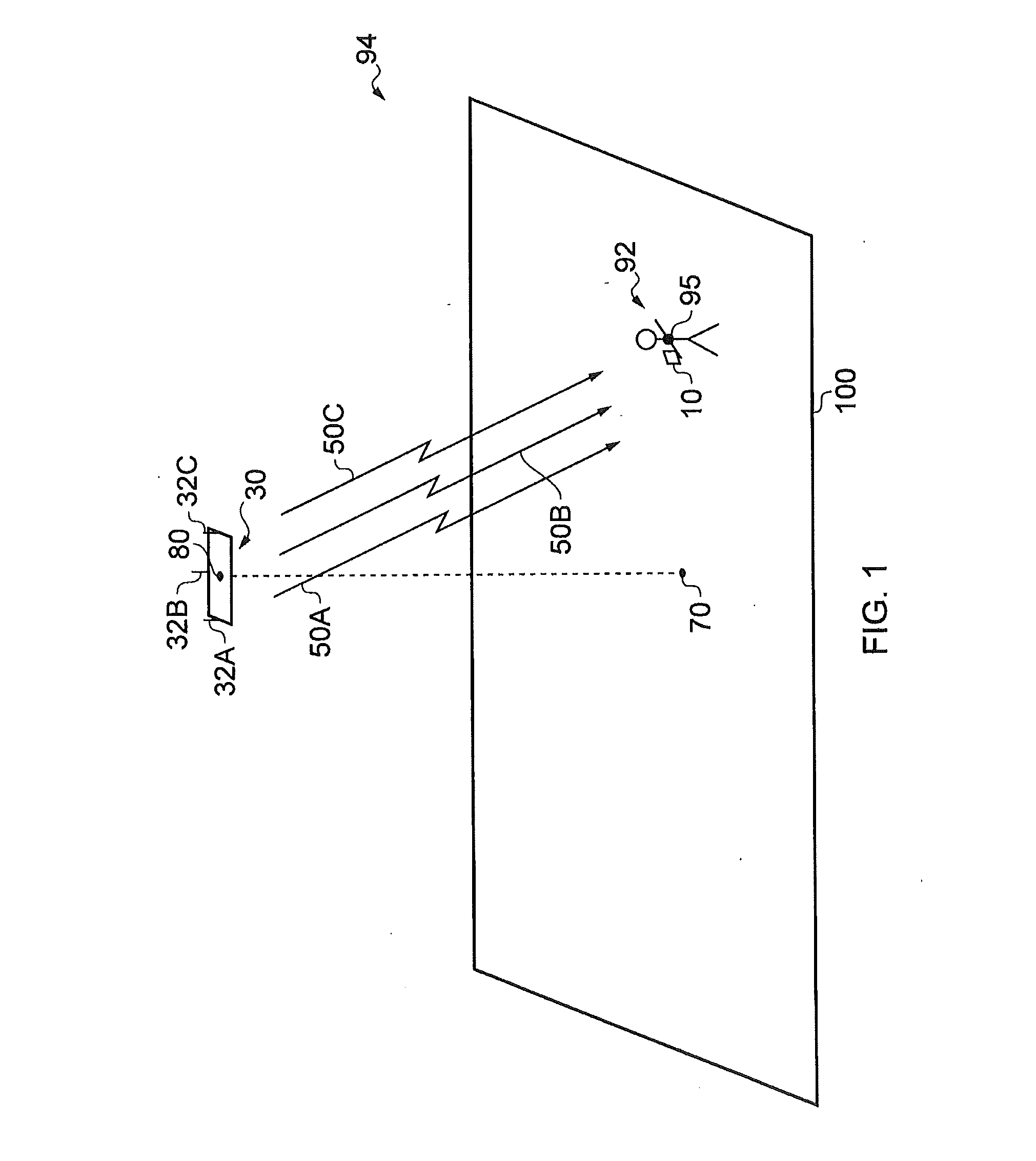
  • Figure 1
    Figure 1
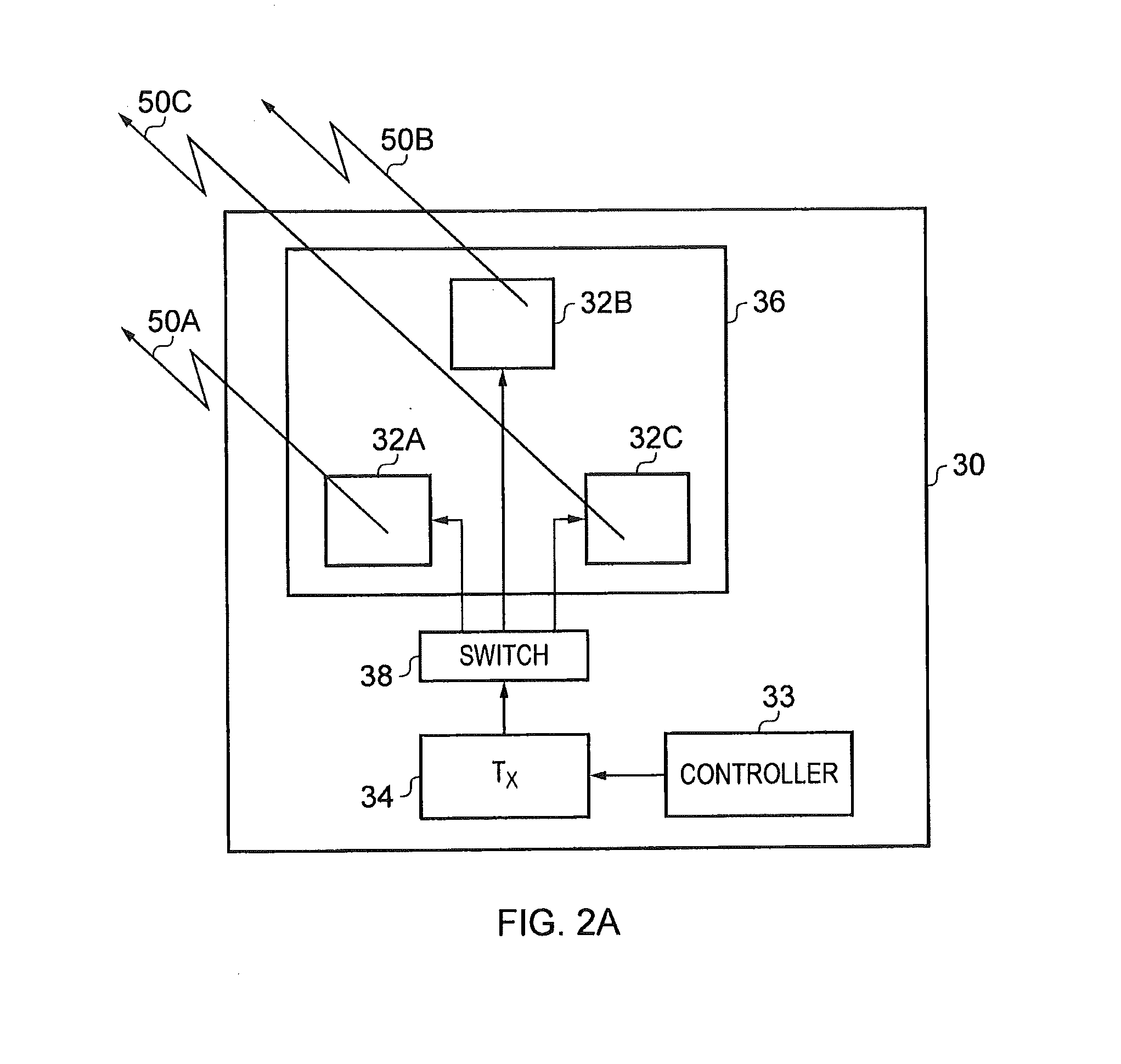
  • Figure 2
    Figure 2
  • Figure 3
    Figure 3
Patent Text Reader

Abstract

Apparatus (30) comprises a battery power supply, a radio-frequency transceiver, a multi-element antenna, and processor and memory. Software causes the apparatus (30): when in an idle mode, to broadcast positioning service advertisements and to refrain from broadcasting positioning packets, when in a positioning mode to broadcast positioning packets from each of the elements of the antenna (32A-C) such as to allow a mobile device (10) to determine a bearing to the mobile device (10) from the apparatus (30), and to transition from the idle mode to the positioning mode in response to receiving either a) a wake-up command or b) a positioning packet, from another apparatus including a multi-element antenna. The apparatus (30) may comprise a Bluetooth Low Energy transceiver; and software that causes the apparatus (30): to transmit advertisements for positioning services on a first channel; and to broadcast positioning packets on a second channel such as to allow a mobile device (10) to determine a bearing to the mobile device (10) from the apparatus (30), wherein the first and second channel are on different frequencies.
Need to check novelty before this filing date? Find Prior Art

Description

FIELD OF THE INVENTION

[0001] This relates to transmitting service advertisements.BACKGROUND TO THE INVENTION

[0002] There are a number of known techniques for determining the position of an apparatus using radio frequency signals. Some popular techniques relate to use of the Global Positioning System (GPS), in which multiple satellites orbiting Earth transmit radio frequency signals that enable a GPS receiver to determine its position. However, GPS is often not very effective in determining an accurate position indoors.

[0003] Some non-GPS positioning techniques enable an apparatus to determine its position indoors. An example technique is described by inventors of the present invention in WO 2011 / 107825.SUMMARY

[0004] A first aspect of the invention provides apparatus comprising:

[0005] a battery power supply,

[0006] a radio-frequency transceiver,

[0007] a multi-element antenna, and

[0008] processor and memory including software that when executed by the processor controls it to cause the apparat...

Examples

Embodiment Construction

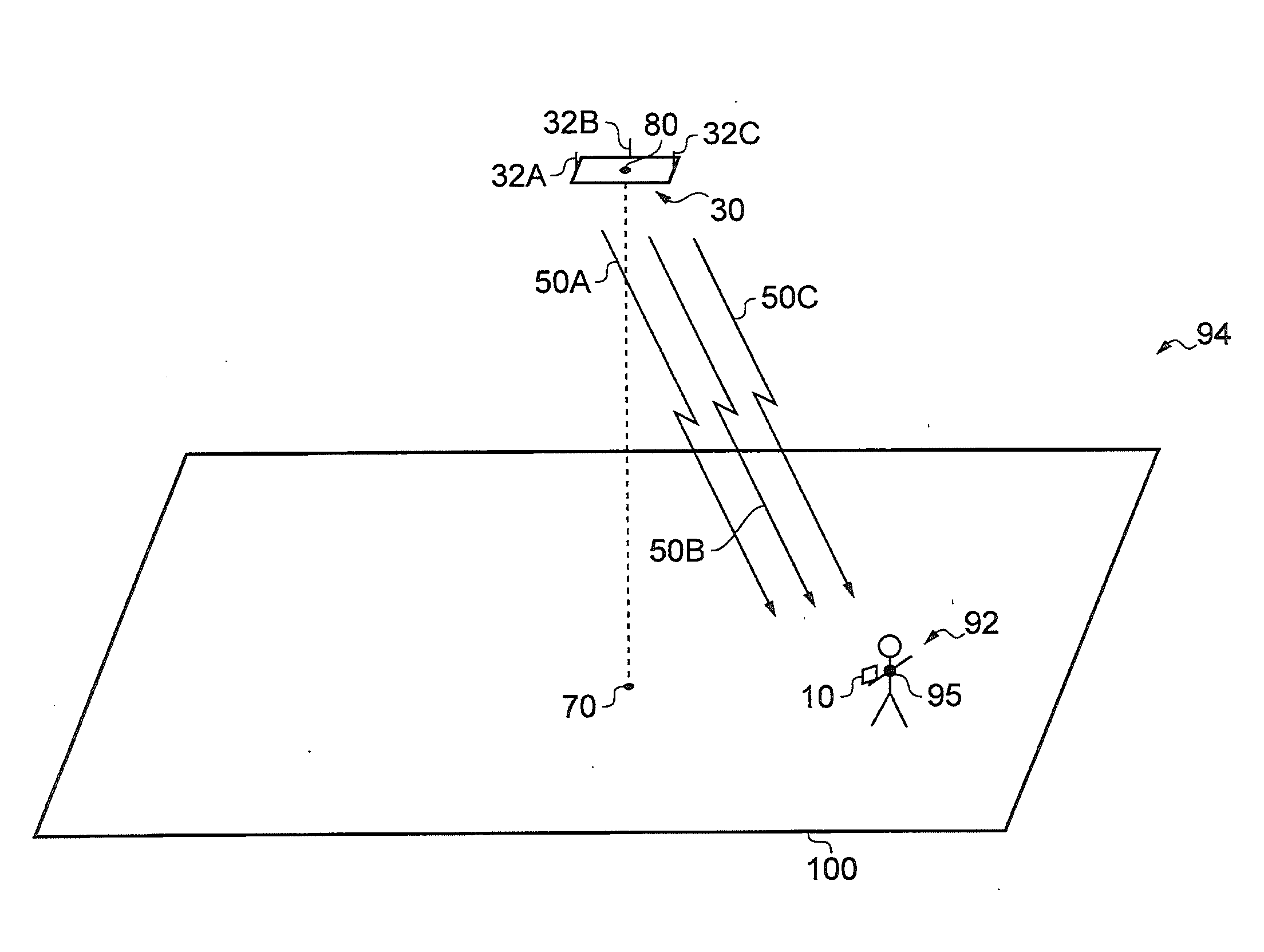
[0068]The Figures illustrate detecting, at an apparatus 10, radio signals 50 from a first location 80; using the one or more detected radio signals to estimate a bearing 82 from the first location 80; and positioning of the apparatus 10 using the bearing.

[0069]FIG. 1 illustrates a person 92 (carrying a receiver apparatus 10) at a position 95 on a floor 100 of a building 94. The building 94 could be, for example, a shopping centre or a conference centre.

[0070]A base station transmitter 30 is positioned at a location 80 of the building 94. In the illustrated example, the location 80 is on the ceiling of the building 94 (i.e. the overhead interior surface) but in other implementations the transmitter may be placed elsewhere such as on a wall. The base station transmitter 30 may be termed a directional transceiver (DT).

[0071]The location 80 is directly above the point denoted with the reference numeral 70 on the floor 100 of the building. The transmitter 30 is for enabling a user of an ...