
Extrinsically influenced near-optimal path apparatus and method
a technology of near-optimal path and apparatus, which is applied in the direction of pulse technique, data switching network, instruments, etc., can solve the problems of not knowing the path through the apparatus (system) or process, information is not available, and the direction of messages or data packets is a serious traffic control question, etc., to achieve rapid and automatic determination, rapid and automatic designation, and rapid and automatic determination
- Summary
- Abstract
- Description
- Claims
- Application Information
AI Technical Summary
Benefits of technology
Problems solved by technology
Method used
Image

Examples
example i
A Path-Finding Method
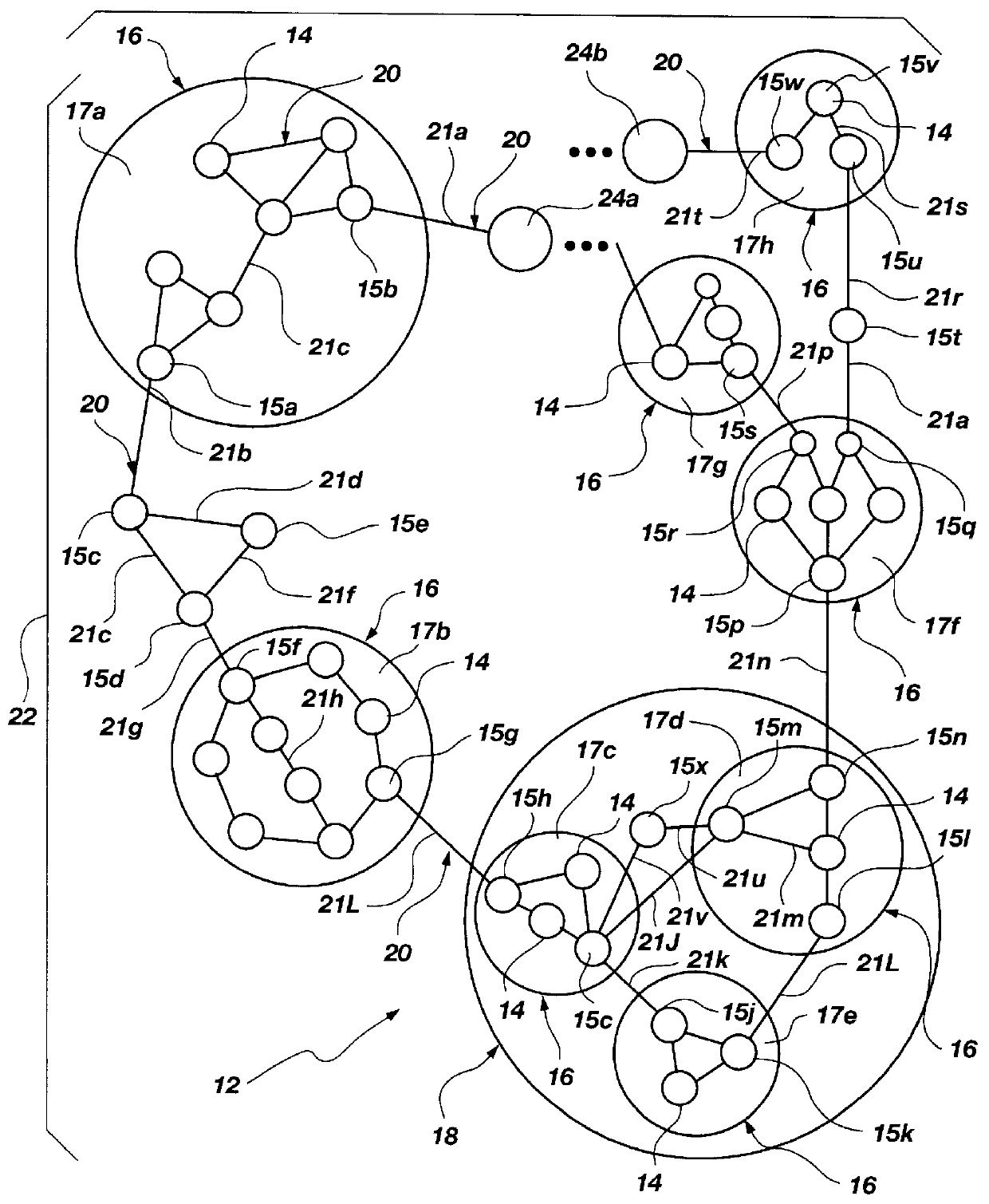
The invention may rely on an algorithm for finding a pretty good (near-optimal) path between any two points (x, y) in a general metric space, in the presence of local metric distortions that are variable in space and time. By "path" is meant a finite, ordered set of unique points with y as the first and x as the last element of the set. By "pretty good" is meant a relatively short path length; that is to say longer paths are "less good" and shorter paths are "more good". The terms "short" and "long" must be defined for each metric space under consideration.
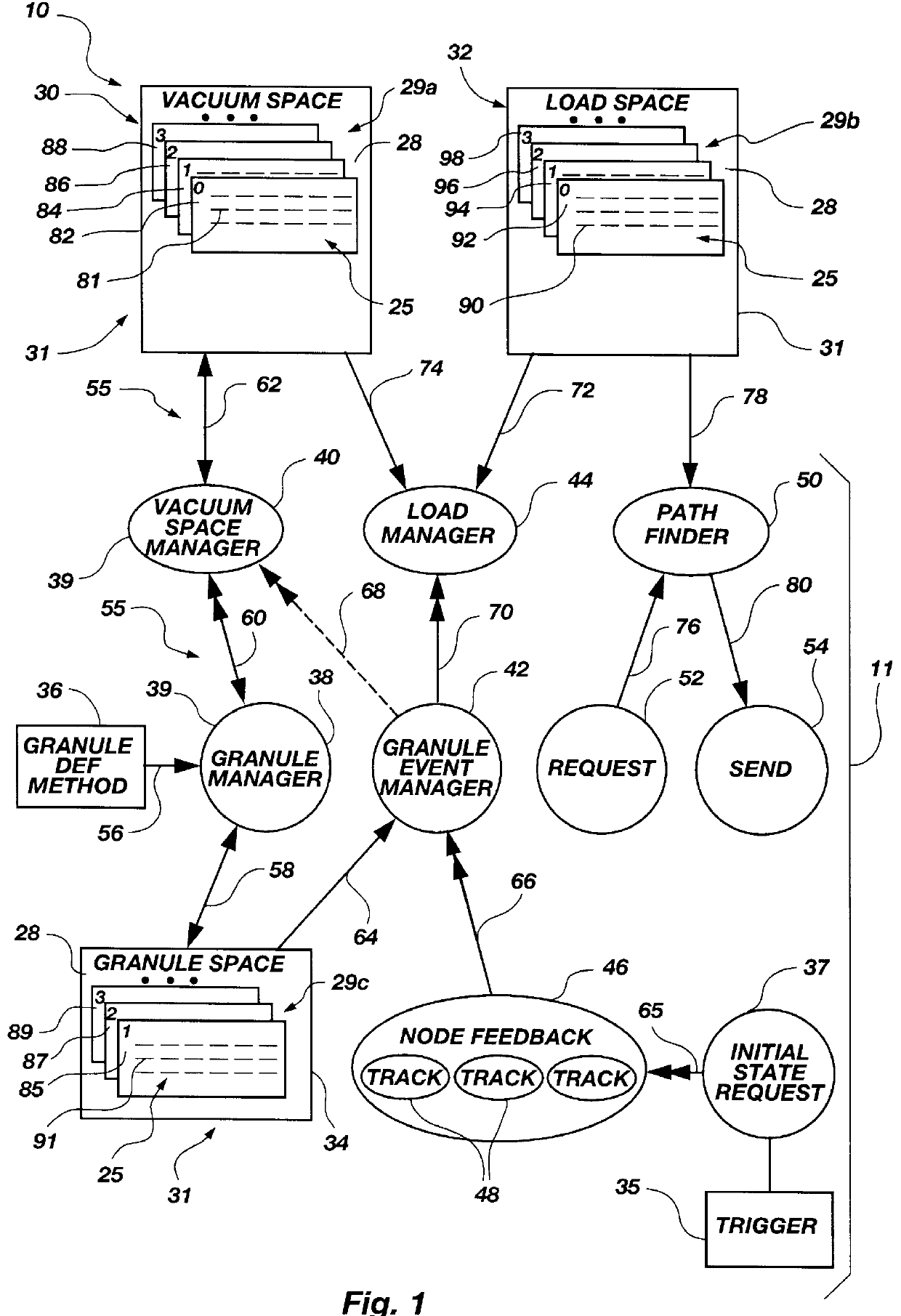
For brevity we shall refer to the algorithm as . Ideally, would find the "best" path (provided such a path exists). But our claim is not that strong--we opt for finding a pretty good path through a (possibly) shifting landscape. To do this, requires a-priori knowledge of a discrete model of the metric space with no local distortions, i.e. a discrete model of the vacuum. The discrete vacuum model provides a "gr...
example ii
User-Assisted, Automatic, Image Segmentation
One embodiment for the invention may be used to isolate meaningful visual elements of an image (photo-real or clip art) with a few, relatively imprecise movements of a "pointing" device such as a mouse. The isolated element can then be independently manipulated (e.g., cut, copy, paste, stretch, rotate, change hue / saturation / intensity, etc.) as an independent "object."
An automatic (or smart) scissors tool may rely on two main processes, edge map creation logic and tool process logic. At the beginning of an edit session, the edge map thread may be spun off in the background when an edit image is first encountered. Edge map creation is time consuming and, therefore, runs best in the background, writing its output data to a separate file. Edge map data may be used later to "channel" the method (tool) along.
Tool logic comes into play when a user selects the automatic scissors as a current tool, such as from a graphics editing palette. The user ...
PUM
 Login to View More
 Abstract
Description
Claims
Application Information
 Login to View More