
Universal pier block
a technology of pier blocks and beams, applied in the field of foundation structures, can solve the problems of large beams, inability to use pier blocks with larger posts that measure 6 times 6) inches,
- Summary
- Abstract
- Description
- Claims
- Application Information
AI Technical Summary
Benefits of technology
Problems solved by technology
Method used
Image

Examples
Embodiment Construction
)
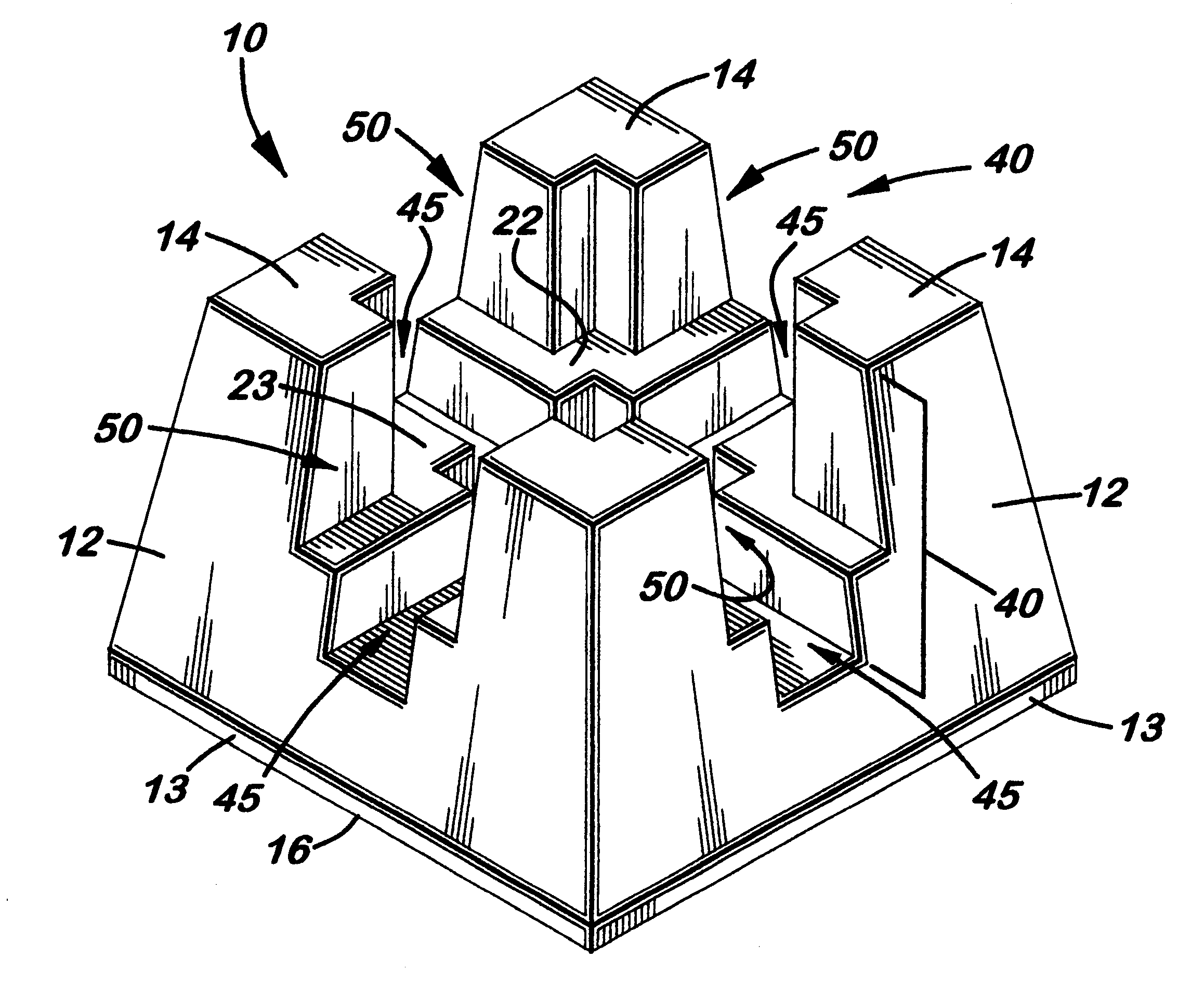
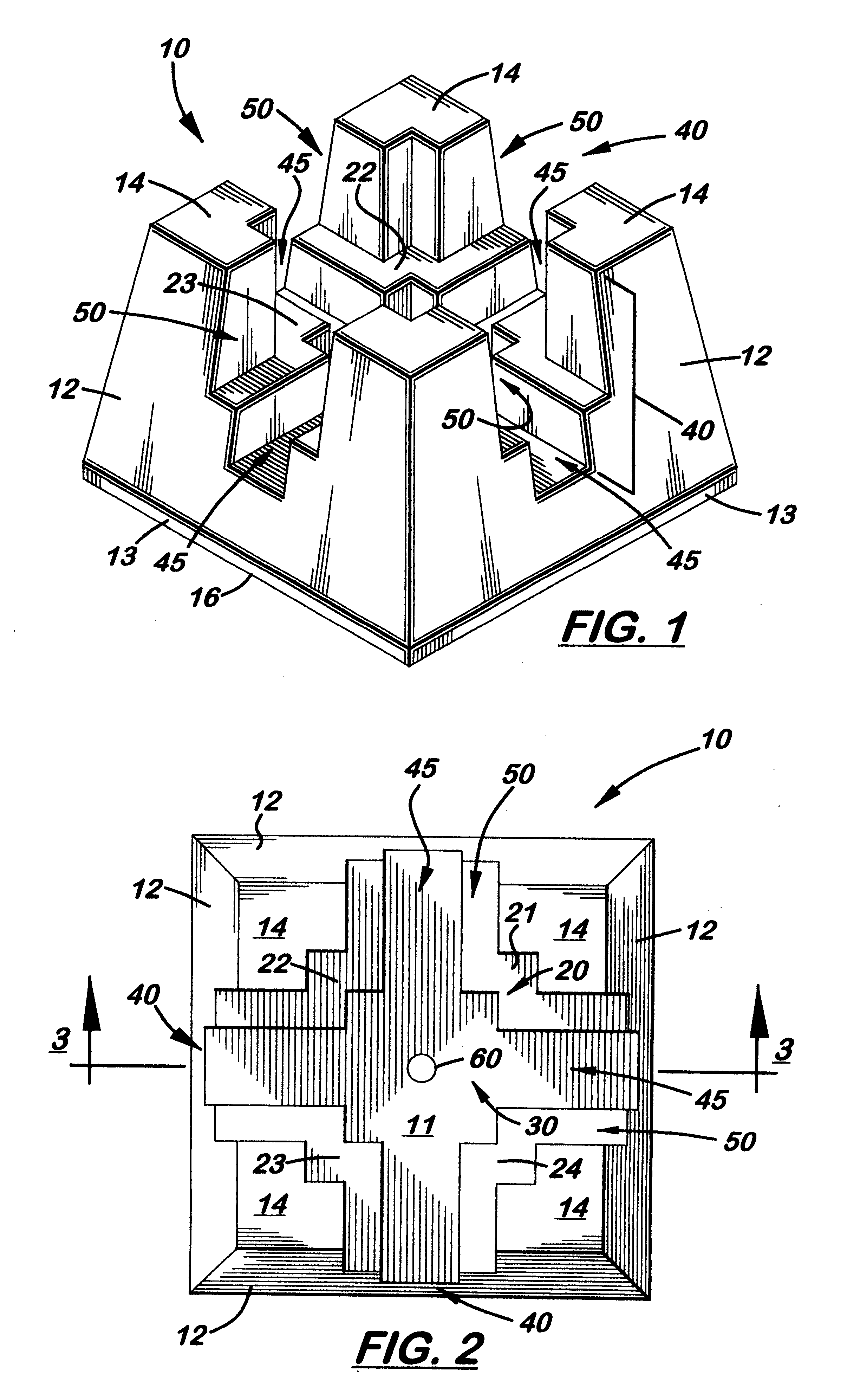
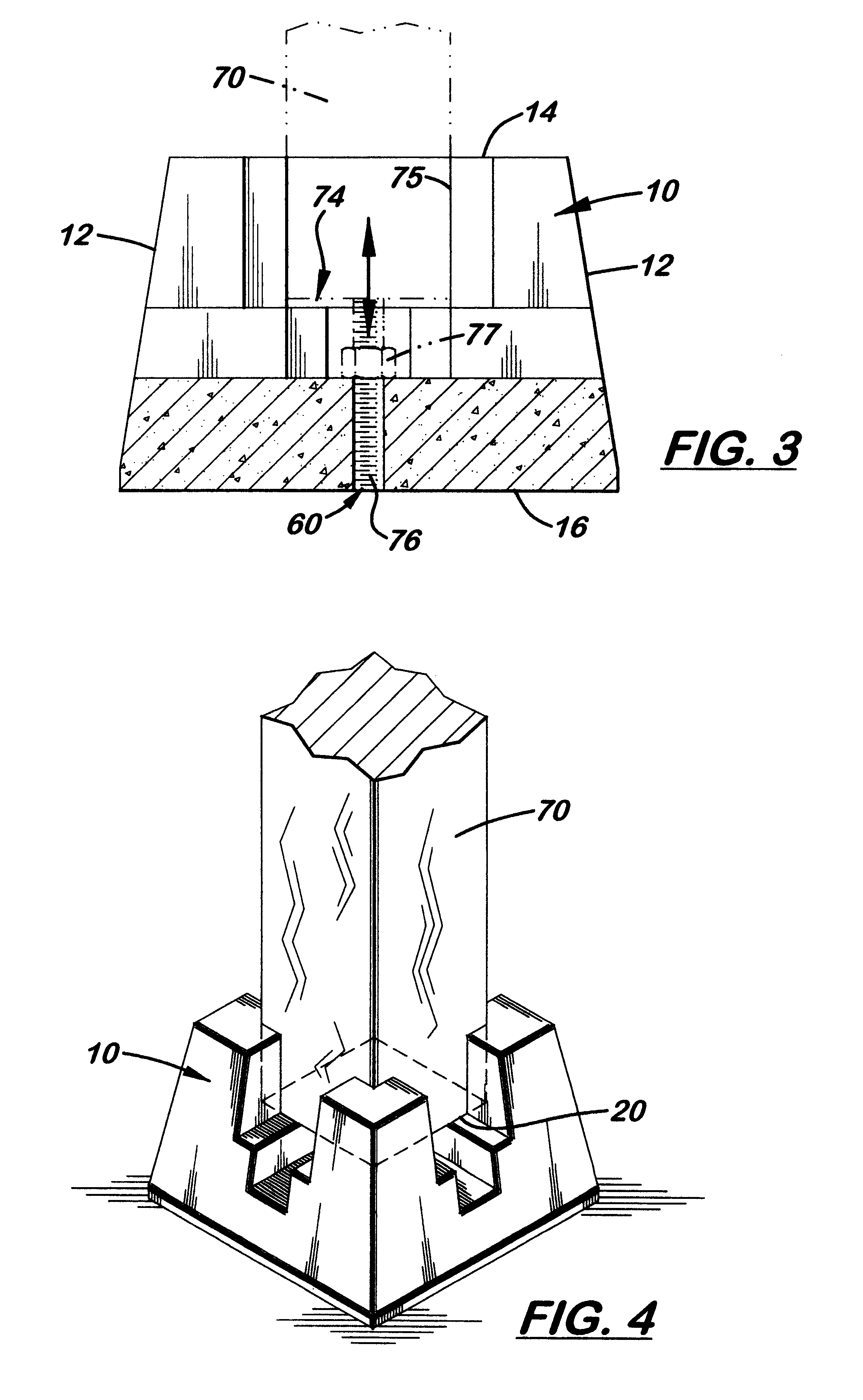
Shown in the accompanying FIGS. 1-7, there is shown an apparatus, generally referred to as a universal pier block 10, designed to be used with different size posts 70, 70' and beams 80, 80'. The pier block 10 is a conical structure with four inward slanted sides 12, a top surface 14 and a bottom surface 16. Formed centrally on the pier block 10 are two, concentrically aligned, different size, post-receiving voids 20, 30 designed to receive the ends of a (6.times.6) or (4.times.4) inch post, respectively. The (6.times.6) inch post-receiving void 20 is positioned above the (4.times.4) inch void 30 so that the end of a (6.times.6) inch post 70' is supported by the four elevated corner sections 21-24 (see FIG. 2). The end of the (4.times.4) inch post 70' is placed into (4.times.4) inch void 30 and supported by the bottom surface 11 of the block 10.
Formed horizontally over the pier block 10 are two crossing beam-receiving slots 40. Each beam-receiving slot 40 includes a lower narrow slo...
PUM
 Login to View More
 Abstract
Description
Claims
Application Information
 Login to View More