

Image forming apparatus and method that identify halftone process parameter
a technology of image forming and process parameters, applied in electrographic process apparatus, instruments, optics, etc., can solve problems such as difficulty in controlling the development conditions, and unstable image forming density
- Summary
- Abstract
- Description
- Claims
- Application Information
AI Technical Summary
Benefits of technology
Problems solved by technology
Method used
Image



Examples
first embodiment
[0033]FIG. 1 is an exemplary configuration of an image forming apparatus according to an embodiment. Here, as an example of the image forming apparatus, an electrophotographic color laser beam printer 100 is used.
[0034]The printer 100 employs a so-called rotary-type image forming station. Of course, the present invention can also be applied to a tandem-type image forming station. The tandem-type image forming station is typically made of a plurality of image forming units arranged in parallel and an intermediate transfer belt. The configuration of the tandem-type image forming station is well-known to those skilled in the art, and therefore not described in detail.
[0035]A light emitting part (scanner part) 101 is made of an optical source, a polygon mirror, etc. Output light 102 from the optical source (e.g., laser diode or LED) is modulated by an image data for each color component obtained from a print data. An electrostatic latent image is formed by scanning a photosensitive drum...
second embodiment
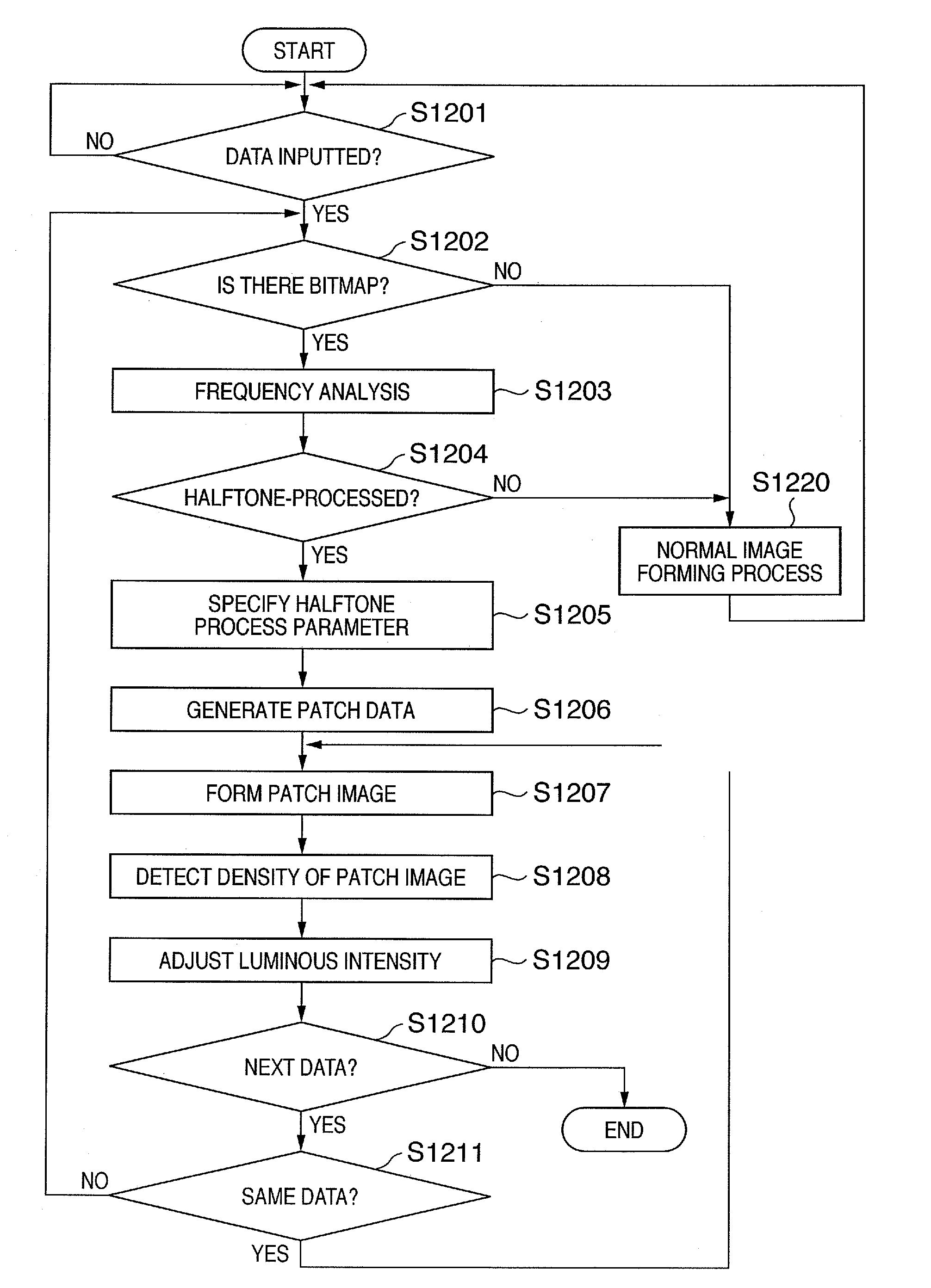
[0087]FIG. 12 is a detailed and exemplary flow chart for stability control according to a second embodiment. In the present embodiment, a more detailed example for stability control is described.
[0088]In step S1201, The CPU 201 in the controller part 200 determines whether or not the data for printing generated at a PC or another server is inputted through the interface part 205. If the data for printing is inputted, the process proceeds to step S1202.
[0089]In step S1202, the CPU 201 determines whether there is a bitmap image in the inputted data using the halftone identifying part 206. If there is not a bitmap image in the data for printing, for example it is a normal text data, the process proceeds to step S1220, where the CPU 201 performs a normal image forming process. The normal image forming process refers to an image forming process in which stability control (adjustment of image forming conditions) according to the present embodiment is skipped. When the normal image forming...
third embodiment
[0101]In the second embodiment, the example of primarily adjusting the luminous intensity of laser (LPW) depending on the density of the patch image has been described. Typically, in order to change LPW, it is required to change bias. Therefore, when bias is switched for each color with respect to light emission of laser, response time for switching may decrease processing speed. Cost may also be increased.
[0102]In a third embodiment, an example of adjusting light emission duration of laser by controlling the pulse width of an image signal inputted to the laser will be described. In general, PWM (pulse width modulation) scheme is applied to the light emitting part 101. Therefore, adjusting light emission duration of laser has an advantage over adjusting luminous intensity of laser in that it is relatively easy to provide it.
[0103]In PWM scheme, since light emission duration at a place where there is a dot can be changed even in a binary image, similar effect as controlling luminous ...
PUM
 Login to View More
 Abstract
Description
Claims
Application Information
 Login to View More