
Pipe gasket with selective economy of scale
a technology of selective economy and gasket, which is applied in the direction of hose connection, coupling, cable termination, etc., can solve the problems of difficulty in belling operation, less than ideal solution, and contribute to the complexity and expense of manufacturing operation, so as to reduce the overall profile, reduce the cost of production, and reduce the effect of rubber mass
- Summary
- Abstract
- Description
- Claims
- Application Information
AI Technical Summary
Benefits of technology
Problems solved by technology
Method used
Image

Examples
Embodiment Construction
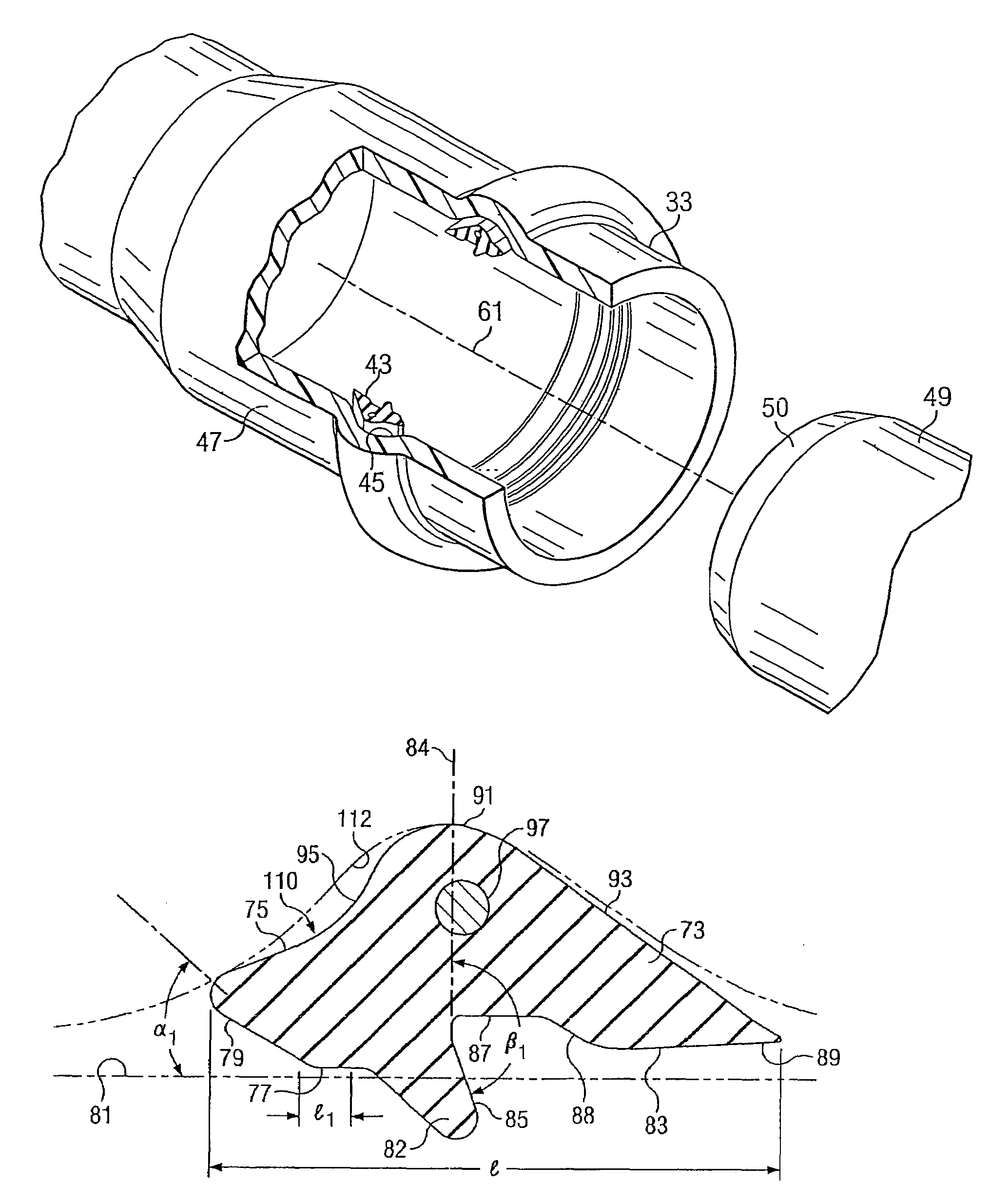
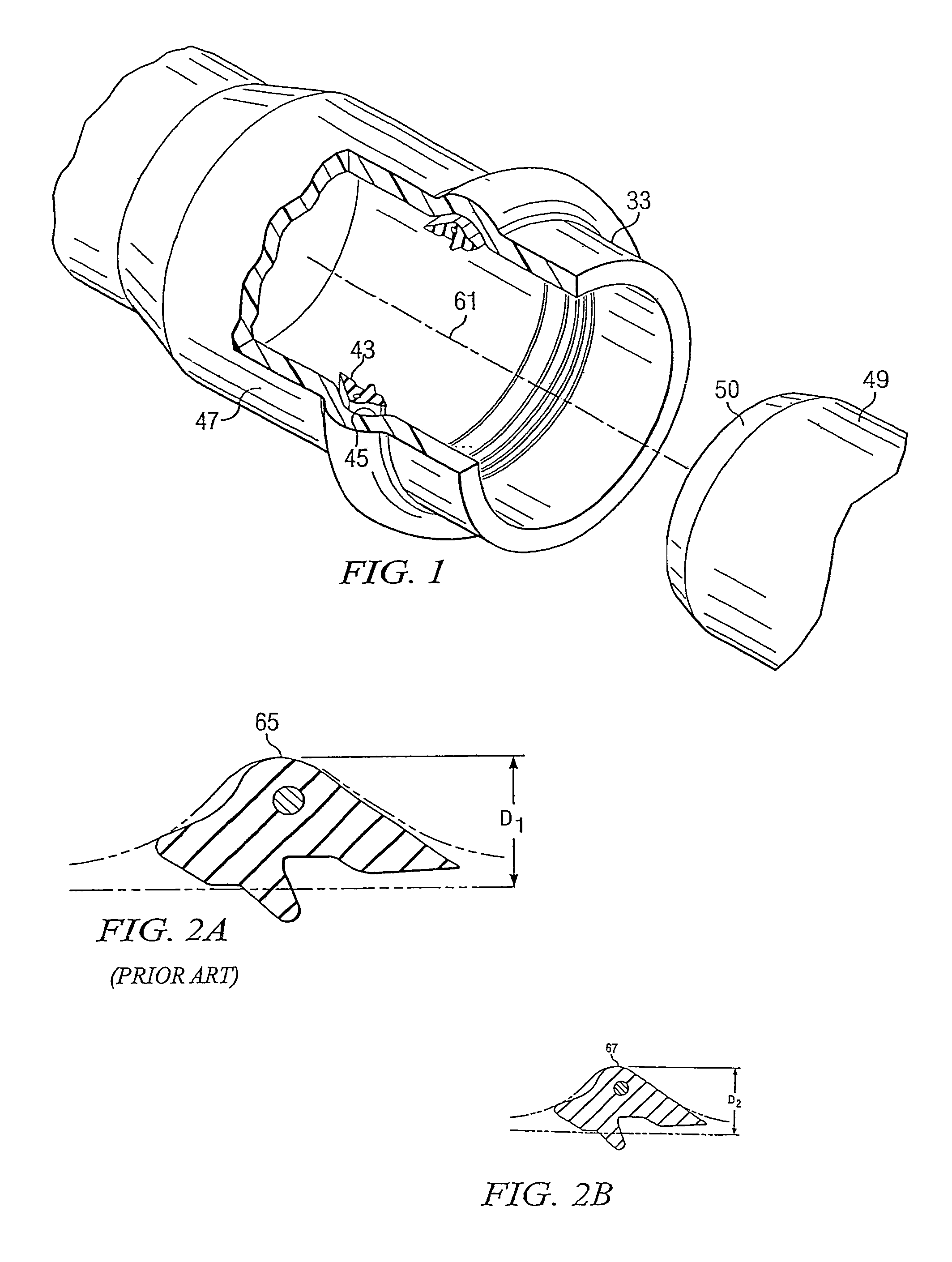
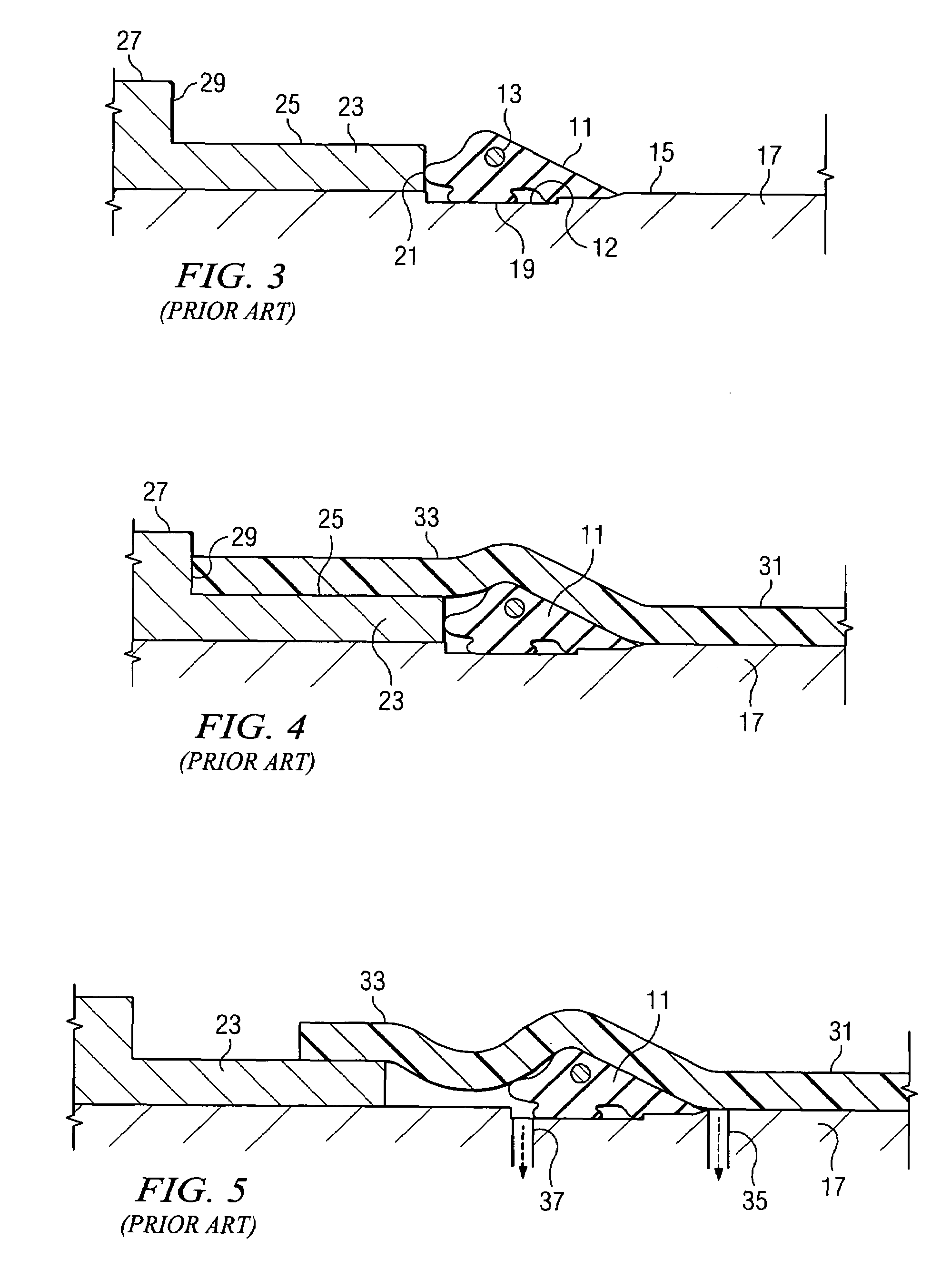
[0028]A first aspect of the present invention concerns the fact that the preferred sealing gaskets in question are “pre-located” within an internal groove provided in the female “belled” pipe end during the manufacture of the pipe in a “Rieber” style manufacturing process. The prior art Rieber process can best be understood with reference to the simplified illustrations provided as FIGS. 3-6 of the drawings.
[0029]FIG. 3 shows an elastomeric sealing gasket 11 having a steel reinforcing ring 13 in place on the generally cylindrical outer working surface 15 of a cylindrically-shaped forming mandrel 17 used in the belling process. Note that in the prior art process, the gasket 11 sits within a slight external groove 12 formed on the exterior of the forming mandrel 17. The elastomeric gasket 11 can be formed of, for example, rubber and is a ring shaped, circumferential member having a lower compression region 19 and an exposed nose portion 21 which, as shown in FIG. 3, abuts a back-up co...
PUM
 Login to View More
 Abstract
Description
Claims
Application Information
 Login to View More