
Method and apparatus for forwarding table reduction
a forwarding table and table technology, applied in electrical devices, digital transmission, data switching networks, etc., can solve the problems of reducing the amount of on-board memory space, unable to meet the needs of flat mac addressing schemes, and unable to increase the size of forwarding tables to accommodate such a flat mac addressing schem
- Summary
- Abstract
- Description
- Claims
- Application Information
AI Technical Summary
Benefits of technology
Problems solved by technology
Method used
Image

Examples
Embodiment Construction
Cross Reference to Related Applications
[0025]This application claims the benefit under 35 U.S.C. §119(e) of U.S. Provisional Patent Application Ser. No. 61 / 181,839 entitled “Method & Apparatus for Forwarding Table Reduction”, filed May 28, 2009, the entire contents of which is incorporated by reference.
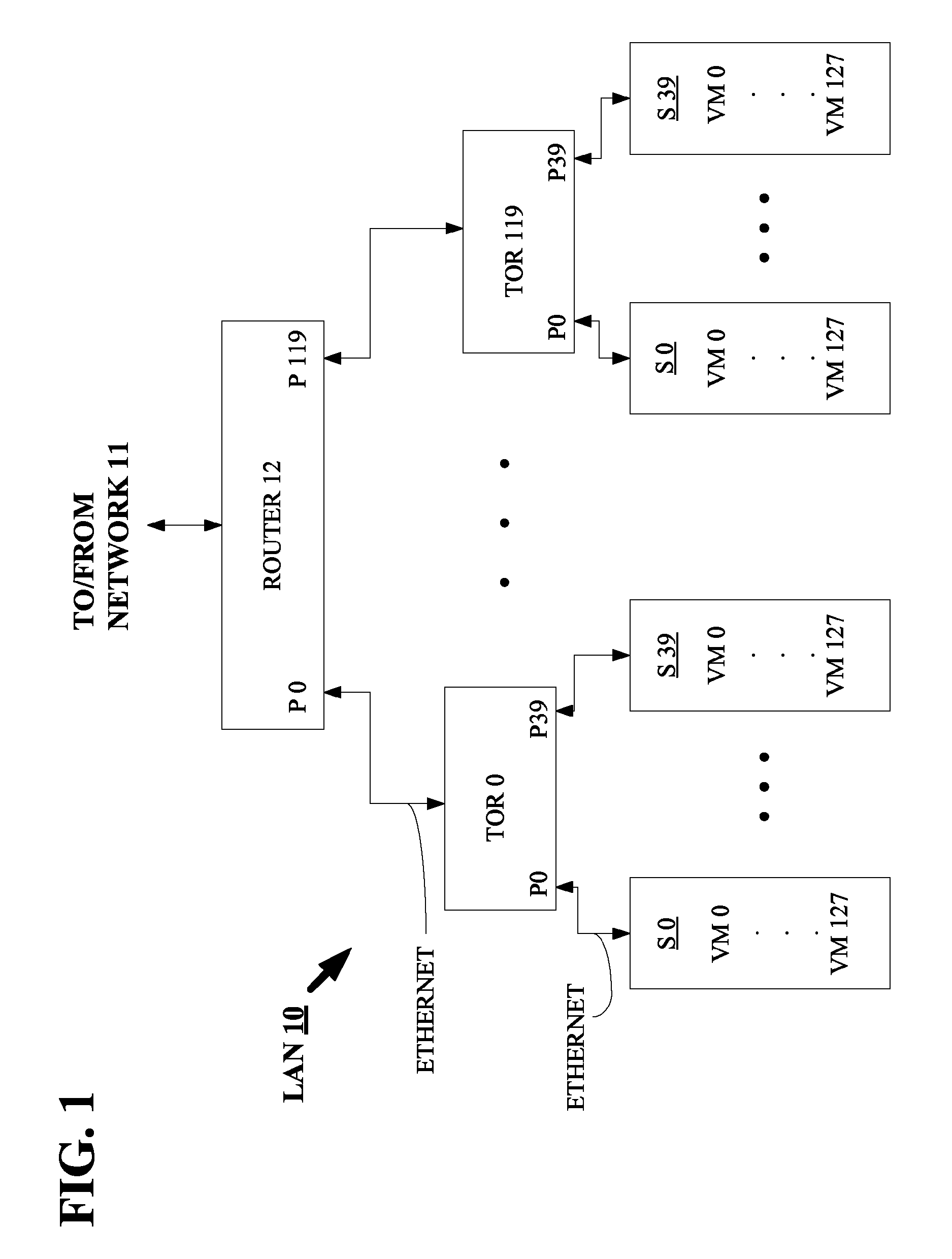
[0026]In order to take advantage of economies of scale, local area networks can be configured with many hundreds or thousands of servers or nodes, each of which, among other things, can support one or more databases or services for instance. The databases can be designed to store customer account information or general information (product information, etc.) that is made available to the public or to subscribers. The services can be directed to sales activities, viewing financial records, corporate information or any general information for example. The servers in such a LAN can be arranged in a rack configuration, and all of the servers in the rack can be in communication with one or...
PUM
 Login to View More
 Abstract
Description
Claims
Application Information
 Login to View More