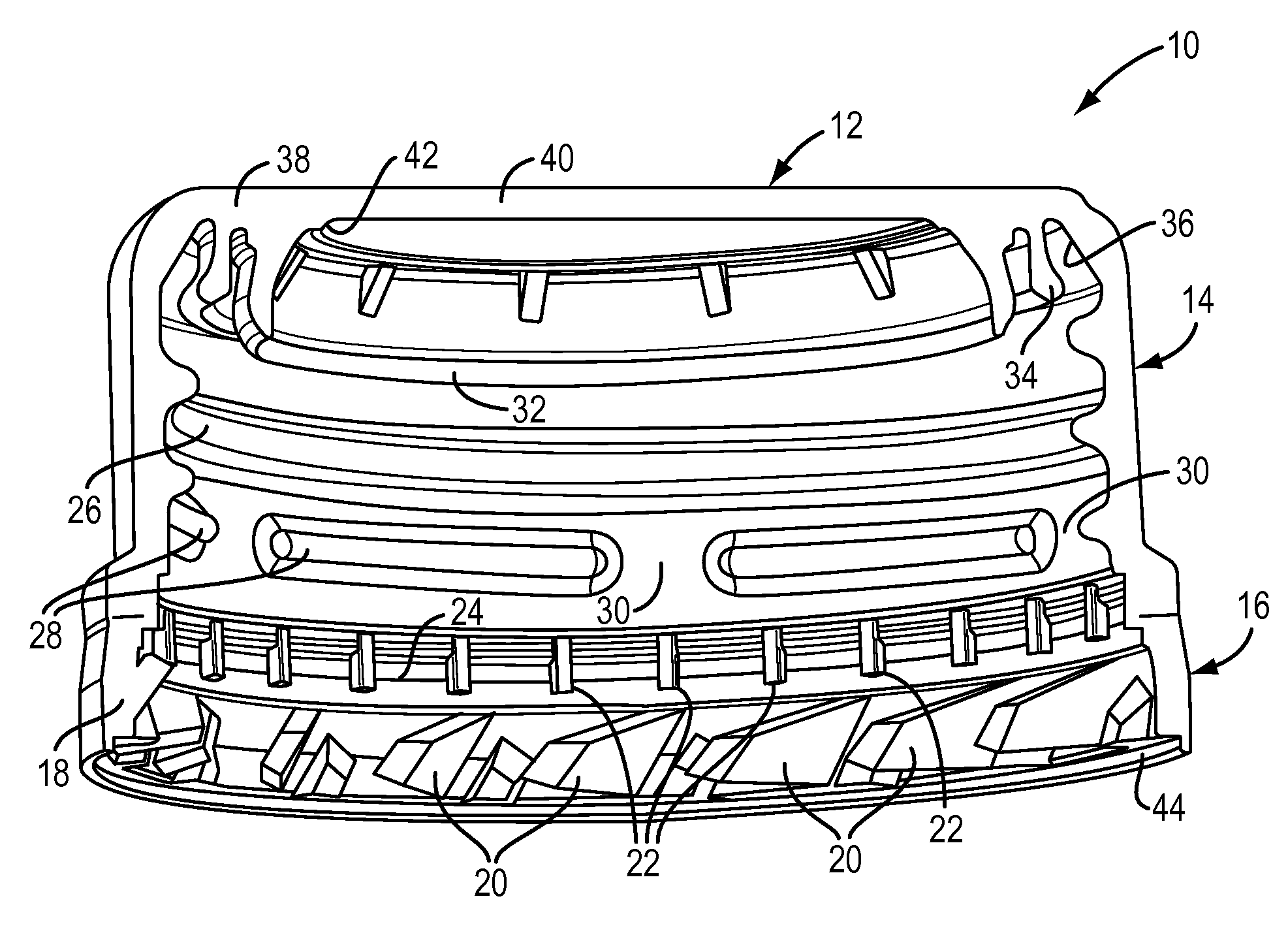
[0008]A plastic closure embodiment embodying the principles of the present invention has been particularly configured for enhanced sealing and structural performance, as well as enhanced tamper-resistance. Notably, the present closure is configured to minimize the use of the polymeric material from which it is formed, while still achieving the necessary sealing and structural performance required for effective use on beverage containers and the like. The closure has further been configured for enhanced tamper-resistance, thereby further promoting efficient and versatile use on beverage containers and the like.
[0009]In accordance with the illustrated embodiment, the present plastic closure includes a disk-shaped top wall portion, and an annular skirt portion depending from the top wall portion. Notably, the annular skirt portion includes a compound, internal helical thread formation which has been specifically configured to enhance closure performance while minimizing material requirements.
[0011]In accordance with the illustrated embodiment, the upper retention portion of the thread formation has a substantially uniform cross-sectional area. By configuring the upper retention portion of the thread formation to extend circumferentially about 360°, the portion of the thread nearest the closed end of the closure is relatively strong and rigid, desirably enhancing the hoop strength of the closure, in comparison to the lower end of the thread formation toward the open end of the closure. The strengthened portion of the thread formation desirably enhances the ability of the closure to resist stripping of the thread formation due to application of excessive torque to the closure, while at the same time desirably permitting a reduction in the thickness and weight of the closure side wall while retaining sufficient strength. The relatively strong retention portion of the thread formation desirably enhances the ability of the closure to maintain the pressure against the seal between the sealing feature of the closure, and the top of the associated container.
[0014]The inner, annular plug seal element of the closure provides a secondary seal for the closure and container package. This secondary seal can be important during top load venting, and acts as a dynamic seal, and plays an important role in venting at opening of the closure. The secondary seal is preferably sized to be relatively short, shorter than typical plug seal arrangements, to desirably reduce closure weight, and enable faster engagement during top load application. The short sealed side also desirably acts to vent gas from within the associated container early during closure opening, thus aiding the venting of gas pressure as early as possible.
[0016]In contrast, a relatively thin, central region of the top wall portion is positioned inwardly of the outer annular region. The junction or step between the relatively thin and relatively thick regions acts as a point of inflection as the top wall portion of the closure “domes” i.e. deforms outwardly, under the influence of internal gas pressure. The relatively thin region domes more than the doming typically exhibited by a conventional closure. In contrast, the internal pressure has minimal effect on doming of the relatively thick top panel region due to the step in the top panel. By this arrangement, closure sealing is minimally affected by the doming and internal pressure. When subjected to a top load, this configuration of the closure results in deflection only at the center region of the top panel, and has only a small effect on the relatively thick, outer annular region of the top panel. The sealing elements are also minimally affected by the top panel configuration. This desirably results in a light weight top panel design that performs better than the typical top panel configuration, having a uniform thickness, at conventional carbonated soft drink gas pressures and top load venting performance.
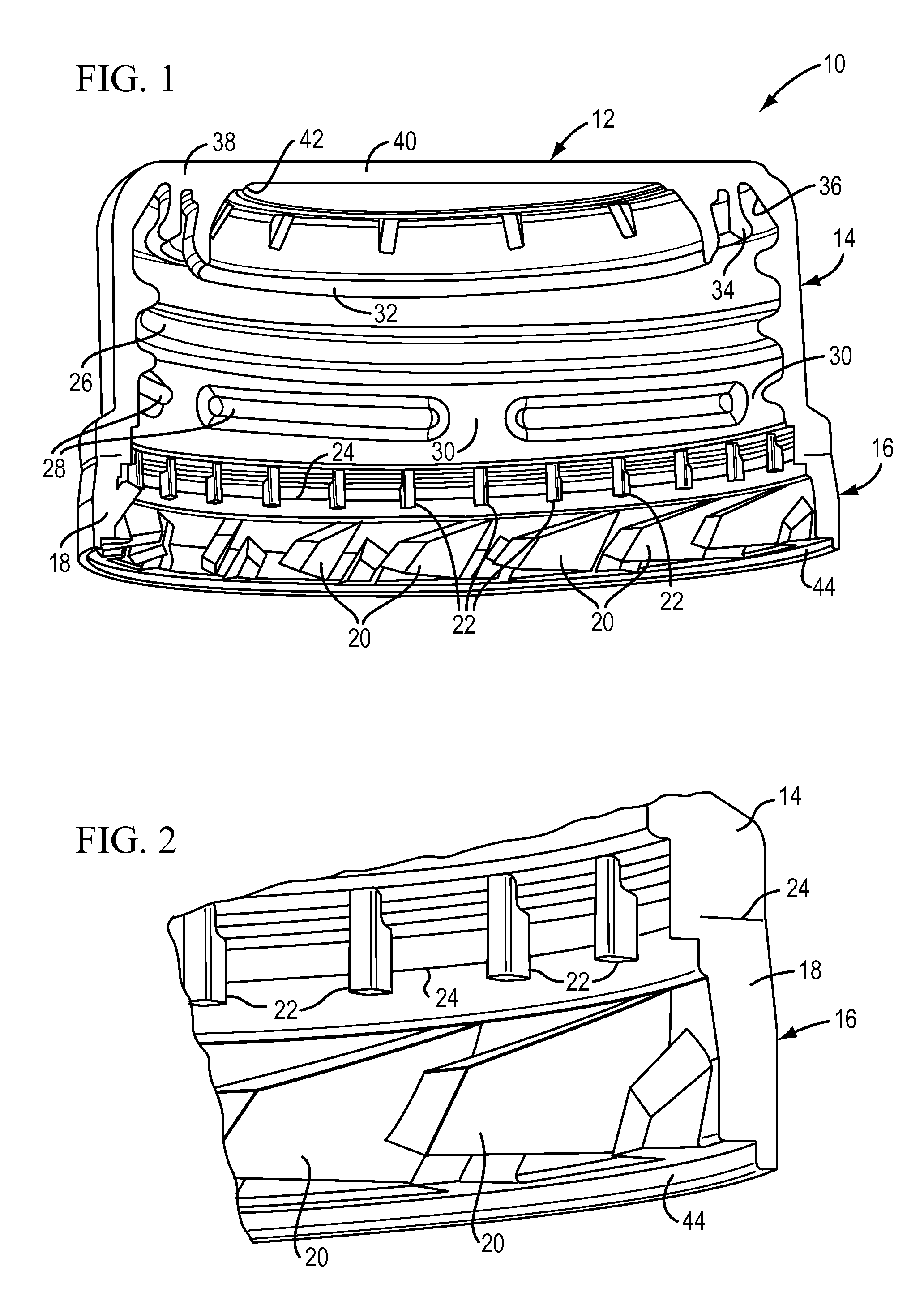
[0017]As noted, closures of the present type are preferably provided with a tamper-evident feature to alert consumers to unauthorized manipulation of the closure. To this end, the present closure can be configured to include a tamper-evident band depending from and at least partially detachably connected to the skirt portion of the closure. Notably, the tamper-evident band includes an annular band portion, and a relatively thin, deformable tamper ring depending from a lower edge of the annular band portion. The tamper ring is readily deformable if subjected to unauthorized manipulation, and thus provides a visually discernible evidence of manipulation to defeat the tamper-evident band.


 Login to View More
  Login to View More