
Flexible strength members for wire cables
a technology of flexible strength and wire cables, applied in the direction of synthetic resin layered products, textiles and paper products, yarns, etc., can solve the problems of high undesirable other applications and higher complexity in manufacturing
- Summary
- Abstract
- Description
- Claims
- Application Information
AI Technical Summary
Benefits of technology
Problems solved by technology
Method used
Image

Examples
specific embodiments
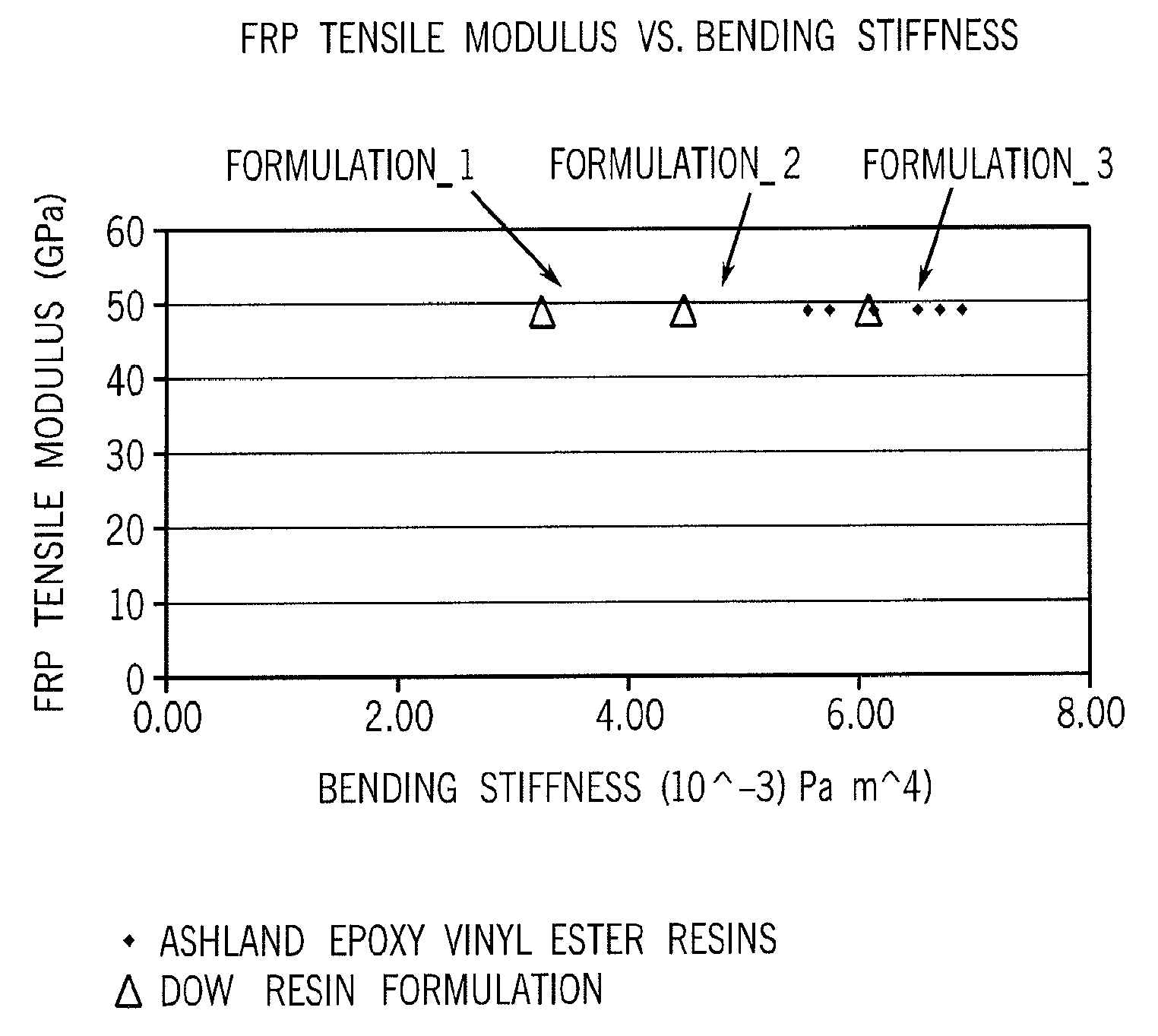
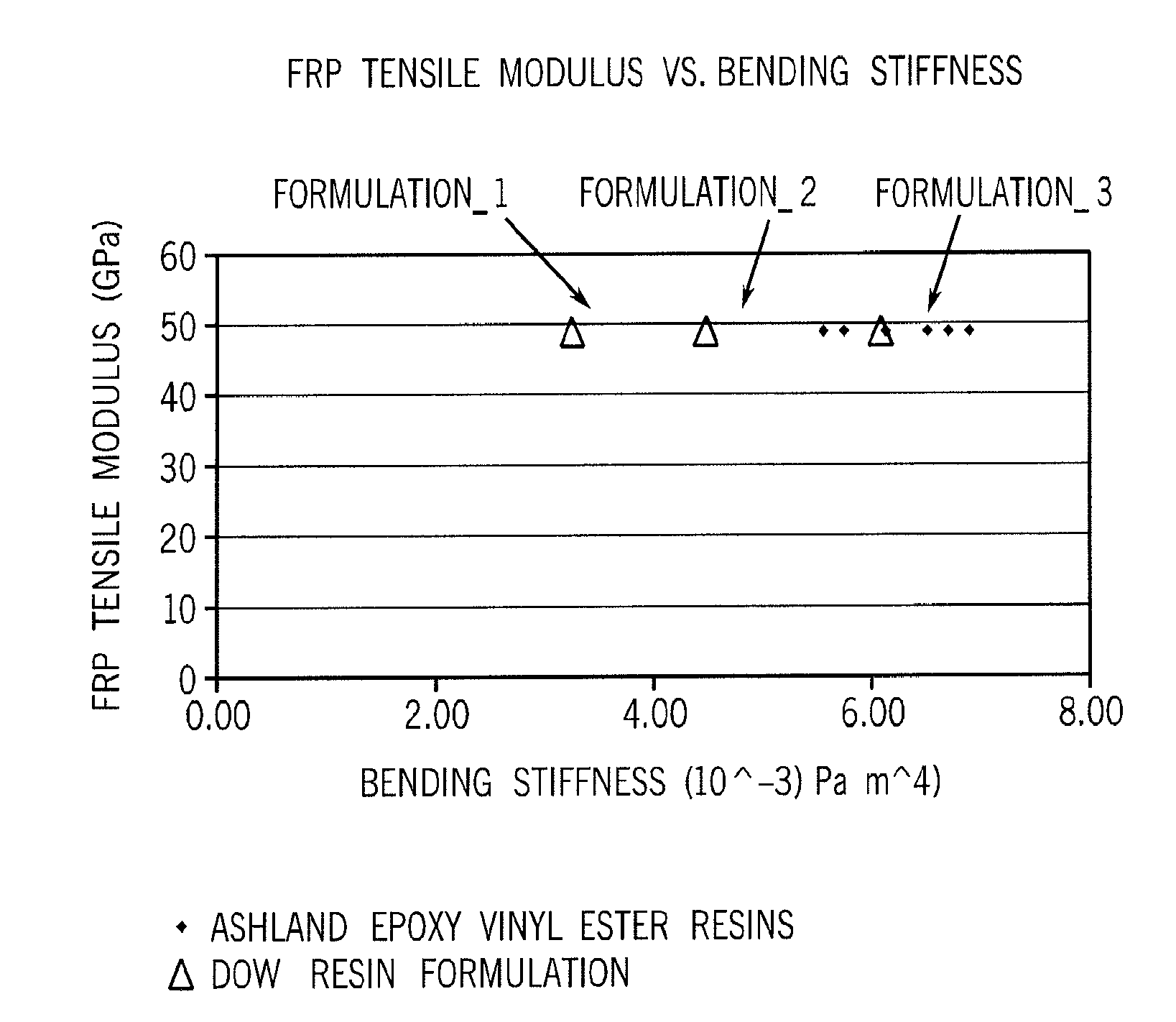
[0025]The formulation of Examples 1, 2 and 3 are found in Table 2. Continuous Advantex® E-glass fiber from Owens Corning SE4121 (modulus=81-83 GPa) was used in the examples.
[0026]
TABLE 2Percent Composition of ExamplesExample 1Example 2Example 3Material(wt %)(wt %)(wt %)Polypropylene82.370.054.6ACHIEVE 6936G1 (Exxon10.08.510.0Mobil)Linear Low Density3.02.62.1PolyethyleneIRGANOX 1010 (Ciba)0.20.20.1IRGAFOX 168 (Ciba)0.40.40.3IRGANOX PS 802 (Ciba)0.400.3Maleic Anhydride Modified3.83.22.6PolypropyleneJetFil 700 Talc015.030.0Glass Fibers (Owen81.0 wt %80.5 wt %81.0 wt %Cornings SE 4121)of theof theof thefinal strengthfinal strengthfinal strengthmembermembermember
[0027]ACHIEVE 6936G1 and the linear low density polyethylene are rheological modifiers of the resin used to optimize the viscosity of the compound. IRGANOX 1010, IRGAFOX 168, and IRGANOX PS 802 are used as antioxidants. Maleic anhydride modified polypropylene is used as an adhesion promoter. The polypropylene used in Examples 1-3...
PUM
| Property | Measurement | Unit |
|---|---|---|
| diameter | aaaaa | aaaaa |
| elastic modulus | aaaaa | aaaaa |
| length | aaaaa | aaaaa |
Abstract
Description
Claims
Application Information
 Login to View More