Supercharge Your Innovation With Domain-Expert AI Agents!

Controlling cleaning of a layer on a substrate using nozzles

a technology of cleaning process and substrate, applied in the field of semiconductor processing, can solve the problems of loss of dopant in subsequent wet cleans, difficult removal of ion implanted photoresist, and loss of spm activity,

Active Publication Date: 2017-08-15
TOKYO ELECTRON LTD
View PDF20 Cites 5 Cited by
  • Summary
  • Abstract
  • Description
  • Claims
  • Application Information

AI Technical Summary

Problems solved by technology

Ion implanted photoresist is challenging to remove because a hard crust layer forms during the implant process on the photoresist.
The challenge with this process is oxidization of the silicon substrate leading to loss of dopant in subsequent wet cleans.
The challenge with all wet process removal or wet benches is that the SPM has to be heated to temperatures approaching 250° C. to achieve the desired resist removal performance and at a removal rate that is practical for manufacturing.
However, over time, the SPM loses its activity as the sulfuric add is diluted by the continuous replenishment of hydrogen peroxide that is required to retain its cleaning activity.
SPM below 80 wt % total add has very poor cleaning performance and a fresh batch of 108-96 wt % sulfuric add is often used.
Both methods significantly increase the complexity, capital cost, and operating costs of the resist strip process.
Effectiveness of this technique is limited by the specific ranges of concentration of the catalyzed hydrogen peroxide, temperature of the treatment liquids, and speed of rotation of the substrate.
The additional operating variables provide some flexibility to control the cleaning process, but some issues develop as the process is used in a manufacturing environment.
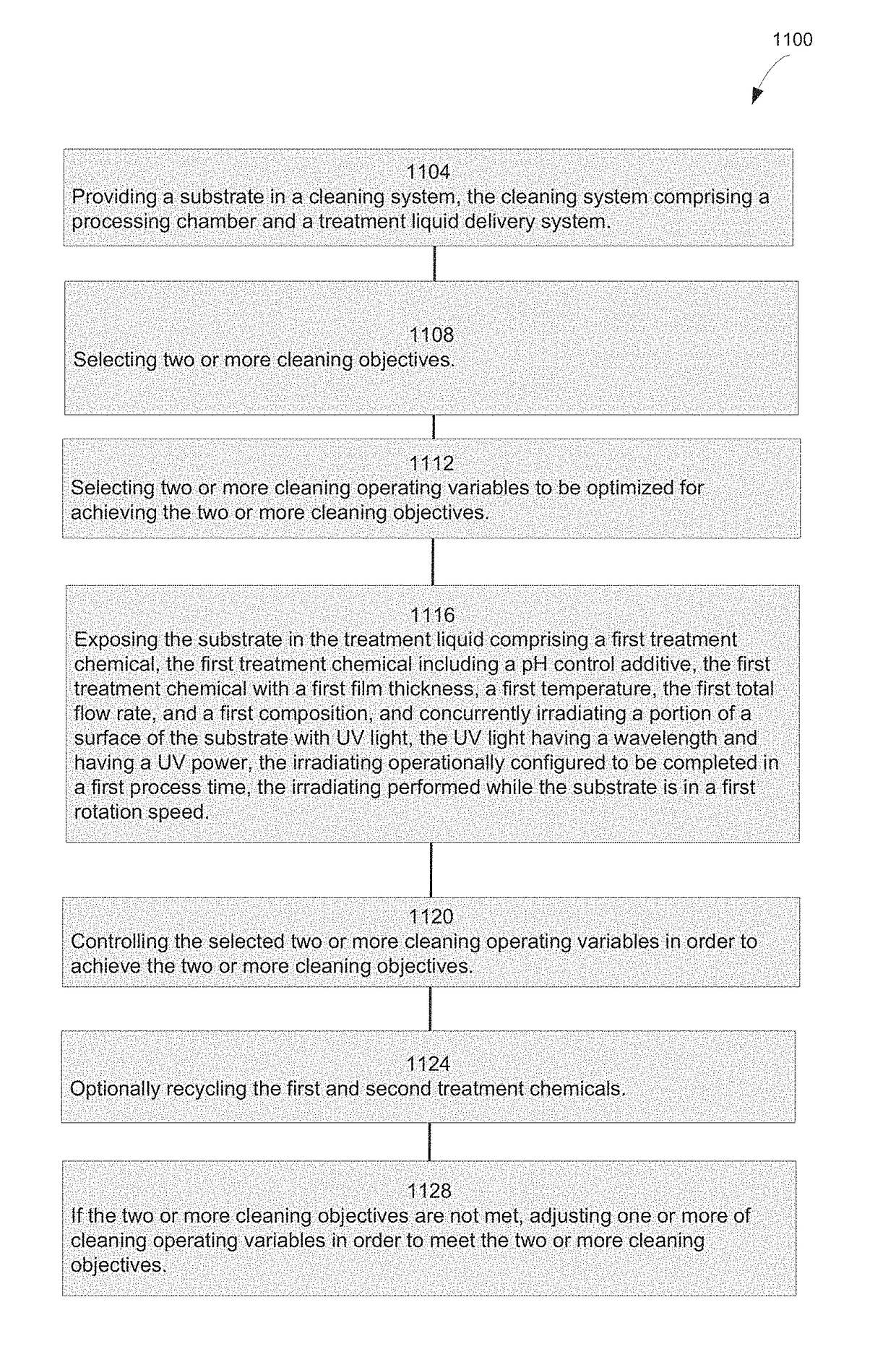
Some of the issues include: a) rotation of bigger size substrates require new and stronger motors and associated housing, b) time constraints involved in starting up and stopping rotation of substrate increases with increasing size and speed, c) time needed to perform the softening of the residue is a function of at least two or more operating variables such as thickness of the first chemical film, rotation speed of the substrate, and exposure time to the UV light, concentration of the first chemical, and intensity of the UV light.

Method used

the structure of the environmentally friendly knitted fabric provided by the present invention; figure 2 Flow chart of the yarn wrapping machine for environmentally friendly knitted fabrics and storage devices; image 3 Is the parameter map of the yarn covering machine
View more

Image

Smart Image Click on the blue labels to locate them in the text.
Viewing Examples
Smart Image
  • Controlling cleaning of a layer on a substrate using nozzles
  • Controlling cleaning of a layer on a substrate using nozzles
  • Controlling cleaning of a layer on a substrate using nozzles

Examples

Experimental program
Comparison scheme
Effect test

Embodiment Construction

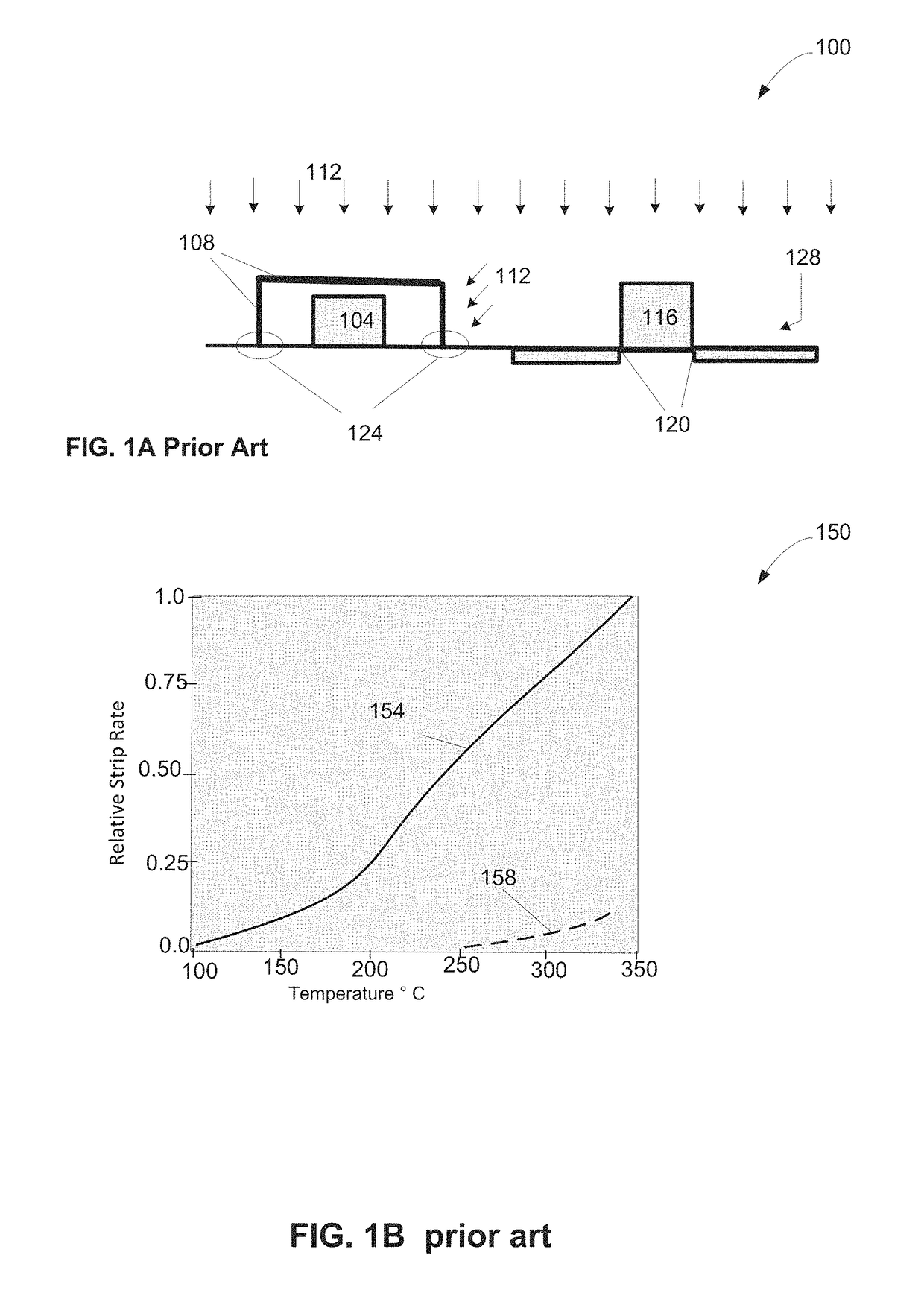
[0023]FIG. 1A depicts an exemplary prior art architectural diagram 100 of the profile of a structure with a crust 108 fused to the surface, points 124, of a structure 104 in the substrate 128 and profile of an adjoining structure 116 without crust fused to the surface, points 120. The high dose ions 112 used in a previous process can cause development of the crust 108 that makes cleaning difficult. Formation of the crust 108 can be at the surface, points 124, of structure 104 in substrate 128 or near the edge bead region (not shown) of the substrate 128. Resist strip performance depends on the ion implant dose and energy. Effectiveness of a resist strip performance is correlated to the extent of removal percentage of the resist, speed of the process, and cost of ownership, which shall be discussed below. FIG. 1B depicts exemplary prior art graphs 150 of relative strip rate as a function of temperature of the resist compared to the temperature of the carbonized layer, such as the cru...

the structure of the environmentally friendly knitted fabric provided by the present invention; figure 2 Flow chart of the yarn wrapping machine for environmentally friendly knitted fabrics and storage devices; image 3 Is the parameter map of the yarn covering machine
Login to View More

PUM

PropertyMeasurementUnit
timeaaaaaaaaaa
process timeaaaaaaaaaa
total flow rateaaaaaaaaaa
Login to View More

Abstract

Provided is a method for cleaning an ion implanted resist layer or a substrate after an ashing process. A duty cycle for turning on and turning off flows of a treatment liquid using two or more nozzles is generated. The substrate is exposed to the treatment liquid comprising a first treatment chemical, the first treatment chemical with a first film thickness, temperature, total flow rate, and first composition. A portion of a surface of the substrate is concurrently irradiated with UV light while controlling the selected plurality of cleaning operating variables in order to achieve the two or more cleaning objectives. The cleaning operating variables comprise two or more of the first temperature, first composition, first film thickness, UV wavelength, UV power, first process time, first rotation speed, duty cycle, and percentage of residue removal are optimized to achieve the two or more cleaning objectives.

Description

[0001]Pursuant to 37 C.F.R. §1.78(a)(4), this application claims the benefit of and priority to prior filed Provisional Application Ser. No. 61 / 730,479 entitled “CONTROLLING CLEANING OF A LAYER ON A SUBSTRATE USING NOZZLES”, filed on Nov. 27, 2012, which is expressly incorporated herein by reference.FIELD[0002]The present application generally relates to semiconductor processing and specifically to a cleaning process on a substrate using a first step of immersion in a first treatment chemical and concurrently irradiating the substrate with ultra-violet (UV) light and a second step using a wet clean process using a second treatment chemical.RELATED ART[0003]In semiconductor processing control of generation and lifetime of active chemical species is important to optimize cleaning processes with respect to removal efficiency of desired material, process time, and selectivity to other materials present on the substrate. In aqueous and plasma chemistry, generation of radicals is a conven...

Claims

the structure of the environmentally friendly knitted fabric provided by the present invention; figure 2 Flow chart of the yarn wrapping machine for environmentally friendly knitted fabrics and storage devices; image 3 Is the parameter map of the yarn covering machine
Login to View More

Application Information

Patent Timeline
no application Login to View More
Patent Type & Authority Patents(United States)
IPC IPC(8): B08B6/00G03F7/42H01L21/67H01L21/311B08B5/00B08B7/04B08B7/00
CPCH01L21/31138G03F7/42G03F7/423G03F7/425H01L21/67051H01L21/67115
Inventor BROWN, IAN J.PRINTZ, WALLACE P.RATHSACK, BENJAMEN M.
Owner TOKYO ELECTRON LTD
Features
  • R&D
  • Intellectual Property
  • Life Sciences
  • Materials
  • Tech Scout
Why Patsnap Eureka
  • Unparalleled Data Quality
  • Higher Quality Content
  • 60% Fewer Hallucinations
Social media
Patsnap Eureka Blog
Learn More