
Fabrics for air pocket and production method thereof
A production method, fabric technology, applied in the direction of fabric, fabric surface trimming, heating/cooling fabric, etc., can solve the problems of small slippage of seamed parts, high strength of seamed parts, etc.
Patent Information
- Authority / Receiving Office
- CN · China
- Current Assignee / Owner
- Publication Date
- 2010-10-13
- Estimated Expiration
- Not applicable · inactive patent
Smart Images
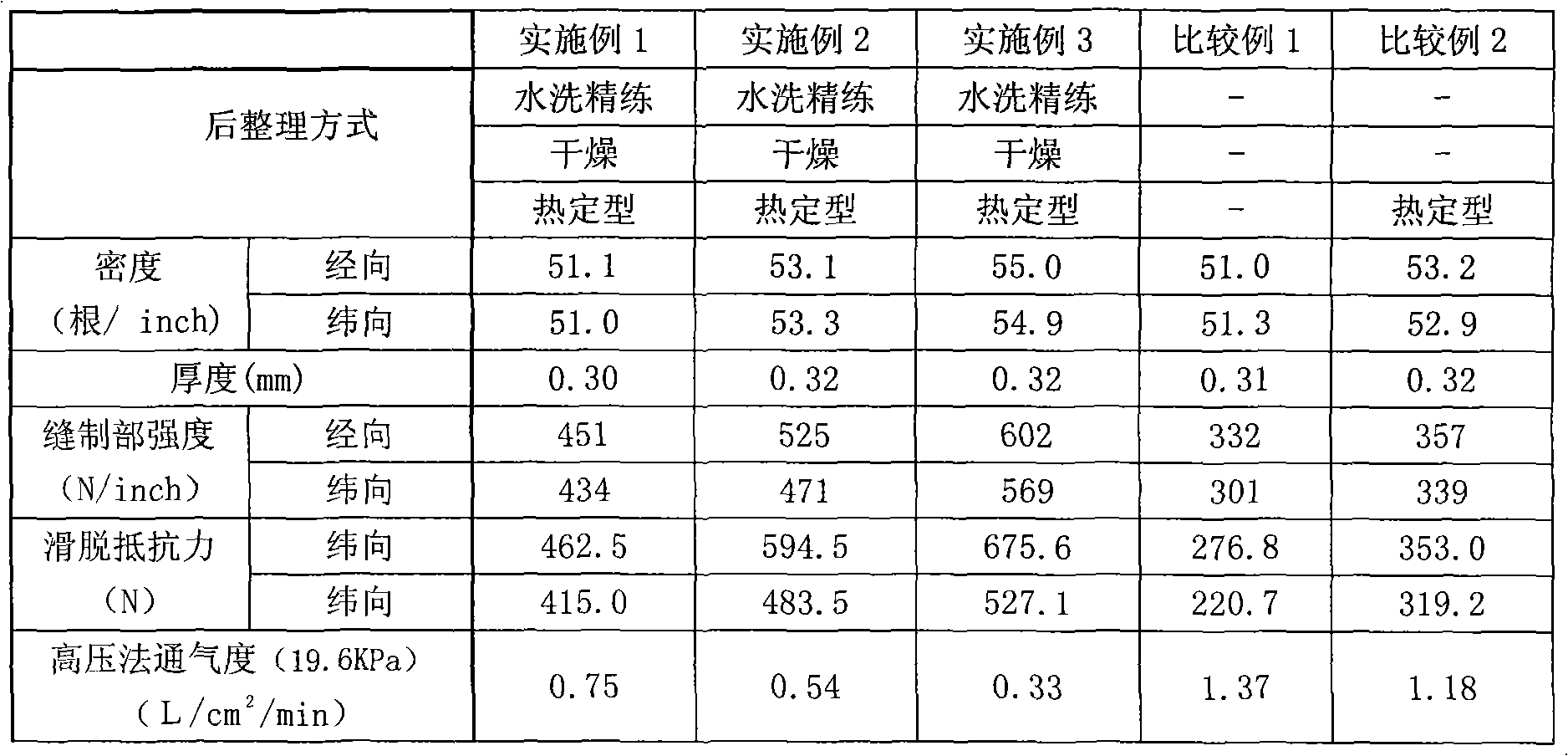
Figure 1
Abstract
Description
Technical field:
[0001] The present invention relates to a fabric for an airbag, which is a safety device for automobiles, and more specifically, relates to a fabric which can maintain the basic performance of the airbag and has a small slippage of the sewn part when the airbag is deployed. Background technique:
[0002] In recent years, people have paid more and more attention to the safety of automobiles, and passive protection systems have become the focus of attention of consumers, government agencies and automobile manufacturers. As one of the safety components of automobiles, the installation rate of airbags is also increasing rapidly with the improvement of the safety awareness of drivers and passengers. Airbags are currently the most widely used passive protection device in the United States, and their use continues to increase in other countries.
[0003] The airbag system consists of three main components: (1) crash sensor; (2) inflation source; (3) airbag. In th...
Examples
Embodiment 1
[0044] Nylon 66 raw yarn with a total denier of 470dtex, 72 single filaments and a circular cross-section was used, with a breaking strength of 39.5N and a breaking elongation of 23.5%. After being woven into plain weave fabric with a water jet loom, it is washed and scoured at 60°C, then dried at 120°C for 30 seconds, and then heat-set at 180°C for 60 seconds to obtain a warp yarn density of 51 threads / inch and a weft yarn density of 51 threads / inch fabric for air bags. The properties of the fabric were evaluated and are shown in Table 1.
Embodiment 2
[0046] Nylon 66 raw yarn with a total denier of 470dtex, 72 single filaments and a circular cross-section was used, with a breaking strength of 39.5N and a breaking elongation of 23.5%. After the plain weave fabric is woven with a water jet loom, it is washed and scoured at 80°C, then dried at 120°C for 60 seconds, and then heat-set at 180°C for 80 seconds to obtain a warp density of 53 threads / inch and a weft density of 53 threads / inch fabric for air bags. The properties of the fabric were evaluated and are shown in Table 1.
Embodiment 3
[0048] Nylon 66 raw yarn with a total denier of 470dtex, 72 single filaments and a circular cross-section was used, with a breaking strength of 39.5N and a breaking elongation of 23.5%. After being woven into plain weave fabric with a water jet loom, it is washed and scoured at 60°C, then dried at 140°C for 90 seconds, and then heat-set at 200°C for 60 seconds to obtain a warp yarn density of 55 threads / inch and a weft yarn density of 55 threads / inch fabric for air bags. The properties of the fabric were evaluated and are shown in Table 1.