

Method for catalytically preparing 6(5H)-phenanthridine ketone by copper component
A copper compound, a catalytic preparation technology, applied in the direction of organic chemistry, etc., to achieve the effect of facilitating the development of industrial production, broad application prospects, and simple recycling
Patent Information
- Authority / Receiving Office
- CN · China
- Current Assignee / Owner
- Publication Date
- 2013-03-20
- Estimated Expiration
- Not applicable · inactive patent
Smart Images
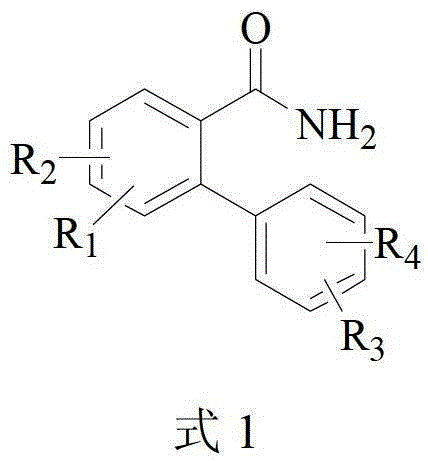
Figure 1 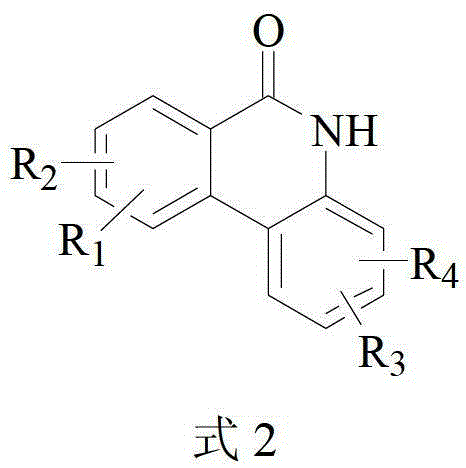
Figure 2 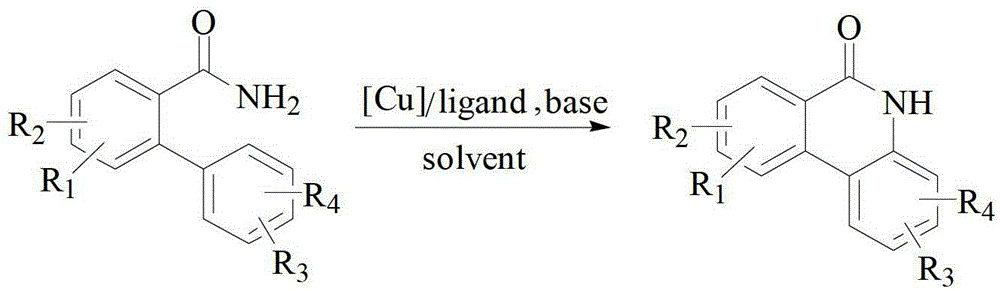
Figure 3
Abstract
Description
technical field
[0001] The invention relates to a method for preparing 6(5H)-phenanthridinone by catalyzing a copper compound, belonging to the fields of organic synthesis and metal catalysis. Background technique
[0002] 6(5H)-phenanthridinones are a class of alkaloid compounds containing nitrogen atoms. Such alkaloids have potent anti-tumor, anti-virus, inhibitory acetylcholinesterase and other biological activities. Some of these alkaloids have been used to treat myasthenia gravis, myopathy, and neurological disorders. Therefore, the development of synthetic methods for phenanthridinones has important practical value. At present, there are some methods for the synthesis of phenanthridinone compounds. For example, phenanthridone can be synthesized by Suzuki Cross-Coupling to substituted 2'-fluorobiphenyl-2-carbonitrile, and then potassium hydroxide is added to promote anion ring closure to form phenanthrene. In addition, 9-fluorenone oxime undergoes Beckmann rearrange...
Examples
Embodiment 1
[0026] Embodiment 1: the synthesis of 6 (5H)-phenanthridone
[0027] Substrate 197mg (1mmol) 2-phenylbenzamide, catalyst 19mg (0.1mmol) CuI, ligand 52mg (0.2mmol) PPh 3 , base 224mg (2mmol) KO-tBu, and solvent 3ml o-xylene were added to a 30ml sealed tube in an air environment. Then the sealed tube was placed in an oil bath at 120°C for 12 h. After the reaction, the reaction liquid was cooled to room temperature, 80 ml of saturated brine was added, and then extracted three times with 100 ml of ethyl acetate, and the organic layers were combined. The organic layer was dried with anhydrous sodium sulfate, filtered, and the filtrate was distilled under reduced pressure and separated by silica gel column chromatography (ethyl acetate / petroleum ether: 1 / 2 as eluent) to obtain 175.5 mg of white solid with a yield of 90%.
[0028] 1 H NMR (400MHz, DMSO-d 6 ):δ11.69(s,1H),8.52(d,J=8.0Hz,1H),8.40(d,J=8.0Hz,1H),8.83(d,J=8.0Hz,1H),7.86(t ,J=7.6Hz,1H),7.65(t,J=7.6Hz,1H),7.50(t,J=7.6H...
Embodiment 2
[0031] Embodiment 2: the synthesis of 3,8-dimethyl-6 (5H)-phenanthridinone
[0032] Substrate 225mg (1mmol) 4,4′-dimethyl-[1,1′-biphenyl]-2-amide, catalyst 19mg (0.1mmol) CuI, ligand 52mg (0.2mmol) PPh 3 , base 224mg (2mmol) KO-tBu, and solvent 3ml o-xylene were added to a 30ml sealed tube in an air environment. Then the sealed tube was placed in an oil bath at 120°C for 12 h. After the reaction, the reaction liquid was cooled to room temperature, 80 ml of saturated brine was added, and then extracted three times with 100 ml of ethyl acetate, and the organic layers were combined. The organic layer was dried with anhydrous sodium sulfate, filtered, and the filtrate was distilled under reduced pressure and separated by silica gel column chromatography (ethyl acetate / petroleum ether: 1 / 2 as eluent) to obtain 174.0 mg of white solid with a yield of 78%.
[0033] 1 H NMR (400MHz, DMSO-d 6 ):δ11.54(s,1H),8.33(d,J=8.0Hz,1H),8.21(d,J=8.0Hz,1H),8.10(s,1H),7.64(d,J=8.0Hz ,1H),7.14(...
Embodiment 3
[0036] Embodiment 3: the synthesis of 8-methoxy-3-methyl-6 (5H)-phenanthridinone
[0037] Substrate 241mg (1mmol) 4-methoxy-4′-methyl-[1,1′-biphenyl]-2-amide, catalyst 19mg (0.1mmol) CuI, ligand 52mg (0.2mmol) PPh 3 , base 224mg (2mmol) KO-tBu, and solvent 3ml o-xylene were added to a 30ml sealed tube in an air environment. Then the sealed tube was placed in an oil bath at 120°C for 12 h. After the reaction, the reaction liquid was cooled to room temperature, 80 ml of saturated brine was added, and then extracted three times with 100 ml of ethyl acetate, and the organic layers were combined. The organic layer was dried with anhydrous sodium sulfate, filtered, and the filtrate was distilled under reduced pressure and separated by silica gel column chromatography (ethyl acetate / petroleum ether: 1 / 2 as eluent) to obtain 203.2 mg of white solid with a yield of 85%.
[0038] 1 H NMR (400MHz, DMSO-d 6 ):δ11.65(s,1H),8.39(d,J=8.0Hz,1H),8.18(d,J=8.0Hz,1H),7.73(s,1H),7.42(d,J=8.8Hz...