
Welding robot control method
A welding robot and control method technology, applied in welding equipment, auxiliary welding equipment, welding/cutting auxiliary equipment, etc., can solve the problem of lack of external information sensing and real-time adjustment functions, inability to adapt to changes in the welding environment and process, man-machine Problems such as operating space limitations, to achieve the effect of simplifying the teaching process, shortening the movement or empty distance, and strong anti-electromagnetic field interference
Patent Information
- Authority / Receiving Office
- CN · China
- Patent Type
- Patents(China)
- Current Assignee / Owner
- Publication Date
- 2015-01-21
- Estimated Expiration
- Not applicable · inactive patent
Smart Images
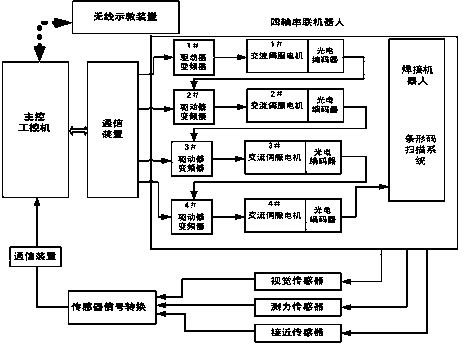
Figure 1 
Figure 2 
Figure 3
Abstract
Description
technical field
[0001] The invention relates to a welding robot control device, in particular to a welding robot control method, a welding robot control method based on wireless intelligent teaching and three-dimensional laser scanning of visual tracking technology. Background technique
[0002] Welding robots are industrial robots that replace welders in welding tasks in the field of welding production. They are mainly divided into two categories: spot welding and arc welding. The welding parameters of the existing teaching reproducible welding robots are preset according to the working conditions, lack of external information sensing and real-time adjustment functions in the welding process, have strict requirements on the consistency of working conditions, and cannot adapt to the welding environment and process. Variety. Secondly, the teaching process of the teaching reproduction welding robot is cumbersome, the empty travel time is too long, and the work efficiency is ...
Examples
Embodiment Construction
[0030] Such as figure 1 As shown, the welding robot control method is used to detect the sensors of various states of the robot, monitor the force state, rotation angle and speed of each arm of the robot in real time, and capture the information of the welding seam at the same time to form a closed-loop control of the robot.
[0031] The signal conversion device converts various signals detected by the sensor and transmits them to the main industrial computer through the communication device. The main industrial computer receives the signal from the wireless teaching device for analysis and processing and completes the human-computer interaction function. The main industrial computer receives the signals from various sensors and performs mechanical calculations, and the control system solves the calculation to form a control error signal. The driving device is used to drive the robot to work by receiving the command sent by the main industrial computer. The wireless teaching ...