
Method of selectively removing sulphur acetyl protecting group in saccharide
A thioacetyl and selective technology, applied in the field of organic chemical synthesis, can solve the problems of narrow trial range of deprotected substrates, difficulty in controlling the reaction process, difficult storage of reagents, etc., and achieve cheap reagents, easy separation and fast speed Effect
Patent Information
- Authority / Receiving Office
- CN · China
- Patent Type
- Applications(China)
- Current Assignee / Owner
- Publication Date
- 2014-02-05
- Estimated Expiration
- Not applicable · inactive patent
Smart Images

Figure 1 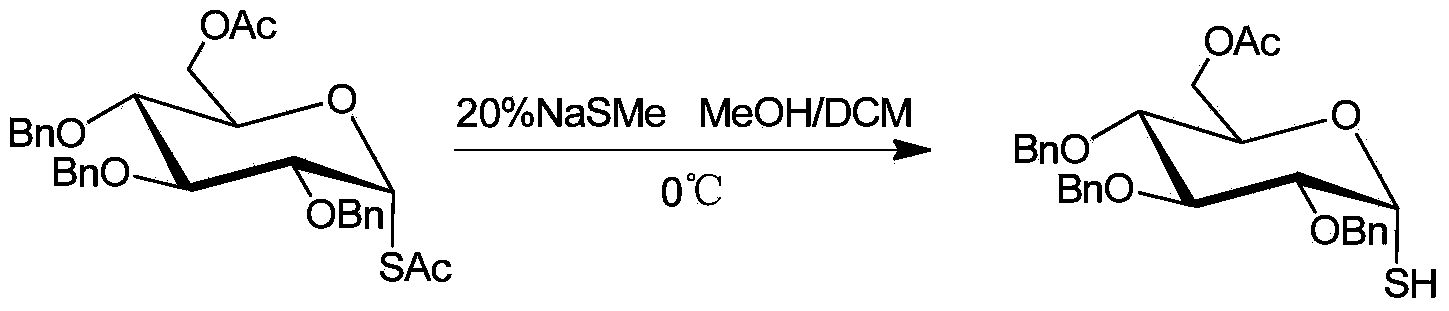
Figure 2 
Figure 3
Abstract
Description
technical field
[0001] The invention belongs to the application field of organic chemical synthesis, in particular to a method for selectively removing the thioacetyl protecting group of sugars in sugar chemistry. Background technique
[0002] Glycosyl thiols are widely used in sugar chemistry. Due to the strong nucleophilicity of sulfhydryl groups, they are often used as good acceptors in glycosylation reactions. The mercapto group protected by acetyl group can be regarded as the precursor of mercapto group, which can be quickly removed under the catalysis of base. Thioacetyl can be at any position of the sugar. If it is necessary to selectively remove the thioacetyl group in the case of the oxyacetyl group in the protective group operation of the sugar, then it is necessary to choose a suitable reagent for deprotection.
[0003] At present, the commonly used reagents for selective desulfurization of acetyl groups include: sodium methylthiolate solid, hydrazine acetate sol...
Examples
Embodiment 1
[0016] Example 1: Selective desulfurization of 6-O-acetyl-2,3,4-tri-O-benzyl-1-S-acetyl-α-D-glucose
[0017] The reaction formula is:
[0018]
[0019] Under ice-bath conditions, add 0.55g (1mmol) 6-O-acetyl-2,3,4-tri-O-benzyl-1-S-acetyl-α-D-glucose to a 50 ml round bottom flask , 9mL methanol, dichloromethane solvent, wherein the volume ratio of methanol and dichloromethane is 1:2, stirred for 10min, 1eq aqueous solution of sodium methyl mercaptide was added dropwise to the flask, and TLC tracked the plate. After the reaction was completed, 10% hydrochloric acid was added to the reaction flask to quench the reaction. Add an appropriate amount of saturated saline and ethyl acetate, extract and separate the liquids, combine the organic phases, and dry over anhydrous sodium sulfate; concentrate under reduced pressure, and the residue is quickly separated by column chromatography to obtain 0.46 g of the product with a yield of 90%. 1 H NMR (400MHz, CDCl 3 )δ7.37-7.26(m,15H)...
Embodiment 2
[0020] Example 2: Selective desulfurization of 2,3,4,6-tetra-O-acetyl-1-S-acetyl-β-D-glucose
[0021] The reaction formula is:
[0022]
[0023] Under ice bath conditions, add 0.41g (1mmol) 2,3,4,6-tetra-O-acetyl-1-S-acetyl-β-D-glucose, 9mL methanol, di Chloromethane solvent, wherein the volume ratio of methanol and dichloromethane is 1:2, stirred for 10min, 1eq sodium methyl mercaptide aqueous solution was added dropwise to the flask, and TLC followed the spot plate. After the reaction was completed, 10% hydrochloric acid was added to the reaction bottle to quench the reaction. Add an appropriate amount of saturated saline and ethyl acetate, extract and separate the liquids, combine the organic phases, and dry over anhydrous sodium sulfate; concentrate under reduced pressure, and the residue is quickly separated by column chromatography to obtain 0.32 g of the product with a yield of 88%. 1 H NMR (400MHz, CDCl 3 )δ5.19(t,J=9.4Hz,1H),5.10(t,J=9.7Hz,1H),4.97(t,J=9.5Hz,1H)...
Embodiment 3
[0024] Example 3: 2,3,4,6-tetra-O-acetyl-1-S-acetyl-β-D-galactose selective desulfurization of acetyl
[0025] The reaction formula is:
[0026]
[0027] Under ice-bath condition, add 0.41g (1mmol) 2,3,4,6-tetra-O-acetyl-1-S-acetyl-β-D-galactose, 9mL methanol, Dichloromethane solvent, wherein the volume ratio of methanol and dichloromethane is 1:2, stirred for 10min, 1eq sodium methyl mercaptide aqueous solution was added dropwise to the flask, and TLC tracked the spot plate. After the reaction was completed, 10% hydrochloric acid was added to the reaction flask to quench the reaction. Add an appropriate amount of saturated saline and ethyl acetate, extract and separate the liquids, combine the organic phases, and dry over anhydrous sodium sulfate; concentrate under reduced pressure, and the residue is quickly separated by column chromatography to obtain 0.35 g of the product with a yield of 95%. 1 H NMR (600MHz, CDCl 3 )δ5.44(d,J=3.2Hz,1H),5.19(t,J=9.9Hz,1H),5.03(dd,J=1...