
A kind of industrial synthesis process of polyphenylene sulfide resin without adding any synthetic auxiliary agent
A technology of polyphenylene sulfide resin and auxiliary agent is applied in the field of polymer material resin synthesis to achieve the effects of improving reaction speed, shortening time and process flow, and improving production efficiency
Patent Information
- Authority / Receiving Office
- CN · China
- Patent Type
- Patents(China)
- Current Assignee / Owner
- Publication Date
- 2016-06-01
Smart Images
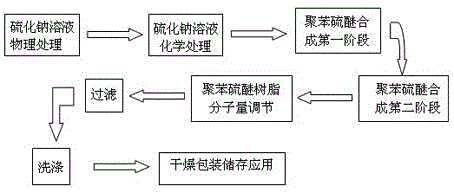
Figure 1
Abstract
Description
technical field
[0001] The invention belongs to the field of polymer material resin synthesis, especially the production of polyphenylene sulfide resin without adding any synthesis auxiliary agent. Background technique
[0002] High-performance polyphenylene sulfide has excellent chemical resistance and thermal stability at high temperatures, and has flame retardancy, insulation, radiation resistance and good mechanical properties. In order to explore the synthesis method of this material, researchers from all over the world have been working hard to find it.
[0003] In U.S. Patent No: 4761468, it is described that chemical substances such as mercapto and mercapto metal salts are used to synthesize polyphenylene sulfide resins. After the synthesis, the polyphenylene sulfide resins are treated to reduce the content of chlorine in the polyphenylene sulfide resins. In the future, the polyphenylene sulfide resin will be applied to the field of electronic components through mod...
Examples
Embodiment 1
[0031] at 28m 3 316L stainless steel autoclave, sodium sulfide (Na 2 S): sodium hydroxide (NaOH): p-dichlorobenzene (abbreviation: p-DCB): NMP molar ratio is 0.98:0.30:1.00:2.30; industrial synthesis process includes:
[0032] 1) In the dehydration treatment stage of sodium sulfide and sodium hydroxide, under the protection of nitrogen and the stirring speed of the stirring blade is 33 rpm, sodium sulfide is dissolved in anaerobic water to form a sodium sulfide concentration of 18%wt Transparent solution, sodium hydroxide is dissolved in anaerobic water to form a transparent solution containing sodium hydroxide concentration of 38%wt, sodium sulfide and sodium hydroxide are added to a 316L stainless steel reaction kettle with a molar ratio of 0.98:0.20, and heated to 130 ℃ to fully mix and dissolve sodium sulfide and sodium hydroxide to form an aqueous solution of sodium sulfide and sodium hydroxide, and then input the mixed solution containing sodium sulfide into a pipeline ...
Embodiment 2
[0039] at 28m 3 316L stainless steel autoclave, sodium sulfide (Na 2 S): sodium hydroxide (NaOH): p-dichlorobenzene (abbreviation: p-DCB): N-methylpyrrolidone (NMP) molar ratio is 1.18:0.30:1.28:3.80; industrial synthesis process includes:
[0040] 1) In the dehydration treatment stage of sodium sulfide and sodium hydroxide, under the protection of nitrogen and the stirring speed of the stirring blade is within 66 rpm, sodium sulfide is dissolved in anaerobic water to form a sodium sulfide concentration of 38%wt Transparent solution, sodium hydroxide is dissolved in anaerobic water to form a transparent solution containing sodium hydroxide concentration of 88%wt, sodium sulfide and sodium hydroxide are added to a 316L stainless steel reaction kettle with a molar ratio of 1.18:0.20, and heated to 130 ℃ to fully mix and dissolve sodium sulfide and sodium hydroxide to form an aqueous solution of sodium sulfide and sodium hydroxide, and then input the mixed solution containing so...
Embodiment 3
[0047] at 28m 3 316L stainless steel autoclave, sodium sulfide (Na 2 S): sodium hydroxide (NaOH): p-dichlorobenzene (abbreviation: p-DCB): NMP molar ratio is 1.01:0.14:1.06:2.68; industrial synthesis process includes:
[0048] 1) In the dehydration treatment stage of sodium sulfide and sodium hydroxide, under the protection of nitrogen and the stirring speed of the stirring blade is 33-66 rpm, sodium sulfide is dissolved in anaerobic water to form a sodium sulfide concentration of 18- 38%wt transparent solution, sodium hydroxide is dissolved in anaerobic water to form a transparent solution containing sodium hydroxide concentration of 38-88%wt, sodium sulfide and sodium hydroxide are added to a 316L stainless steel reaction kettle at a molar ratio of 1.01:0.10 and heated to 121°C to fully mix and dissolve sodium sulfide and sodium hydroxide to form an aqueous solution of sodium sulfide and sodium hydroxide, and then input the mixed solution containing sodium sulfide into a pi...