
Preparation method of temperature and pH sensitive shell cross-linked polymeric micelle
A cross-linked polymer, sensitive technology, applied in the fields of drug combination, liquid delivery, anti-tumor drugs, etc., can solve the problems of strict polymer block ratio requirements, low critical micelle concentration, and uneven micelle size, etc. Achieve excellent drug loading performance, good environmental protection and stability, and easy operation.
Patent Information
- Authority / Receiving Office
- CN · China
- Patent Type
- Patents(China)
- Current Assignee / Owner
- Publication Date
- 2014-07-16
- Estimated Expiration
- Not applicable · inactive patent
Smart Images
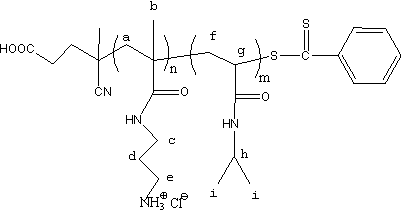
Figure 1 
Figure 2 
Figure 3
Abstract
Description
technical field
[0001] The invention belongs to the technical field of chemical engineering and new materials, and in particular relates to a preparation method of temperature- and pH-sensitive shell cross-linked polymer micelles. Background technique
[0002] Polymer micelles are self-assembled by polymers in solvents. Because of their excellent tissue permeability, good compatibilization effect, and structural diversity, they have become one of the hot research topics at home and abroad. However, the poor stability of polymer micelles limits its practical application to a large extent, especially in the process of micellar self-assembly, when the polymer concentration is lower than the critical micelle concentration, the dilution effect of micelles affects controlled release efficiency. In order to improve the stability of polymer micelles and the integrity of supramolecular nanostructures so that they can be better applied in biological environments, people have been wor...
Examples
Embodiment 1
[0026] The first step of synthesis: Dissolve 3.6g of N-3-aminopropylmethacrylamide hydrochloride monomer in 8ml of deionized water, adjust the pH to 4~5 and freeze it, and dissolve 0.06g of 4-cyano-4 -(Thiobenzoyl)valeric acid and 0.015g 4,4'-azo-(4-cyanovaleric acid) were dissolved in 0.5ml of dioxane solvent, and the two were mixed in a one-necked bottle. The rotor is contained inside, and the glass tee is connected to it, the air is completely excluded, and the solution is placed in a nitrogen-protected environment, and the oil bath is heated to 70°C for 16 hours. Dialyzed in medium for three days, and then freeze-dried to obtain poly(N-3-aminopropylmethacrylamide hydrochloride) polymer.
[0027] The second step of synthesis: Take 0.27g of poly(N-3-aminopropylmethacrylamide hydrochloride) as a macromolecular chain transfer agent and place it in a single-necked bottle containing a rotor, and add 1.5mg of 4,4'- Nitrogen-(4-cyanovaleric acid), 0.7g N-isopropylacrylamide monom...
Embodiment 2
[0032] Same as Example 1, but the amount of 4,4'-azo-(4-cyanovaleric acid) in the first step of synthesis becomes 0.012g of the monomer in the system (N-3-aminopropylmethacrylamide hydrochloride salt) to chain transfer agent (4-cyano-4-(thiobenzoyl)valeric acid) and initiator (4,4'-azo-(4-cyanovaleric acid)) molar ratio is 100:1:0.2.
Embodiment 3
[0034] Same as Example 1, but the water solvent in the first step of synthesis is changed to 15ml, the monomer (N-3-aminopropylmethacrylamide hydrochloride) and the chain transfer agent (4-cyano-4-( Thiobenzoyl)valeric acid) and initiator (4,4'-azo-(4-cyanovaleric acid)) molar ratio is still 100:1:0.25.