
Regeneration method of MnOx/TiO2 based low-temperature denitration catalyst
A denitration catalyst, low temperature denitration technology, applied in catalyst regeneration/reactivation, physical/chemical process catalysts, chemical instruments and methods, etc., can solve the problems of increasing catalyst utilization cost, environmental pollution, etc., to improve activity and anti-poisoning. capacity, good denitration effect, and the effect of saving heating time
Patent Information
- Authority / Receiving Office
- CN · China
- Patent Type
- Applications(China)
- Current Assignee / Owner
- Publication Date
- 2016-05-18
Smart Images
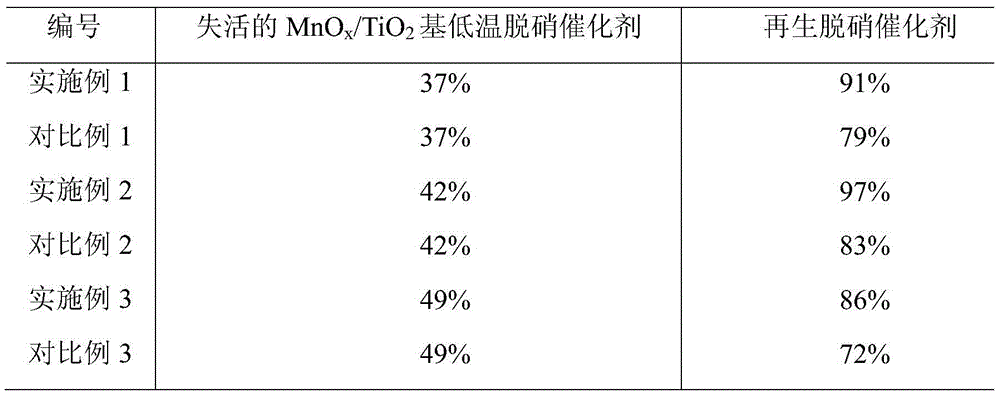
Figure 1
Abstract
Description
technical field
[0001] The invention belongs to the technical field of deactivated catalyst regeneration, in particular to a MnO x / TiO 2 A regeneration method for a low-temperature denitrification catalyst. Background technique
[0002] Nitrogen oxides (NO x ) is one of the main air pollutants, which seriously endangers the production and life of human beings and causes huge pollution to the ecological environment, which mainly includes damage to plants and poisonous effects on the human body, as well as the formation of photochemical smog, acid rain and destruction of the ozone layer. It is a major problem in air pollution control.
[0003] Now many domestic and foreign power plants adopt selective catalytic reduction (SCR) denitrification technology to meet the increasingly stringent nitrogen oxide emission standards. V-W(Mo)-Ti series catalysts are the most widely used denitrification catalysts in the industry, and they have high denitrification activity in the tempe...
Examples
Embodiment 1
[0034] A kind of MnO x / TiO 2 A regeneration method for a low-temperature denitration catalyst based on deactivated MnO with a denitration rate of 37% x / TiO 2 Based low-temperature denitration catalyst, specifically comprising the following steps:
[0035] 1) Deactivate MnO by purging with dry compressed air x / TiO 2 Based on low-temperature denitrification catalyst, the pressure of compressed air is 1KPa, and the purging time is 70min; then under the condition of 500W ultrasonic vibration, the deactivated MnO x / TiO 2 The low-temperature denitrification catalyst was immersed in deionized water for 120 minutes to remove other impurities and soluble substances on the surface of the catalyst, and then dried;
[0036] 2) The deactivated MnO treated in step 1) x / TiO 2 Immerse the base-based low-temperature denitration catalyst into the activation solution (active sol of the Mn-Ti component) for activation treatment, and the immersion activation treatment time is 10 hours...
Embodiment 2
[0043] A kind of MnO x / TiO 2 A regeneration method based on low-temperature denitrification catalyst, aiming at deactivated MnO with a denitrification rate of 42% x / TiO 2 Based low-temperature denitration catalyst, specifically comprising the following steps:
[0044] 1) Deactivate MnO by purging with dry compressed air x / TiO 2 Based on low-temperature denitrification catalyst, the pressure of compressed air is 2KPa, and the purging time is 60min; then under the condition of 400W ultrasonic vibration, the deactivated MnO x / TiO 2 The base low-temperature denitrification catalyst was immersed in deionized water for 90 minutes to remove other impurities and soluble substances on the surface of the catalyst, and then dried;
[0045] 2) The deactivated MnO treated in step 1) x / TiO 2 Immerse the base-based low-temperature denitrification catalyst into the activation solution (active sol of Mn-Ti component) for activation treatment, and the immersion activation treatment...
Embodiment 3
[0052] A kind of MnO x / TiO 2 A regeneration method for a low-temperature denitrification catalyst based on deactivated MnO with a denitrification rate of 49% x / TiO 2 Based low-temperature denitration catalyst, specifically comprising the following steps:
[0053] 1) Deactivate MnO by purging with dry compressed air x / TiO 2 Based on low-temperature denitrification catalyst, the pressure of compressed air is 3KPa, and the purging time is 40min; then under the condition of 300W ultrasonic vibration, the deactivated MnO x / TiO 2 The base low-temperature denitrification catalyst was immersed in deionized water for 180 minutes to remove other impurities and soluble substances on the surface of the catalyst, and then dried;
[0054] 2) The deactivated MnO treated in step 1) x / TiO 2 Immerse the base-based low-temperature denitrification catalyst into the activation solution (active sol of Mn-Ti component) for activation treatment, and the soaking and activation treatment t...