
Method and device for detecting and selecting laser-induce enhanced Raman spectrum in liquid
A technology of laser induction and Raman spectroscopy, which is applied in the directions of measurement devices, Raman scattering, and material excitation analysis, can solve the problems of complex implementation process, high requirements for instrument hardware, and experimental operation, and achieve simple implementation methods and reduced spectrum acquisition time , The effect of reducing the consumption of consumables
Patent Information
- Authority / Receiving Office
- CN · China
- Patent Type
- Applications(China)
- Current Assignee / Owner
- Publication Date
- 2016-07-13
Smart Images
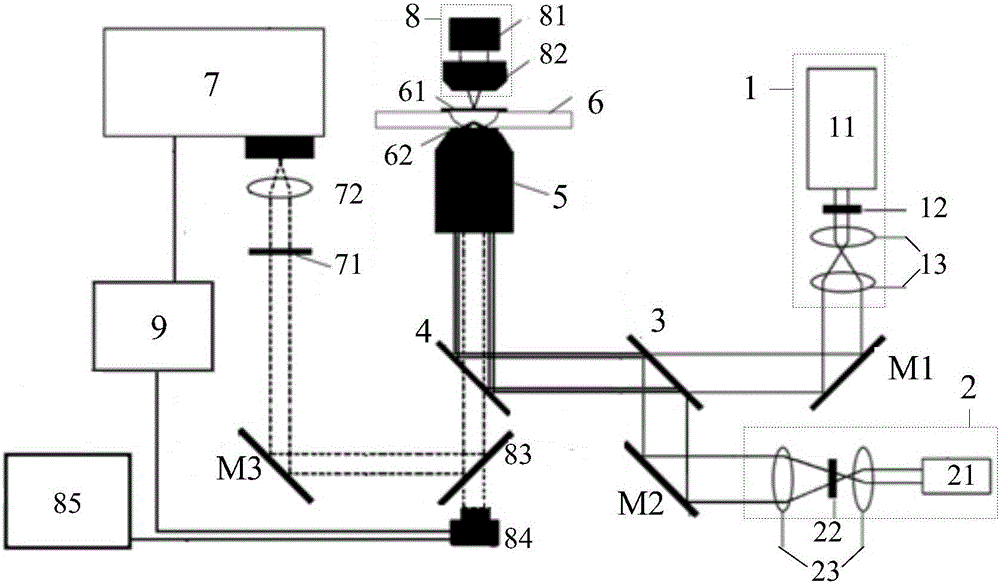
Figure 1 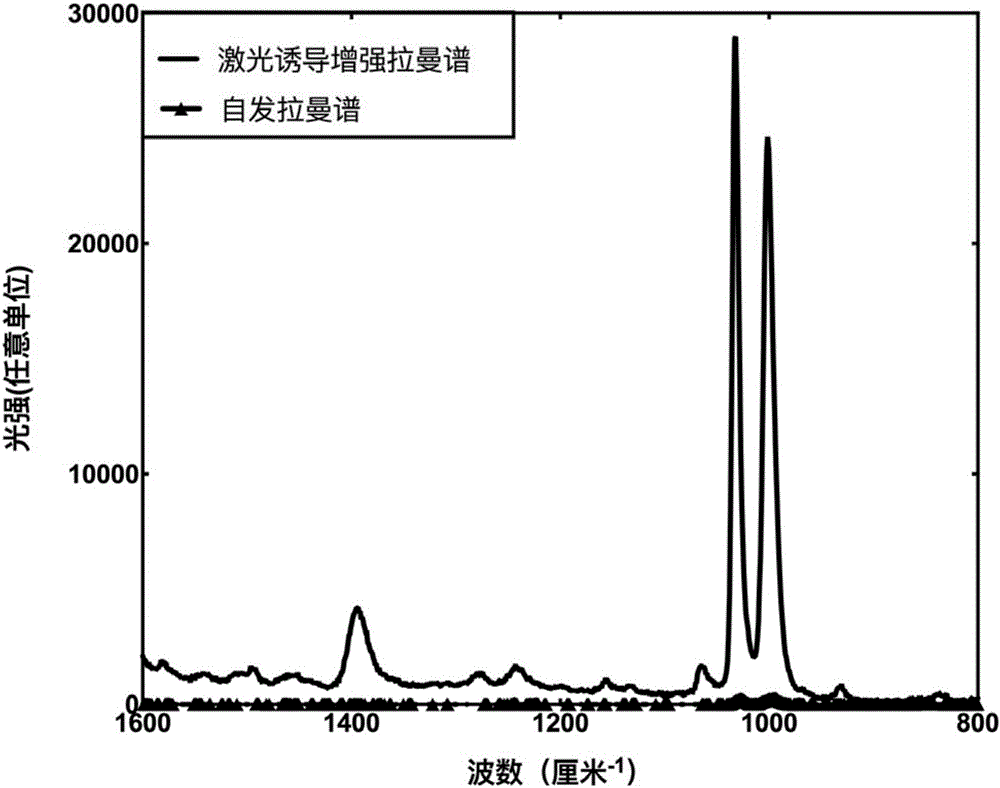
Figure 2
Abstract
Description
technical field
[0001] The invention relates to Raman signal sample detection technology, in particular to a detection and sorting method and device for laser-induced enhanced Raman spectrum in liquid. Background technique
[0002] When the light beam is irradiated on the sample, most of the photons of the scattered light are emitted in the form of Rayleigh scattering, and the frequency of the scattered light is equal to that of the incident light. In addition, there are very few photons that will undergo Raman scattering. When these photons interact with the sample, energy exchange will occur, and the frequency of the outgoing light will be blue-shifted or red-shifted, collectively known as Raman shift (RamanShift). Corresponding to anti-Stokes (anti-Stokes) line and Stokes (Stokes) line, respectively. In practical research, a spectrometer is usually used to collect Raman scattered light to form a Raman spectrum. Compared with the most commonly used fluorescence research ...
Examples
Embodiment Construction
[0043] The present invention will be further elaborated below through specific embodiments in conjunction with the accompanying drawings.
[0044] Such as figure 1 As shown, the detection and sorting device of laser-induced enhanced Raman spectrum in liquid in this embodiment includes: induced light device 1, excitation light device 2, beam combining mirror 3, first dichroic mirror 4, objective lens 5, sample Pond 6, metal nanoparticle, focusing lens, Raman spectrometer 7, illuminating light device 8 and computer 9; Wherein, hold the sample to be measured dissolved in the liquid in the transparent sample pool 6, metal nanoparticle is injected into the sample pool In the liquid; the induced light device 1 emits a near-infrared laser as the induced light, which is first reflected by the first reflector M1 and then passed through the beam combiner 3, reflected by the first dichroic mirror 4 and entered into the objective lens 5, which is highly focused by the objective lens 5, fr...