
Bacillus cereus strain for preventing and treating melon root rot, and culture method and application thereof
A Bacillus cereus, culture method technology, applied in the directions of microorganism-based methods, applications, pest control, etc., can solve the problem of no control effect of Fusarium solani on melons, and achieve a wide range of sterilization applications and long shelf life. long-term, stable effect
Patent Information
- Authority / Receiving Office
- CN · China
- Patent Type
- Applications(China)
- Current Assignee / Owner
- Publication Date
- 2016-12-07
Smart Images
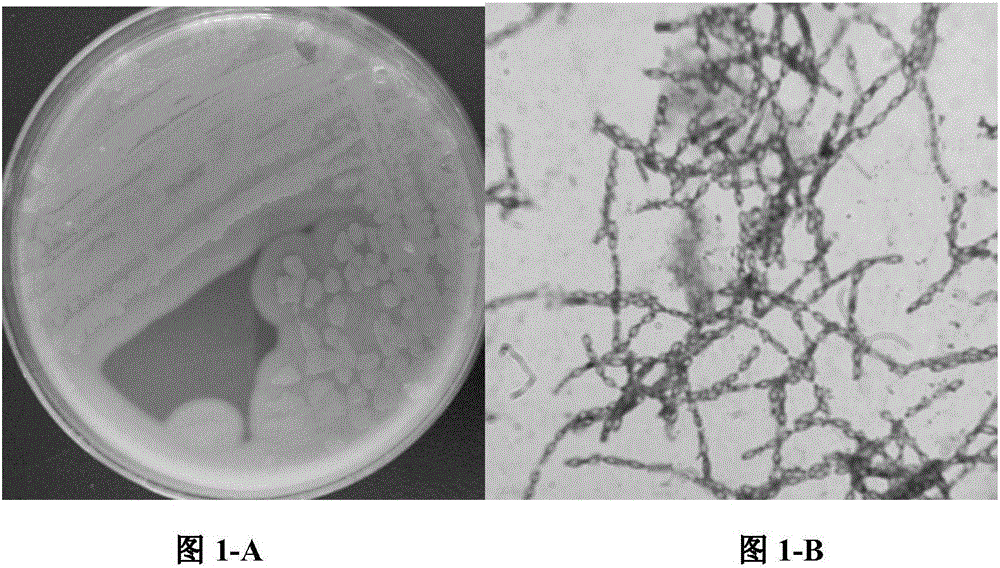
Figure 1 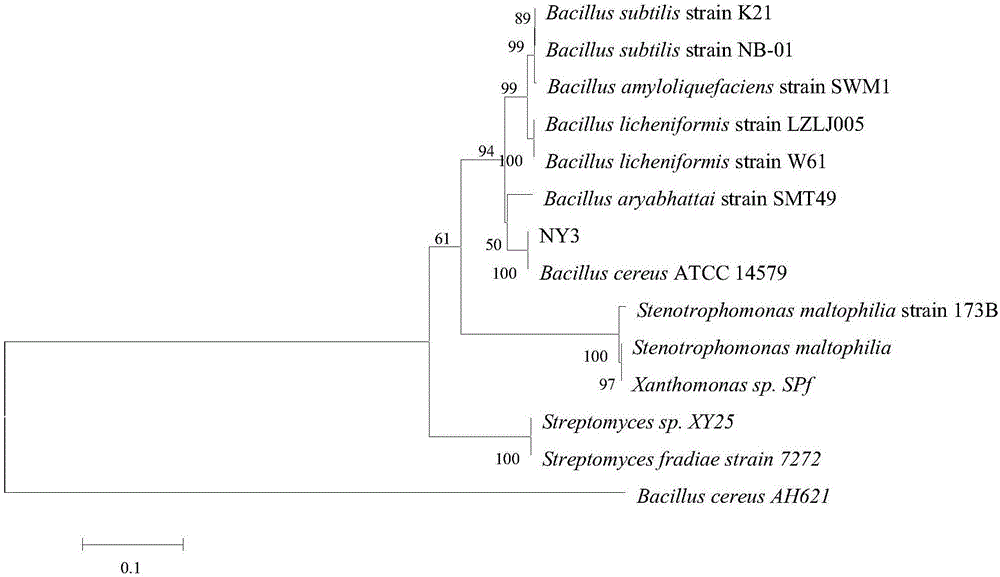
Figure 2 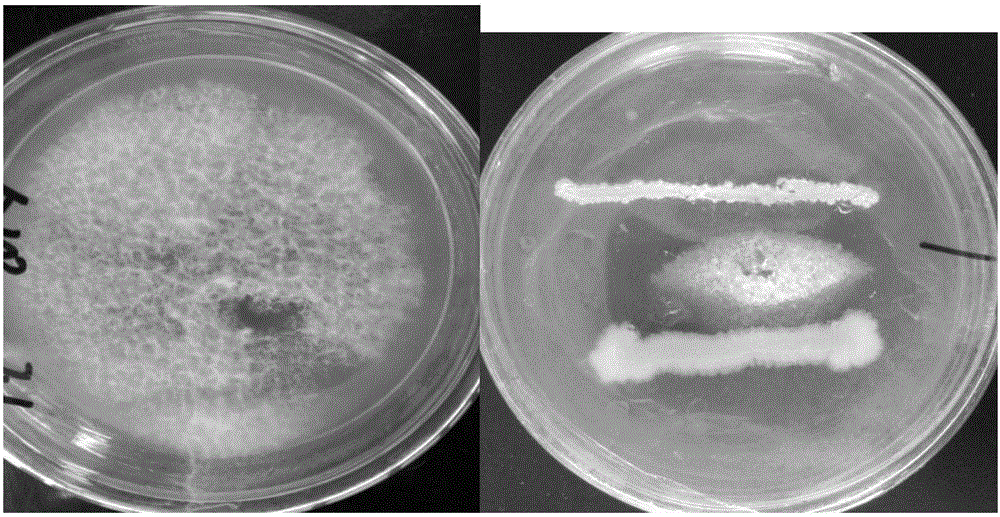
Figure 3
Abstract
Description
technical field
[0001] The invention relates to a bacillus cereus for preventing and treating melon root rot, a cultivation method and application thereof, and belongs to the technical field of biological control of plant diseases. Background technique
[0002] Root rot is a common disease of melons. It is more common in the division of seedlings or before the slow seedlings after planting, and the damage is serious. The pathogen is mainly Fusarium solani of melons. The pathogen survives the winter as chlamydospores, mycelia or sclerotia in the soil and on the diseased residues. The chlamydospores can survive in the soil for 5-10 years. Chlamydospores are the main source of infection causing the disease. The bacteria invade from the root wound. After the onset, conidia are produced in the diseased part, spread by rain or watering, and repeat infection. Once it occurs, it is difficult to cure. For a long time, the field control of this disease has mainly relied on chemical f...
Examples
Embodiment 1
[0042] Example 1. Isolation and Identification of Bacillus cereus.Frankland NY3
[0043] 1. Isolation of Bacillus cereus NY3
[0044]Select soil samples from the muskmelon rhizosphere soil in greenhouses in Linyi City, Shandong Province, and use a sterilized sampling shovel to collect 5-25 cm deep soil from the muskmelon rhizosphere with good growth in the same area. Store in a refrigerator at 4°C. When separating, weigh 10g of soil sample and put it into a conical flask filled with sterile water and glass beads, shake it fully for 30 minutes, after the soil sample is evenly dispersed, let it stand for 10 minutes to form a bacterial suspension with a concentration of 0.1g / ml. The bacterial suspension was diluted to obtain a concentration of 10 -2 , 10 -3 , 10 -4 , 10 -5 , 10 -6 , 10 -7 g / ml bacterial suspension. Heat each gradient dilution in a water bath at 80°C for 20 minutes, absorb 0.1ml of each gradient dilution of soil suspension, spread it on a chitosan selectiv...
Embodiment 2
[0055] The propagation of embodiment 2, NY3 bacterial classification
[0056] The culture method of above-mentioned bacillus cereus (Bacillus cereus) NY3, step is as follows:
[0057] (1) Bacillus cereus (Bacillus cereus) NY3 was activated and cultured on LB plate medium at 37°C for 20 hours to obtain an activated strain;
[0058] Described LB plate culture medium, every liter of components is as follows:
[0059] Tryptone 10g, yeast extract 5g, sodium chloride 5g, agar powder 18g, water to 1000mL, pH 7.2;
[0060] (2) Transfer the activated bacterial strain prepared in step (1) to LB liquid medium, and cultivate the seeds for 18 hours at a temperature of 37° C. and a shaker speed of 200 rpm to obtain a seed solution;
[0061] Described LB liquid culture medium, per liter composition is as follows:
[0062] Tryptone 10g, yeast extract 5g, sodium chloride 5g, water to 1000mL, pH 7.2;
[0063] (3) Inoculate the seed solution prepared in step (2) into the fermentation medium ...
Embodiment 3
[0068] Embodiment 3, the inhibitory action of NY3 bacterial strain to the hyphae of muskmelon root rot
[0069] 1. Inoculate the muskmelon root rot bacterial block in the center of the PDA medium plate. After pre-cultivating at 28°C for 1 day, inoculate the Bacillus cereus (Bacillus cereus) NY3 strain in the center of the plate and 2cm away from the center, and cultivate in a 28°C incubator 3d, observe the zone of inhibition, and repeat the experiment three times. The average width of the antibacterial zone was measured to be 16mm.
[0070] 2. Take 500 μL of the concentration of 1.0×10 7 The melon root rot bacteria spore suspension of cfu / ml is sub-packed in the 1.5ml centrifuge tube, then adds the Bacillus cereus NY3 fermented liquid that 50 μ L embodiment 2 prepares in the centrifuge tube, the matched group adds equal amount of sterile water, Mix them with the spore suspension of Melon Fusarium wilt respectively, and then culture them at a constant temperature of 28°C. Ea...