

Compound dressing with high liquid absorption performance and preparation method of compound dressing
A high-performance, high-absorbing technology, applied in absorbent pads, pharmaceutical formulations, pharmaceutical sciences, etc., can solve problems such as poor biocompatibility, poor mechanical properties, adverse environmental effects, etc., achieve high porosity, good controllability, Significant social benefits
Patent Information
- Authority / Receiving Office
- CN · China
- Patent Type
- Applications(China)
- Current Assignee / Owner
- Publication Date
- 2017-01-25
- Estimated Expiration
- Not applicable · inactive patent
Smart Images
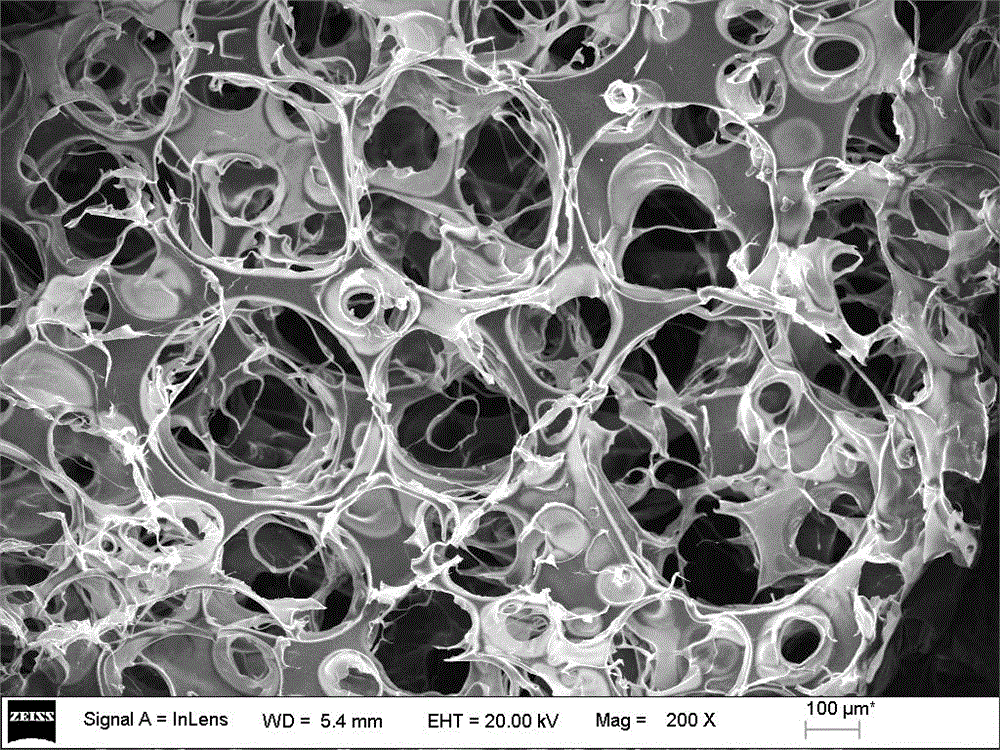
Figure 1
Abstract
Description
technical field
[0001] The invention belongs to the field of medical devices, and relates to a composite dressing and a production process thereof, in particular to a non-woven dressing made of chitosan and cotton polysaccharide as raw materials, which is suitable for tissue repair with high mechanical strength and high liquid absorption. A biomedical material, the dressing is suitable for covering and treating burn wounds, trauma wounds, chronic ulcer wounds, decubitus wounds, infected wounds, and surgical wounds. Background technique
[0002] Medical dressings are a class of clinical medical materials that temporarily cover burns, ulcers, wounds and other wounds. Its main function is to control the exudate of the wound and protect the wound from external sources such as bacteria and dust particles. With the accelerated pace of modern life and the increasing demand for medical care, the demand for medical dressings is also increasing year by year. From a global perspective,...
Examples
Embodiment 1
[0029] Weigh 1.0 g of sodium alginate and dissolve it in 140 mL of water, add 10 mL of sodium periodate solution (40 mg / mL) dropwise, and react with electromagnetic stirring at room temperature for 4 hours. Add 0.200 mL of ethylene glycol dropwise therein, stir and react for 1 hour, then use a dialysis bag with a molecular weight cut-off of 3500 to soak in deionized water for dialysis for 24 hours, during which the water is changed every 4 hours, and the vacuum equipment is freeze-dried for 48 hours to obtain Hydroformylated sodium alginate solid.
[0030] Then weigh 1.0 g of carboxymethyl chitosan and dissolve it in 30 mL of water. During the process, ultrasound or stirring is required to dissolve for about 30 minutes. At the same time, the following solution is prepared: 50 mg of the above-mentioned alginate sodium alginate is dissolved in 10 mL of water; 1.50 G glycerol was dissolved in 1 mL water, 0.30 g poloxamer 407 was dissolved in 9 mL water and 10 mL PBS. Next, add t...
Embodiment 2
[0033] Weigh 1.5 g of starch and dissolve it in 150 mL of water, add 10 mL of sodium periodate solution (80 mg / mL) dropwise, and react with electromagnetic stirring at room temperature for 2 hours. Add 0.40 mL of ethylene glycol dropwise therein, and react for 1 hour, then use a dialysis bag with a molecular weight cut-off of 3500 to soak in deionized water for dialysis for 24 hours, during which the water is changed every 4 hours, and the vacuum equipment is freeze-dried for 48 hours to obtain Aldehydated starch.
[0034]Then weigh 2.0 g of carboxymethyl chitosan and dissolve it in 60 mL of water. During the process, ultrasound or stirring is required to dissolve for about 30 minutes. At the same time, the following solution is prepared: 100 mg of the above-mentioned formaldehyde starch is dissolved in 20 mL of water; 1.5 g of glycerol Dissolved in 2 mL of water, 0.60 g of poloxamer 407 was dissolved in 20 mL of water. Next, add the prepared glycerin into the carboxymethyl c...
Embodiment 3
[0038] The preparation of the macromolecular cross-linked substance is the same as in Example 1.
[0039] Weigh 2.40 g of carboxymethyl chitosan and dissolve in 110 mL of water, 120 mg of alginate sodium alginate in 20 mL of water, 3.0 g of glycerol in 2 mL of water, and 0.60 g of poloxamer 407 in 38 mL of water , 12 mg of quaternized PEI was dissolved in 10 mL of water. Add glycerin to the above chitosan solution and stir for 5 min. Add the PEI solution to the chitosan solution and stir for 15 minutes. Then the sodium alginate solution was added dropwise into the chitosan solution and stirred for 25 min. Add the poloxamer solution into the chitosan solution, and stir at high speed for 60 minutes.
[0040] Fix the cotton polysaccharide woven fabric at the bottom of the coating machine, pour the liquid obtained by the above-mentioned high-speed stirring on the upper end of the non-woven fabric, set the coating height to 5mm, and perform composite coating, and freeze-dry the ...