
Dual-alloy nanocrystal rare earth permanent magnet and preparation method therefor
A technology of rare earth permanent magnets and nanocrystals, which is applied in the direction of magnetic objects, inductors/transformers/magnets, magnetic materials, etc., can solve the problems of nanocomposite magnets that cannot be sintered and thermally deformed, so as to reduce material costs, improve density, The effect of low manufacturing cost
Patent Information
- Authority / Receiving Office
- CN · China
- Patent Type
- Applications(China)
- Current Assignee / Owner
- Publication Date
- 2017-12-01
Smart Images
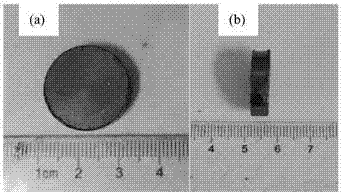
Figure 1 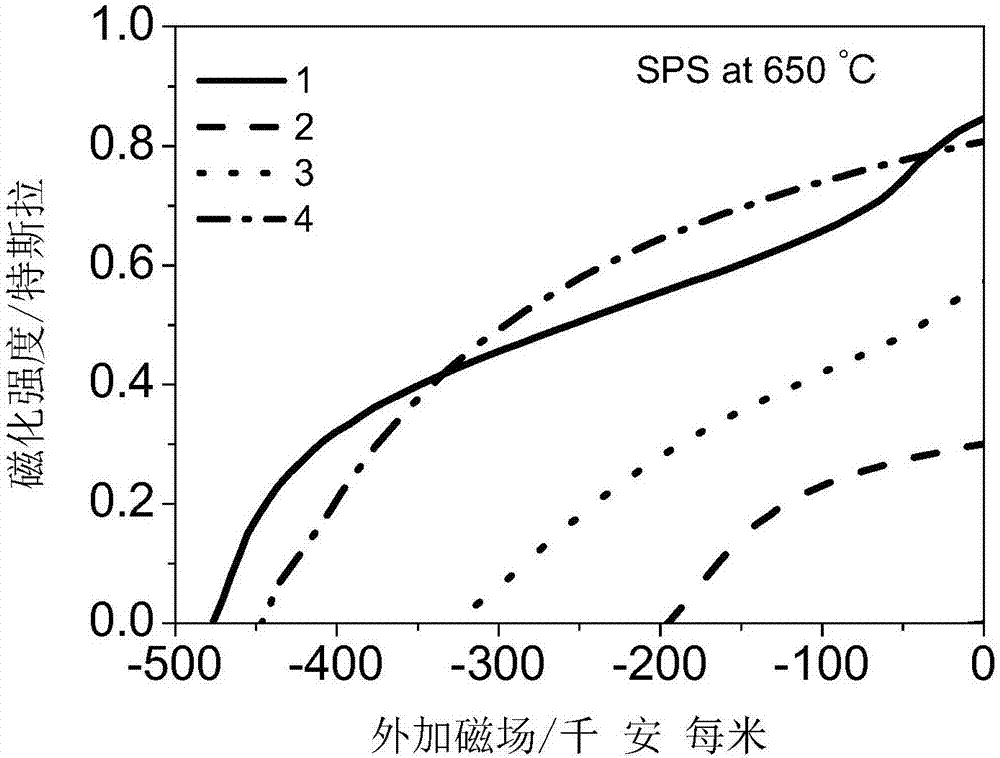
Figure 2 
Figure 3
Abstract
Description
technical field
[0001] The present invention relates to the field of rare earth permanent magnet materials, in particular to a low-cost and cost-effective nanometer magnetic powder prepared by spark plasma sintering technology from rare earth-rich nanocrystalline rare earth-iron-boron and iron-rich nanocomposite rare earth-iron-boron magnetic powder. Crystal rare earth permanent magnet and its preparation method. Background technique
[0002] As the most widely used rare earth permanent magnet material, NdFeB is called the "magnet king" because of its excellent magnetic properties. A large number of NdFeB materials are used in nuclear magnetic resonance imaging, electric bicycles, electric vehicles, speakers, magnetic recording, magnetic separation systems, etc. every year. With the continuous growth of the NdFeB industry, the raw materials Nd and Pr alloy resources used in NdFeB magnets are becoming more and more scarce. La, Ce, Y, etc., as abundant rare earth elements (R...
Examples
Embodiment 1
[0033] Sieve the commercial nanocomposite Nd-Fe-B (rare earth 10%, Fe 84%, B 6%) magnetic powder, and screen the magnetic powder with a particle size of 105-300 μm. Take 10g of magnetic powder and put it into a graphite mold with a diameter of 20mm, and then sinter it on SPS-825 spark plasma sintering equipment. The sintering pressure is 50MPa. Set the sintering temperature T sps is 650°C, the heating time is 7min, and the sintering holding time is t sps For 7min, the vacuum degree during sintering is less than 6Pa. This sintered sample is designated as No. 1 sample.
Embodiment 2
[0035] According to the alloy composition ratio Ce 17 Fe 78 B 6 (Atomic percentage) Ce, Fe and FeB alloys with a purity greater than 99.95% were weighed, and the weighed alloys were put into an electric arc melting furnace to be melted into button-shaped ingots. The ingot was broken into small pieces of 3-5g. In the belt throwing machine, under the protection of Ar gas and the roll speed of 18m / s, alloy thin strips were obtained by melt quenching technology.
[0036] Ce will be obtained 17 Fe 78 B 6 Put the alloy strip into a glove box, grind it into magnetic powder with a mortar, and then sieve the magnetic powder with a particle size of 105-300 μm. Take Ce with a mass of 10g 17 Fe 78 B 6 The magnetic powder is put into a graphite mold with a diameter of 20mm, and then sintered on the SPS-825 spark plasma sintering equipment. The sintering pressure is 50MPa. Set the sintering temperature T sps is 650°C, the heating time is 7min, and the sintering holding time is t...
Embodiment 3
[0038] MQ magnetic powder (Example 1) with a particle size of 105-300 μm and a mass fraction of 50% and 50% of Ce 17 Fe 78 B 6 A total of 10 g of magnetic powder (Example 2) was put into a graphite mold with a diameter of 20 mm, and sintered on a SPS-825 spark plasma sintering equipment. The sintering pressure is 50MPa. Set the sintering temperature T sps is 650°C, the heating time is 7min, and the sintering holding time is t spsFor 7min, the vacuum degree during sintering is less than 6Pa. This sintered sample is designated as sample No. 3.