
A kind of preparation method and obtained product of iron ion-doped carbon nitride nanotube
A carbon nitride and iron ion technology is applied in the preparation of carbon nitride nanotubes and the preparation of ion-doped carbon nitride, which can solve the problems of uneven ion doping and easy oxidation of doped ions, and achieve high Reactivity, improved separation and transfer, good reproducibility
Patent Information
- Authority / Receiving Office
- CN · China
- Patent Type
- Patents(China)
- Current Assignee / Owner
- Publication Date
- 2020-07-07
- Estimated Expiration
- Not applicable · inactive patent
Smart Images
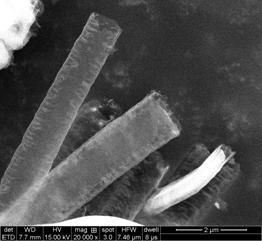
Figure 1 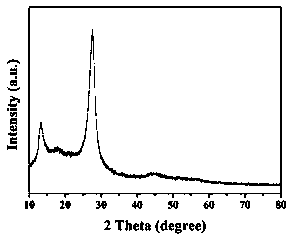
Figure 2 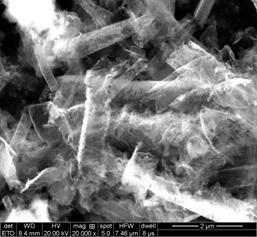
Figure 3
Abstract
Description
technical field
[0001] The invention relates to a method for preparing ion-doped carbon nitride, in particular to a method for preparing iron ion-doped carbon nitride nanotubes and the resulting product, and belongs to the technical field of semiconductor material preparation. Background technique
[0002] As a non-toxic, easy-to-synthesize, stable physical and chemical properties, narrow bandgap (band gap about 2.7 eV) and high earth content organic semiconductor, carbon nitride has attracted widespread attention in recent years. Carbon nitride in the graphite phase has a graphene-like layered structure and has a series of properties similar to graphene, so people have conducted a lot of exploration on it and applied it to photocatalytic degradation and photocatalytic hydrogen production. , analytical chemistry and many other fields.
[0003] For carbon nitride, increasing carbon nitride active sites and ion doping are effective means to improve the separation and transfer...
Examples
Embodiment 1
[0033] 1.1 Reflux 2 g of melamine and 100 ml of deionized water at 100 °C until the melamine is completely dissolved to obtain an aqueous solution of melamine.
[0034] 1.2 Make anhydrous ferric chloride into ferric chloride aqueous solution with a concentration of 0.02 g / ml, add 100 microliters of ferric chloride aqueous solution into melamine aqueous solution, and reflux at 100°C for 30 min under stirring to make melamine and ferric chloride Mix well.
[0035] 1.3 Lower the temperature of the solution in 1.2 above in stages. The specific operation is: lower the temperature of the solution in 1.2 above 100°C at a cooling rate of 1°C / min until it drops to room temperature. During the cooling process, crystals gradually precipitate.
[0036] 1.4 After the crystallization is complete, the precipitated crystals are taken out from the solution, and the solution on the crystals is blotted dry on filter paper to obtain iron-doped melamine crystals.
[0037] 1.5 The iron-doped melam...
Embodiment 2
[0042] 2.1 Reflux 2 g of melamine and 100 ml of deionized water at 100 °C until the melamine is completely dissolved to obtain an aqueous solution of melamine.
[0043]2.2 Make anhydrous ferric chloride into ferric chloride aqueous solution with a concentration of 0.02 g / ml, add 500 microliters of ferric chloride aqueous solution into melamine aqueous solution, and reflux at 100°C for 30 min under stirring to make melamine and ferric chloride Mix well.
[0044] 2.3 Lower the temperature of the solution in 2.2 above in stages. The specific operation is: lower the temperature of the 100°C solution in 2.2 above at a cooling rate of 1°C / min until it drops to room temperature. During the cooling process, crystals gradually precipitate.
[0045] 2.4 After the crystallization is complete, the precipitated crystals are taken out from the solution, and the solution on the crystals is blotted dry on filter paper to obtain iron-doped melamine crystals.
[0046] 2.5 The iron-doped melami...
Embodiment 3
[0050] 3.1 Reflux 2 g of melamine and 100 ml of deionized water at 100 °C until the melamine is completely dissolved to obtain an aqueous solution of melamine.
[0051] 3.2 Make anhydrous ferric chloride into ferric chloride aqueous solution with a concentration of 0.02 g / ml, add 1 ml of ferric chloride aqueous solution into melamine aqueous solution, and reflux at 100°C for 30 min under stirring to fully dissolve melamine and ferric chloride. well mixed.
[0052] 3.3 Lower the temperature of the solution in 3.2 above in stages. The specific operation is: lower the temperature of the 100°C solution in 3.2 above at a cooling rate of 1°C / min until it drops to room temperature. During the cooling process, crystals gradually precipitate.
[0053] 3.4 After the crystallization is complete, the precipitated crystals are taken out from the solution, and the solution on the crystals is blotted dry on filter paper to obtain iron-doped melamine crystals.
[0054] 3.5 The iron-doped mel...