
Flexible supercapacitor with nickel sulfide-molybdenum sulfide heterogeneous nano-sheet array structure based on carbon cloth loading and preparation method thereof
A nanosheet array and supercapacitor technology, which is applied in the manufacture of hybrid/electric double layer capacitors, hybrid capacitor electrodes, etc., can solve the problems of poor compatibility and difficulty in growing active materials
Patent Information
- Authority / Receiving Office
- CN · China
- Current Assignee / Owner
- Publication Date
- 2018-12-21
Smart Images
Figure 1 
Figure 2 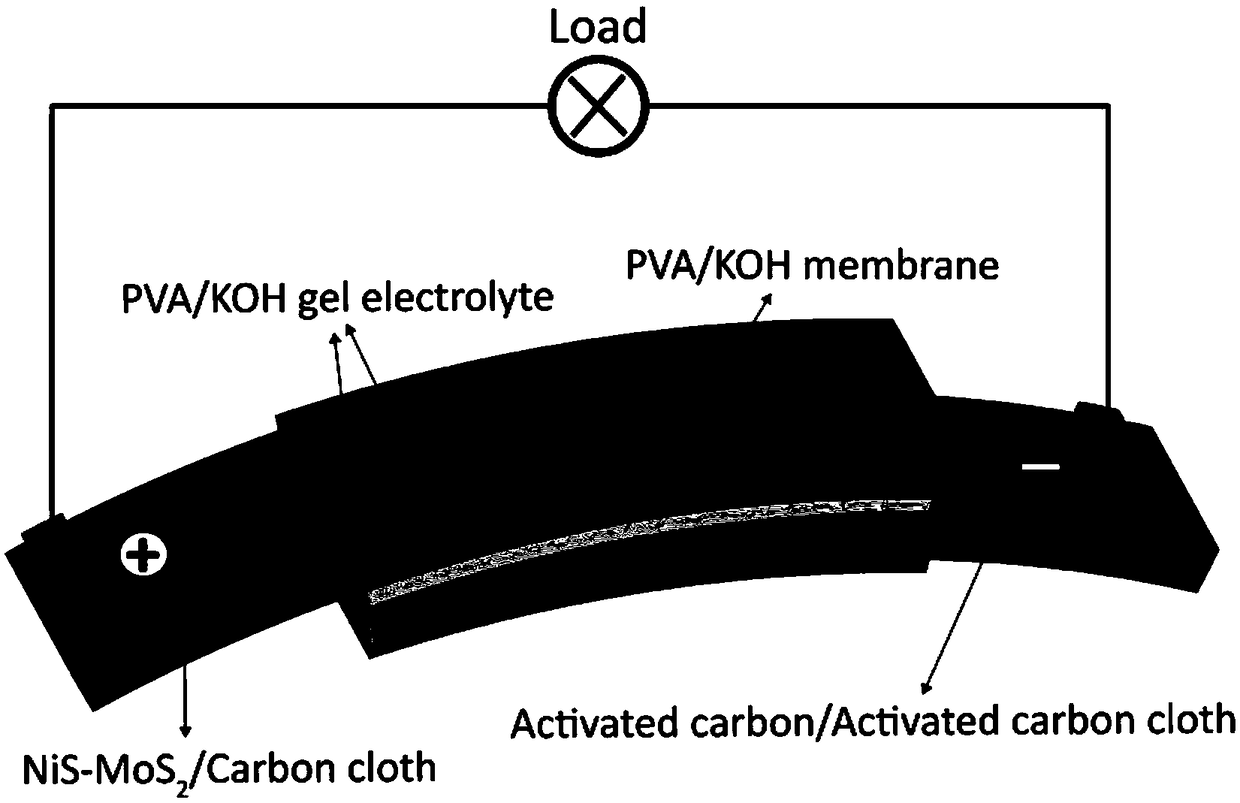
Figure 3
Abstract
Description
technical field
[0001] The invention relates to a flexible supercapacitor with a carbon cloth-loaded nickel sulfide-molybdenum sulfide heterogeneous nanosheet array structure and a preparation method thereof, belonging to the technical field of new energy materials and device preparation. Background technique
[0002] Supercapacitor is a general term for a class of energy storage devices with light weight, fast charging speed, long service life, high power density and low cost of use. Since the concept of supercapacitor came out, its research has attracted much attention. According to their different energy storage mechanisms, supercapacitors can be divided into two categories: double-layer capacitors and pseudocapacitors. Among them, double-layer capacitive capacitors mainly rely on the adsorption-desorption process on the electrode surface to store and release electrical energy, which is characterized by fast charge and discharge speed, high power density, and good cycle ...
Examples
preparation example Construction
[0050] NiS-MoS based on carbon cloth supported by the present invention 2 A method for preparing a flexible supercapacitor with a heterogeneous nanosheet array structure, comprising the following steps and contents:
[0051] (1) Cleaning of the carbon cloth: The carbon cloth was ultrasonically cleaned in advance with acetone, 1-2 mol / L hydrochloric acid aqueous solution, and deionized water for 0.5-1 hour in sequence, dried at 60°C, and stored for later use.
[0052] (2) Preparation of anode material: Put commercially available analytically pure nickel acetate, ammonium molybdate, thiourea and sodium lauryl sulfate powder into a beaker, then add deionized water and stir to make it evenly mixed, and control the mixing solution The concentration of nickel acetate is 0.03-0.05mol / L, the concentration of ammonium molybdate is 0.001-0.005mol / L, the concentration of thiourea is 0.05-0.08mol / L, and the concentration of sodium lauryl sulfate is 0.15-0.25mol / L ; Utilize the sodium hyd...
Embodiment 1
[0061] Embodiment 1: The preparation steps of the supercapacitor of this embodiment are as follows in sequence:
[0062] (1) Two 2×4cm carbon cloths were ultrasonically cleaned with acetone, 1mol / L hydrochloric acid aqueous solution and deionized water for 1 hour in advance, dried at 60°C, and stored for later use.
[0063] (2) In a 100mL beaker, add 0.224g nickel acetate, 0.074g ammonium molybdate, 0.137g thiourea and 1.73g sodium lauryl sulfate in sequence, then add 30mL deionized water and stir until the solution is clear; then slowly Add an appropriate amount of 0.5mol / L sodium hydroxide aqueous solution dropwise to adjust the pH value of the reactant mixed solution to 6.2; Immerse it vertically in the solution, seal the reaction vessel; then put it into an electric furnace and heat it to 180°C at a speed of 5°C / min and react for 9 hours. After naturally cooling to room temperature, open the reactor, take out the carbon cloth, rinse it with deionized water and alcohol alt...