
Chiral 2-aromatic methylene naphthenic alcohol and asymmetric synthesizing method thereof
A technology for arylmethylenecycloalkanol and its synthesis method, which is applied in the field of chiral 2-arylmethylenecycloalkanol and its asymmetric synthesis, can solve the problems of high price of chiral ligands, and achieve mild reaction conditions , simple synthesis and convenient experimental operation
Patent Information
- Authority / Receiving Office
- CN · China
- Patent Type
- Applications(China)
- Current Assignee / Owner
- Publication Date
- 2019-01-01
Smart Images
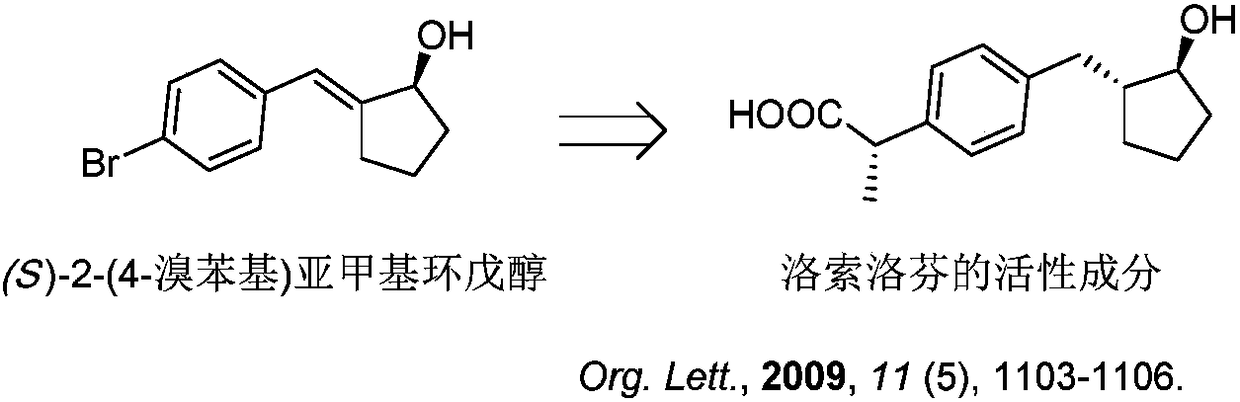
Figure 1 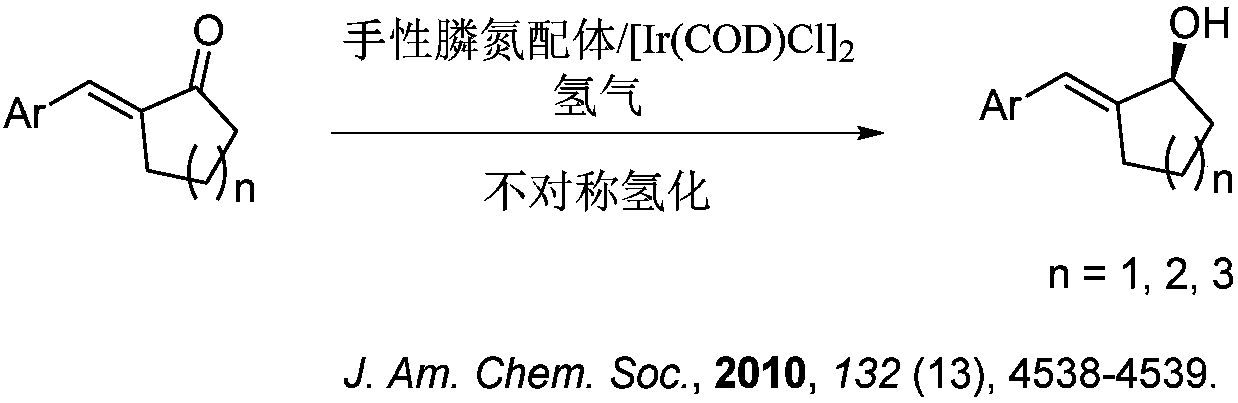
Figure 2 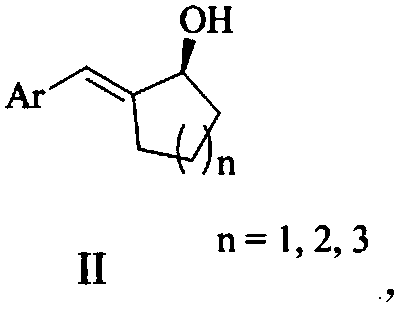
Figure 3
Abstract
Description
technical field
[0001] The invention belongs to the technical field of asymmetric catalysis, and in particular relates to a chiral 2-arylmethylenecycloalkanol and an asymmetric synthesis method thereof. Background technique
[0002] 2-Arylmethylenecycloalkanols are intermediates in the synthesis of many natural products, drugs, pesticides, and biologically active substances. For example, the non-steroidal anti-inflammatory drug loxoprofen is used for chronic rheumatoid arthritis, osteoarthritis, low back pain, periarthritis of the shoulder, neck, shoulder and wrist syndrome, as well as analgesia and pain relief after surgery, trauma, and tooth extraction. Aspects such as anti-inflammation have extensive application, and (S)-2-(4-bromophenyl) methylene cyclopentanol is the key chiral intermediate (Org.Lett.,2009,11 (5), 1103–1106).
[0003]
[0004] The development of a new method for the asymmetric synthesis of chiral 2-arylmethylenecycloalkanols with simple operation, ...
Examples
Embodiment 1
[0027] Embodiment 1: the synthesis of (E)-2-phenylmethylene cyclohexanol
[0028]
[0029] Add 0.2mmol (E)-2-phenylmethylenecyclohexanone to a 10ml sealed test tube, add 1 mmol formic acid / triethylamine, add 0.004mmol catalyst, 1mL solvent, seal the test tube, and react at 30°C for 6 Hour. After the reaction was finished, the reaction was washed with water, the aqueous phase was extracted 3 times with ethyl acetate, the combined organic phase was concentrated to dryness, and the product was separated by column chromatography (petroleum ether: ethyl acetate=10:1), and the enantiomeric excess (ee ) value. HPLC separation conditions: chiral column OD-H column, mobile phase: n-hexane / isopropanol=90:10 (volume ratio), flow rate: 1.0 ml / min, wavelength: 254 nm, column temperature: 30 degrees Celsius, t 1 = 6.41 minutes, t 2 = 7.79 minutes; 1 H NMR (400MHz, CDCl 3 ):δ=7.37(t,J=7.6Hz,2H,Ar–H), 7.26(t,J=6.8Hz,3H,Ar–H),6.57(s,1H,C=CH),4.31–4.27 (m,1H,OCH), 2.80-2.73(m,1H,CH 2 ...
Embodiment 2
[0032] Embodiment 2: the synthesis of (E)-2-(3-methoxybenzylidene) cyclohexanol
[0033]
[0034] Add 0.2mmol (E)-2-(3-methoxybenzylidene)cyclohexanone to a 10ml sealed test tube, add 1mmol formic acid / triethylamine (1.1:1), add 0.004mmol catalyst E, Chloroform 1mL, seal the test tube, and react at 30°C for 6 hours. After the reaction was finished, it was washed with water, the aqueous phase was extracted 3 times with ethyl acetate, the combined organic phases were concentrated to dryness, and the isolated yield was 86% (petroleum ether: ethyl acetate=10:1), and the enantiomeric excess of 82% was determined by HPLC. ee value. HPLC separation conditions: chiral column OD-H column, mobile phase: n-hexane / isopropanol=90:10 (volume ratio), flow rate: 1.0 ml / min, wavelength: 254 nm, column temperature: 30 degrees Celsius, t 1 = 10.12 minutes, t 2 = 14.05 minutes; 1 H NMR (400MHz, CDCl 3 ):δ=7.27(d,J=8.4Hz,1H,Ar–H),6.87-6.81(m,3H,Ar–H),6.54(s,1H,C=CH),4.29–4.26(m, 1H,OCH),3...
Embodiment 3
[0035] Embodiment 3: the synthesis of (E)-2-(2-methylbenzylidene) cyclohexanol
[0036]
[0037] Add 0.2 mmol (E)-2-(2-methylbenzylidene) cyclohexanone to a 10 ml sealed test tube, add 1 mmol formic acid / triethylamine (1.1:1), add 0.004 mmol catalyst E, Chloroform 1mL, seal the test tube, and react at 30°C for 6 hours. After the reaction was finished, it was washed with water, the aqueous phase was extracted 3 times with ethyl acetate, the combined organic phases were concentrated to dryness, the separation yield was 80% (petroleum ether: ethyl acetate=10:1), and the enantiomeric excess of 83% was determined by HPLC. ee value. HPLC separation conditions: chiral column OD-H column, mobile phase: n-hexane / isopropanol=90:10 (volume ratio), flow rate: 1.0 ml / min, wavelength: 254 nm, column temperature: 30 degrees Celsius, t 1 = 5.87 minutes, t 2 = 6.86 minutes; 1 H NMR (400MHz, CDCl3 ):δ=7.24-7.17(m,3H,Ar–H),7.15-7.12(m,1H,Ar–H),6.51(s,1H,C=CH),4.33–4.30(m,1H,OCH ),2.59-2....