
Preparation method of tert-butyl-1,8-dioxa-4,11-diazaspiro[5.6]dodecane-11-carboxylate
A diazaspiro, tert-butyl technology, applied in the field of tert-butyl-1,8-dioxa-4,11-diazaspiro[5.6]dodecane-11-carboxylate production , can solve the problem of no suitable industrial synthesis method, etc., and achieve the effect of reasonable reaction process design, easy reaction and short route
Patent Information
- Authority / Receiving Office
- CN · China
- Patent Type
- Patents(China)
- Current Assignee / Owner
- Publication Date
- 2022-05-17
Smart Images
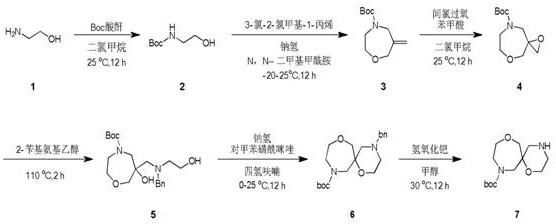
Figure 1
Abstract
Description
technical field
[0001] The invention relates to a synthesis method of compound tert-butyl-1,8-dioxa-4,11-diazaspiro[5.6]dodecane-11-carboxylate. Background technique
[0002] The compound tert-butyl-1,8-dioxa-4,11-diazaspiro[5.6]dodecane-11-carboxylate (CAS: 1251010-99-7) and related derivatives in Medicinal Chemistry It has wide applications in organic synthesis. At present, there are few reports on the synthesis of tert-butyl 1,8-dioxa-4,11-diazaspiro[5.6]dodecane-11-carboxylate. Therefore, it is necessary to develop a synthetic method that is easy to obtain raw materials, easy to operate, easy to control the reaction, suitable for overall yield, and suitable for industrial production. Contents of the invention
[0003] The purpose of the present invention is to develop a tert-butyl 1,8-dioxa-4,11-diazaspiro[5.6]dodecane with easy to obtain raw materials, convenient operation, easy to control reaction and high yield Synthesis of alkane-11-carboxylates. It mainly solv...
Examples
Embodiment
[0012] Step 1: Compound 1 was dissolved in dichloromethane (1.2 L), and Boc anhydride (480 g, 2.2 mol) dissolved in dichloromethane (600 mL) was added at 20°C. The reaction was then stirred at room temperature 25°C for 12 hours. TLC showed that the reaction of the raw materials was complete, and the reaction solution was washed successively with saturated aqueous sodium bicarbonate (600 mL) and saturated brine (600 mL), and then dried over anhydrous sodium sulfate. The organic phase was dried under vacuum to obtain compound 2 (340 g) as a colorless oil.
[0013] Step 2: Dissolve 3-chloro-2-chloromethyl-1-propene (11.7 g, 0.073 mol) in N,N-dimethylformamide (120 mL), cool to -20°C and add sodium hydrogen (3.7 g, 0.154 mol). After 30 minutes, compound 2 dissolved in N,N-dimethylformamide (20 mL) was added to the reaction system. Then return to room temperature 25°C and stir for 12 hours. The reaction solution was diluted with water (1.4 L) and extracted with methyl tert-buty...