
Preparation method of 2-(2-(tert-butyloxycarbonyl)-2-azaspiro [3.4] octane-5-yl) acetic acid
A technology of butoxycarbonyl and azaspiro, which is applied in the field of compound synthesis, can solve the problems of no literature reports on the synthesis method, and achieve the effects of reasonable reaction process design, easy reaction and short route
Patent Information
- Authority / Receiving Office
- CN · China
- Current Assignee / Owner
- Publication Date
- 2021-03-26
Smart Images

Figure 1 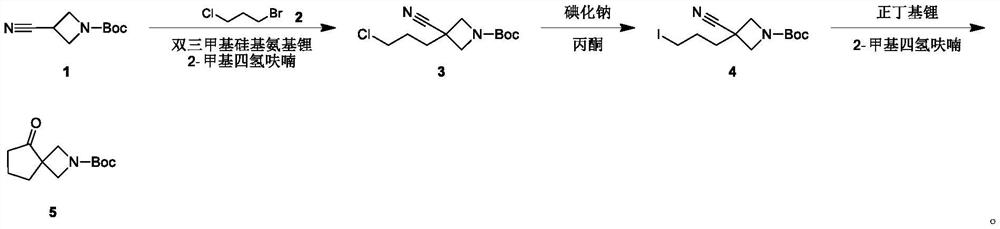
Figure 2 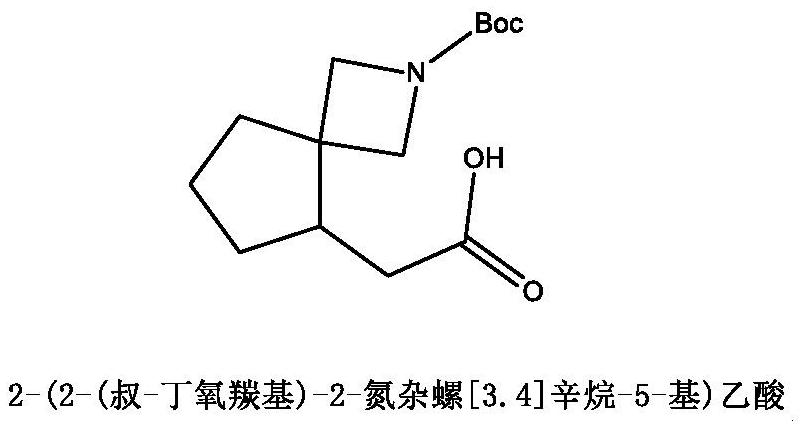
Figure 3
Abstract
Description
technical field
[0001] The invention relates to a compound synthesis method, in particular to a compound 2-(2-(tert-butoxycarbonyl)-2-azaspiro[3.4]octane-5-yl)acetic acid preparation method. Background technique
[0002] Compared with foreign competitors, Chinese pharmaceutical companies are often plagued by technical and financial problems, unable to effectively carry out new drug research and development, and can only simply repeat the production or imitate foreign patent expired drugs. The products lack international competitiveness, and the domestic market also suffers. The serious threat of imported western medicines, and the discovery of lead compounds is the only way to discover innovative drugs. Due to the long cycle of new drug development (8-10 years) and high cost (800-100 million US dollars), most developed countries currently adopt the method of "many, fast, high, and low cost"—combinatorial chemical technology platform to speed up the development of small molec...
Examples
Embodiment 1
[0036] The reaction formula of embodiment 1 is as follows:
[0037]
[0038] This embodiment adopts the following steps:
[0039] Step 1: Prepare a 10-liter three-necked bottle, mechanical stirring, thermometer, and dropping funnel. Compound 1 (191g, 1.05mol, 1.00eq) and compound 2 (187g, 1.19mol, 1.13eq) were dissolved in 2-methyltetrahydrofuran (2000mL), cooled to -60°C with dry ice, and then slowly added dropwise Lithium methylsilylamide (1.0M, tetrahydrofuran solution, 1100mL, 1.05eq), the temperature does not exceed -60°C, drop it in about 2 hours, and stir at -70°C for 2 hours after the dropwise addition. TLC showed the starting material was completely reacted. The reaction solution was quenched with 10% aqueous ammonium chloride solution (900mL), diluted with water (800mL), then extracted twice with methyl tert-butyl ether (600mL), and the organic phases were combined with 20% aqueous citric acid solution (1500mL) and saturated Each was washed once with saline (80...
Embodiment 2
[0047] The reaction formula of embodiment 2 is as follows:
[0048]
[0049] This embodiment adopts the following steps:
[0050] Step 1: Prepare a 10-liter three-necked bottle, mechanical stirring, thermometer, and dropping funnel. Compound 1 (191g, 1.05mol, 1.00eq) and compound 2 (187g, 1.19mol, 1.13eq) were dissolved in 2-methyltetrahydrofuran (2000mL), cooled to -60°C with dry ice, and then slowly added dropwise Lithium methylsilylamide (1.0M, tetrahydrofuran solution, 1100mL, 1.05eq), the temperature does not exceed -60°C, drop it in about 2 hours, and stir at -70°C for 2 hours after the dropwise addition. TLC showed the starting material was completely reacted. The reaction solution was quenched with 10% aqueous ammonium chloride solution (900mL), diluted with water (800mL), then extracted twice with methyl tert-butyl ether (600mL), and the organic phases were combined with 20% aqueous citric acid solution (1500mL) and saturated Each was washed once with saline (80...
Embodiment 3
[0058] The reaction formula of embodiment 3 is as follows:
[0059]
[0060] This embodiment adopts the following steps:
[0061] Step 1: Prepare a 10-liter three-necked bottle, mechanical stirring, thermometer, and dropping funnel. Compound 1 (191g, 1.05mol, 1.00eq) and compound 2 (187g, 1.19mol, 1.13eq) were dissolved in 2-methyltetrahydrofuran (2000mL), cooled to -60°C with dry ice, and then slowly added dropwise Lithium methylsilylamide (1.0M, tetrahydrofuran solution, 1100mL, 1.05eq), the temperature does not exceed -60°C, drop it in about 2 hours, and stir at -70°C for 2 hours after the dropwise addition. TLC showed the starting material was completely reacted. The reaction solution was quenched with 10% aqueous ammonium chloride solution (900mL), diluted with water (800mL), then extracted twice with methyl tert-butyl ether (600mL), and the organic phases were combined with 20% aqueous citric acid solution (1500mL) and saturated Each was washed once with saline (80...