
Compositions and methods for treating hiv/aids with immunotherapy
A technology of combining structural domains and chimeric antigen receptors, applied in biochemical equipment and methods, chemical equipment and methods, for targeting specific cell fusion, etc., can solve problems such as reducing therapeutic efficacy
Patent Information
- Authority / Receiving Office
- CN · China
- Patent Type
- Applications(China)
- Current Assignee / Owner
- Publication Date
- 2020-11-17
Smart Images
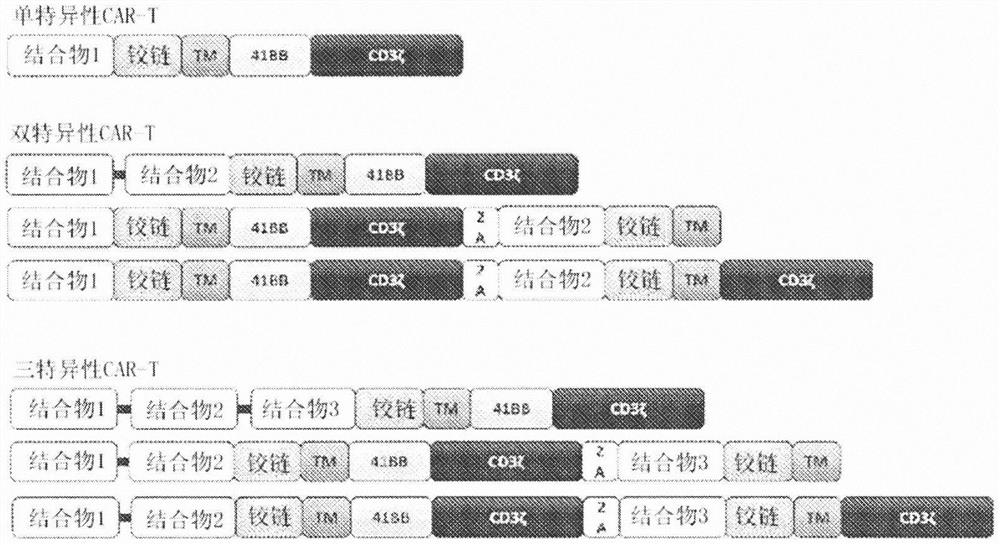
Figure 1 
Figure 2 
Figure 3
Abstract
Description
[0001] Cross References to Related Applications
[0002] This application claims priority under 35 U.S.C Section 119(e) to U.S. Provisional Patent Application No. 62 / 608,479, filed December 20, 2017, U.S. Provisional Patent Application No. 62 / 660,819, filed April 20, 2018 rights and interests, the entire contents of each of which are incorporated herein by reference.
[0003] sequence listing
[0004] This application contains a Sequence Listing that has been filed electronically in ASCII format and is hereby incorporated by reference in its entirety. The ASCII copy created on December 18, 2018 is named SequenceListing.txt and is 232 kilobytes in size.
[0005] Statement Regarding Federally Sponsored Research or Development
[0006] Not applicable technical field
[0007] The present application relates to the field of diseases associated with human immunodeficiency virus / acquired immunodeficiency syndrome (HIV, HIV / AIDS) infection, in particular to protein binding domains...
Examples
Embodiment 1
[0473] Assembly of HIV-specific binders into functional CAR molecules
[0474] This example describes the general method used to construct monospecific, bispecific and trispecific anti-HIV CARs comprising mD1.22, m36.4 and C46 peptides, and how to express these CARs on the surface of primary T cells.
[0475] Materials and methods:
[0476] Generation of lentiviral vector constructs
[0477] The CAR antigen-binding domain sequence is derived from published sequences (Chen et al., J. Virol. 2014; 88: (2) 1125-1139; Chen et al., Antiviral Research 2010; 88: (1) 107-115; Egerer et al., Molecular Therapy 2010;19:(7)1236-1244) and were synthesized by ATUM (formerly DNA2.0; Newark, CA) or IDT Technologies (IA, Coralville). Synthetic gene fragments were subcloned in-frame onto an MSCV promoter-based lentiviral backbone comprising the CD8 linker / hinge, CD8 transmembrane domain, 41-BB, and CD3ζ signaling domain. For bicistronic bispecific and trispecific CAR constructs, the cleavabl...
Embodiment 2
[0491] Novel bispecific and trispecific anti-HIV CARs potently destroy HIV envelope targets
[0492] This example describes the functional characterization of anti-HIVCAR as determined by a highly sensitive luciferase-based cytotoxicity assay. Additionally, T cell activation was determined by quantification of cytokine secretion in the absence and presence of HIV-envelope expressing target cells.
[0493] Materials and methods:
[0494] Cell Lines Used for Functional Characterization
[0495] The 293T cell line was engineered to stably express the single-chain full-length HIV envelope protein (293T-Env) and was generously provided by Dr. Dimiter Dimitrov (NCI, Fort Detrick, MD). Briefly, 293T-Env cells were grown in Dulbecco's modified eagle medium (DMEM) in the presence of 10% fetal bovine serum and 60 μg / ml zeocin to maintain selection . To generate luciferase-expressing cells, 293T-Env cells were transduced with a lentiviral vector containing the firefly luciferase gene...
Embodiment 3
[0516] Bispecific and trispecific anti-HIV duoCAR-T cells broadly and potently eliminate HIV-infected PBMCs in vivo and in vitro
[0517] This example interrogates the anti-HIV CAR-T cell killing potency and the susceptibility of CAR-T cells to HIV-1 infection after in vitro and in vivo challenge of PBMCs infected with different Env-IMC-LucR HIV-1 viruses.
[0518] Materials and methods:
[0519] In vitro potency of an anti-HIV CAR using a replication-competent Env-IMC-LucR molecular clone to infect donor-matched PBMCs
[0520] Inhibition of HIV-1 infection was investigated using a replication-competent HIV-1 molecular clone containing the desired heterologous HIV-1 envelope upstream of the Renilla luciferase ORF in frame (Env-IMC-LucR) . Infectious clones were generated as previously described (Edmonds et al., Virology 2010, 408: 1-13). HIV-1 infection of PBMC or CD4 + Following T cells, Renilla luciferase expression was used as a highly sensitive and quantifiable measure o...