
Methods for predicting the survival time of patients with decompensated alcoholic cirrhosis
Patent Information
- Authority / Receiving Office
- US · United States
- Patent Type
- Patents(United States)
- Current Assignee / Owner
- Publication Date
- 2020-10-06
Smart Images
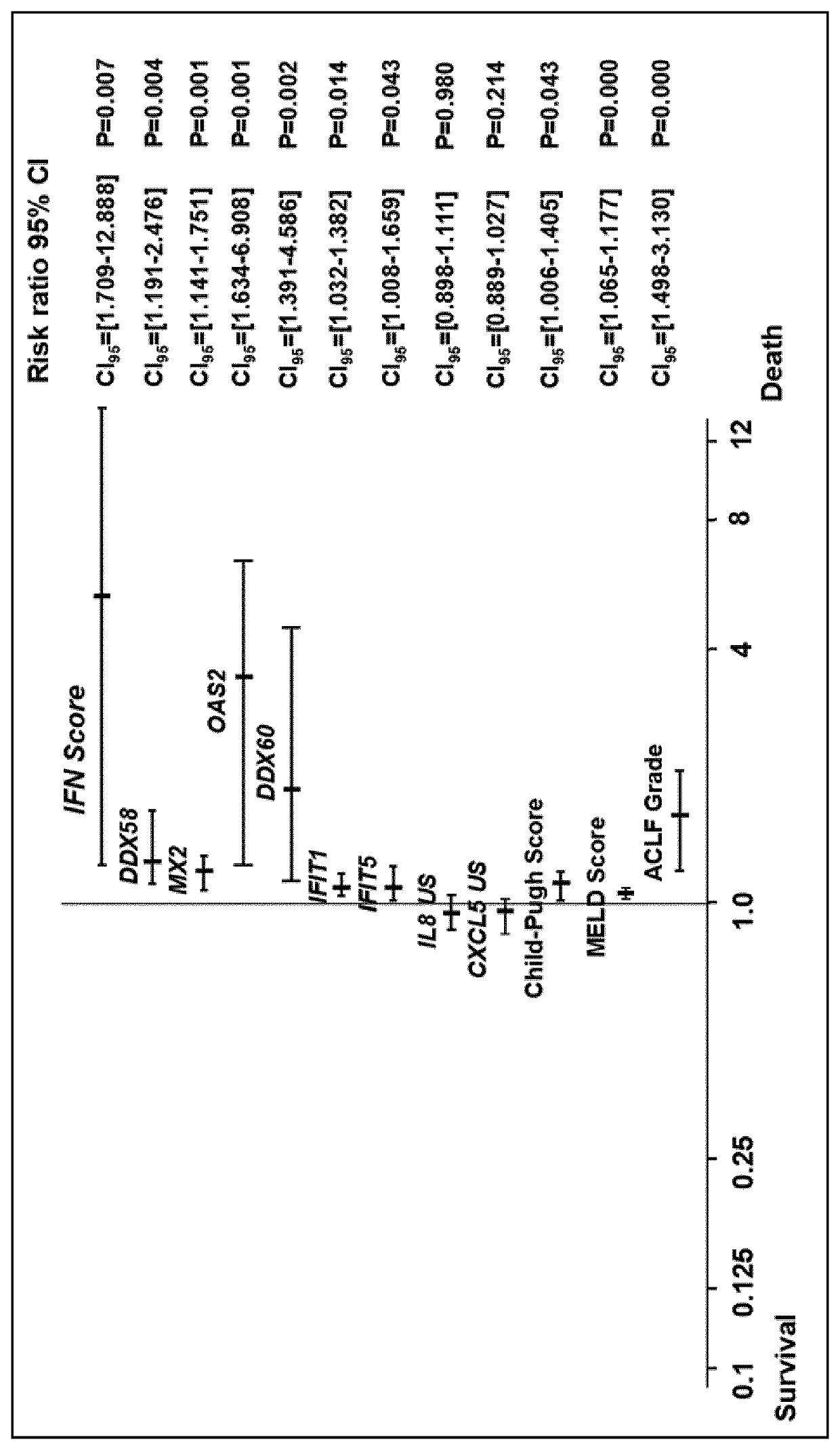
Figure 1
Abstract
Description
FIELD OF THE INVENTION
[0001] The present invention relates to methods for predicting the survival time of patients with decompensated alcoholic cirrhosis.BACKGROUND OF THE INVENTION
[0002] Cirrhosis is a chronic disease of the liver whose prevalence will dramatically increase during the next decade. Cirrhosis can result from a number of chronic liver diseases such as alcoholic liver disease, chronic viral hepatitis, non-alcoholic steatohepatitis, autoimmune diseases of the liver (primary biliary cirrhosis, primary sclerosing cholangitis, and autoimmune hepatitis). Cirrhosis progresses over several years. The occurrence of complications indicates the transition to the phase called “decompensated” (approximately 100,000 patients per year in France); These complications include ascites (30 000 patients per year in France), gastrointestinal bleeding (10,000 episodes / year in France), renal failure and bacterial infections which is very common and often due to the translocation of Gram-negat...
Examples
example 1
[0042]Patients and Methods
[0043]I—Patients
[0044]This protocol has been approved by the ethic committee (Comité de protection des personnes Ile de France III) and informed consent was obtained from every patients. 94 cirrhotic patients from the Liver Disease department of Beaujon Hospital (Assistance Publique—Hôpitaux de Paris, Clichy, 92110, France) were selected according the prerequisites of each experiment. As mentioned in the method section of part 1, patients enrolled in the study had severe decompensated biopsy-proven alcoholic cirrhosis. However, they were stable and did not have untreated or recently treated (less than 1 week) bacterial infection or gastrointestinal bleeding. Global characteristics of the patients are displayed in Table 1. Healthy subjects were selected among healthy caregivers. Fifteen to twenty milliliters of venous blood was sampled in 3 mL EDTA tubes (Becton Dickinson, France) from patients and healthy subjects. Clinical and biological data were collecte...
example 2
[0089]Baseline ISG Expression is Related to Outcome in Cirrhosis
[0090]The inventors prospectively followed-up a cohort of patients after measurement of PBMC ISG expression at enrollment. Forty-one patients died during a median follow-up of 6.55 (1.32-12.60) months. A univariate Cox model showed that higher mortality was significantly associated with a higher model of end-stage liver disease (MELD) score, a higher IFN score in unstimulated cells, and higher expressions of DDX58, MX2, OAS2, DDX60, IFI44, IFIT1, IFIT5 and IRF1 in unstimulated cells (FIG. 1; Table 5). Unlike ISGs, cytokine gene expression (including the ISG CXCL10) did not significantly predict death in unstimulated cells (FIG. 1; Table 5). Only one (IFI35) of the genes measured in LPS-stimulated cells significantly predicted death (Table 5). Bivariate analysis including the baseline IFN and MELD scores only showed the former to be significantly predictive of death (Table 6). These results are mainly explained by the in...