
Method for synthesizing high adsorptive nanometer scale titanium dioxide solution
Patent Information
- Authority / Receiving Office
- US · United States
- Current Assignee / Owner
- Publication Date
- 2005-12-01
- Estimated Expiration
- Not applicable · inactive patent
Smart Images
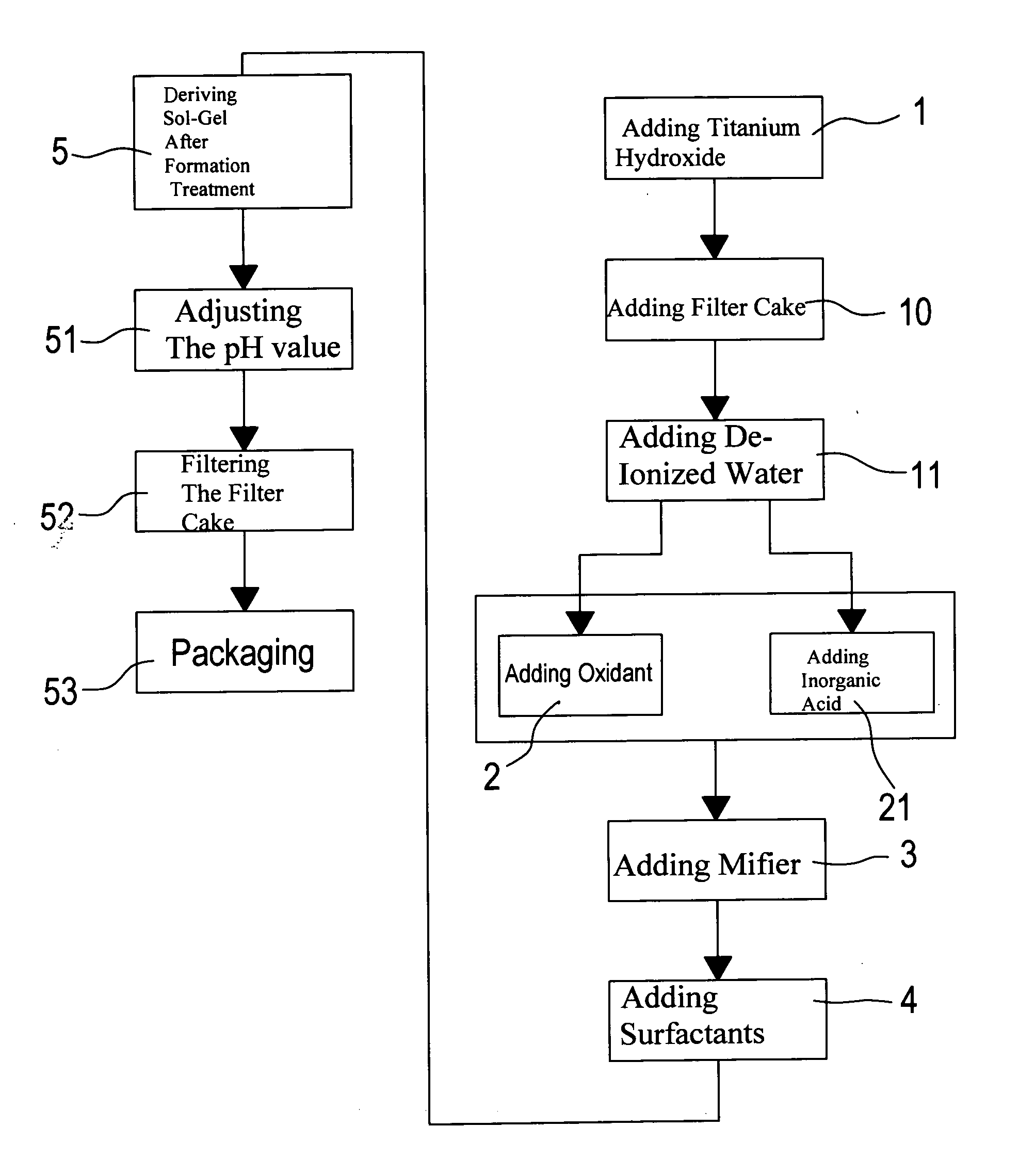
Figure 1 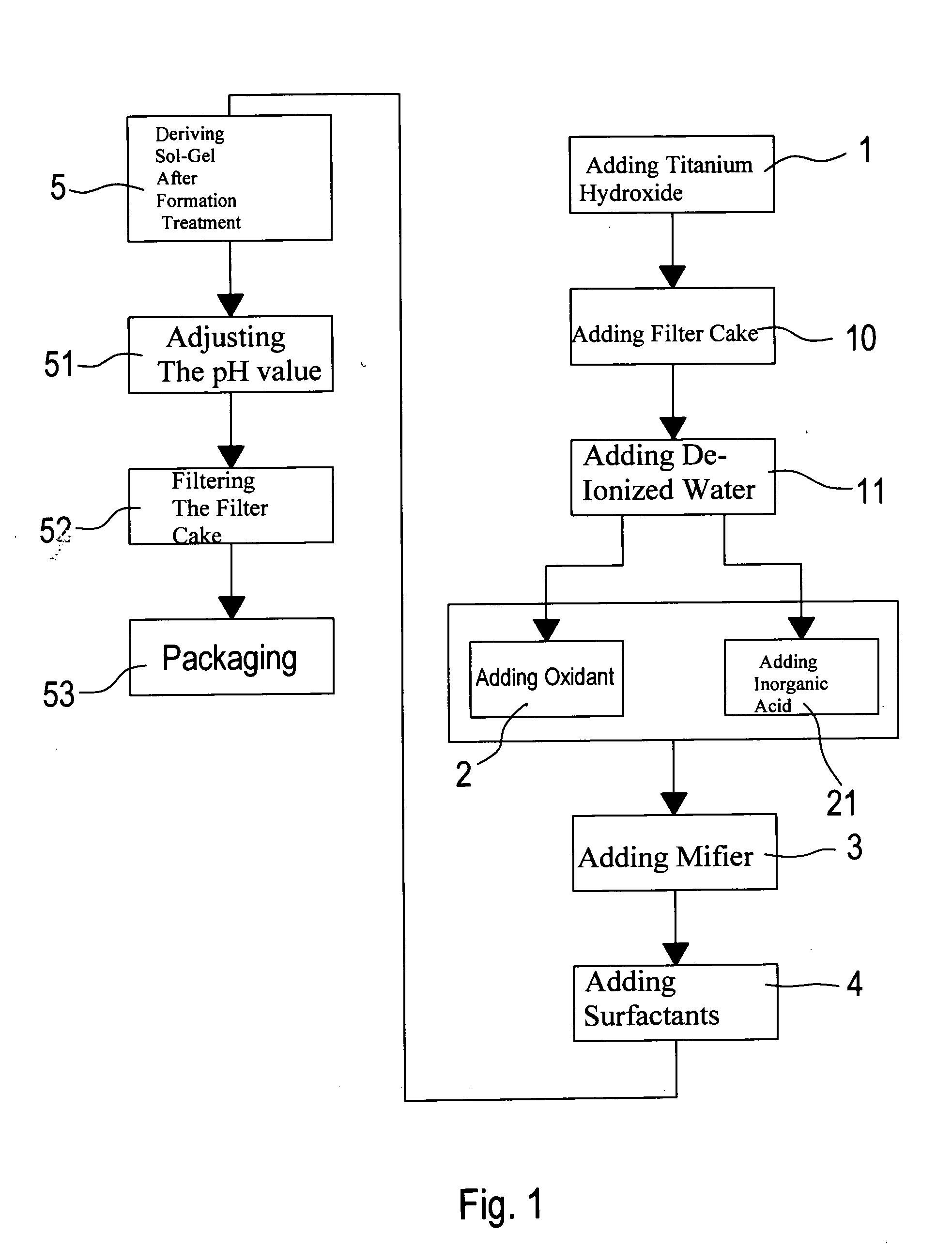
Figure 2
Abstract
Description
FIELD OF THE INVENTION
[0001] The present invention relates to method for synthesizing high adsorptive nanometer scale titanium dioxide solution, and particular to a method for synthesizing nanometer scale titanium dioxide solution with high adsorption and which is easily formed as stable film. Namely, a series of chemical process is used to form nanometer scale titanium dioxide sol-gel solution with high adsorption and easily formed as stable films with particles sizes between 2 and 500 nm and the content of titanium dioxide in the solution is between 0.5 and 10%. BACKGROUND OF THE INVENTION
[0002] From 1970s, a large amount of documents disclosed methods for manufacturing semiconductor titanium dioxide. Most of the documents use normal chemical components, especially titanium dioxide particles, as raw material. The photochemical 1 reaction and semiconductor reaction are also discussed. The configuration of crystals and size of the particles will affect the efficiency of the reacti...
Examples
first embodiment
[0029] In the first embodiment of the present invention, the method for synthesizing high adsorptive nanometer scale titanium dioxide solution is performed by the following processes. 10 liters de-ionized water is added to a reaction tank with a volume of 20 liters. The agitating speed is set at 300 rpm. The reaction tank is retained in temperature of 5 to 10° C. by ice-water bath. A predetermined amount, 500 grams, of titanium tetrachloride (with a ratio of 98%) is added to the water with a speed of 4 ml / min by using a dosing pump. When all the titanium tetrachloride is added and agitated through 2 hours until the liquid is clear and become transparent, ammonia water with a concentration of 20% is added with an addition speed of 10 ml / min and an agitation speed of 600 rpm. Variation of pH value is monitored. When the pH value is attained to 4.0, the addition speed is changed to 2-4 ml / min until the pH value is achieved to 7.5 to 8.0. Above solution is filtered with a vacuum filter....
second embodiment
[0030] The process is identical to the first embodiment except that in the form-transfer process, 100 milliliter of the poly aluminium chloride (10%) is used to replace silicic acid. Operation conditions are same as the first embodiment. The acquired titanium dioxide sol-gel is yellow transparent solution with a pH value between 7 and 9. The content of titanium dioxide is 1%. The particle size is about 5 to 30 nm with needle-like or sheet-like crystals. The product can be directly used in spray treatment and then is processed as film so as to have the function of self-cleaning. If the solution of the present invention is radiated by ultra-violet light, it has the function of sterilization. The product is performed with spraying treatment, and then dried at room temperature to become a thin film. Then the adhesion test by using 3M tape is applied to the film. As a result, it appears that no product falls off, but for the film of titanium dioxide sol-gel without adding silicic acid, w...
third embodiment
[0031] The process is the same as the first embodiment, but in the final formation process, the agitation time is prolonged to 48 hours from the original six hours. The acquired titanium dioxide sol-gel is transparent or yellow transparent solution with a pH value between 4 and 9. The content of titanium dioxide is 1%. The particle size is about 20 to 100 nm with needle-like or sheet-like crystals. The product is directly performed with spraying treatment, and then dried at room temperature to become a thin film. As a result, it appears that an object coated with the film can be cleaned by water easily. Because there is no function of photo-catalyst in the film, organic material will not destroy to the structure of the product. Thereby, the film has preferred adhesive ability so that it can be widely used in furniture or daily-used articles.