
Acrylic Polymer and Radiation-Sensitive Resin Composition
a technology of radiation-sensitive resin and acrylic polymer, which is applied in the direction of photosensitive materials, instruments, photomechanical equipment, etc., can solve the problems of device design fatal defects, and achieve the effects of reducing the roughness of the line edge, reducing the dependence, and high radiation transparency
Patent Information
- Authority / Receiving Office
- US · United States
- Patent Type
- Applications(United States)
- Current Assignee / Owner
- Publication Date
- 2007-11-22
Smart Images
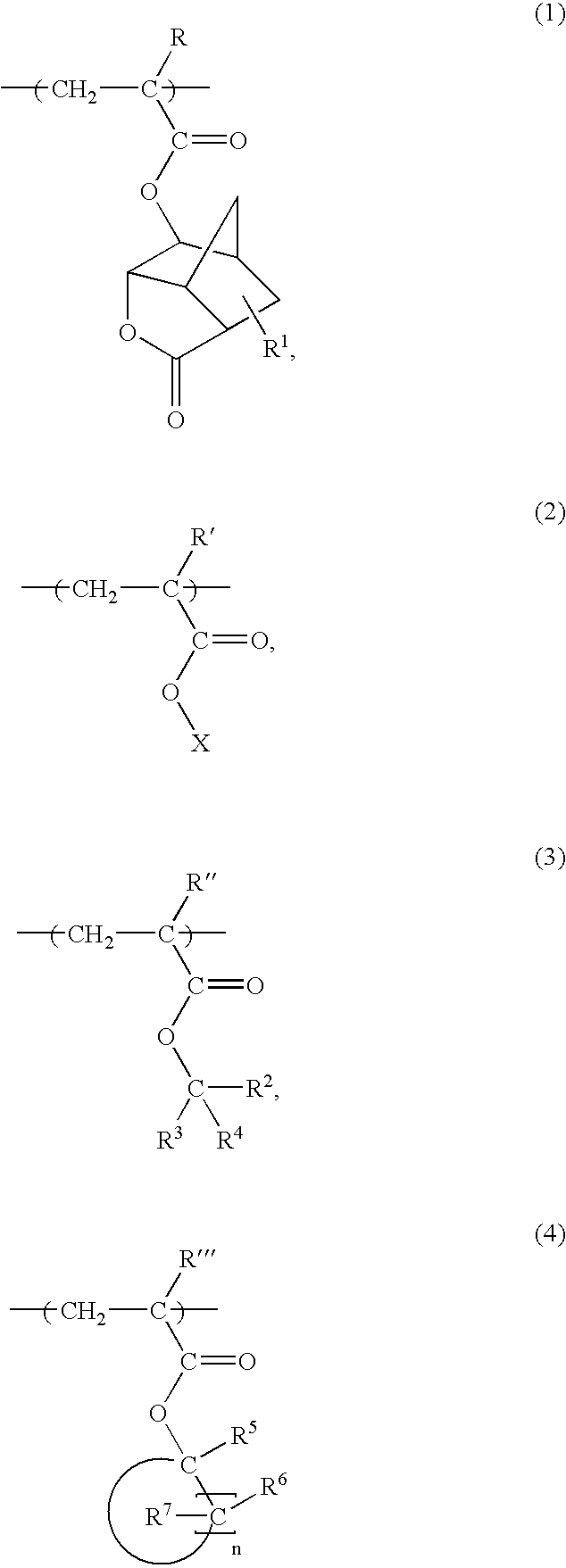
Figure 1 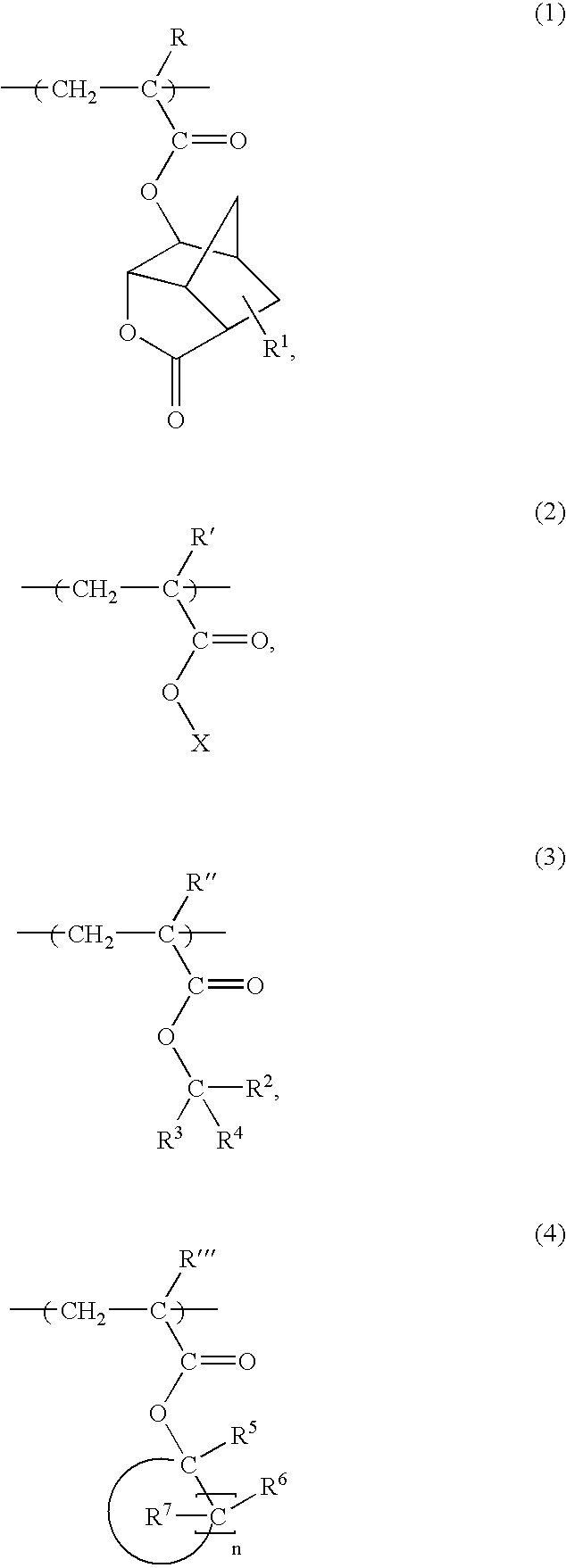
Figure 2 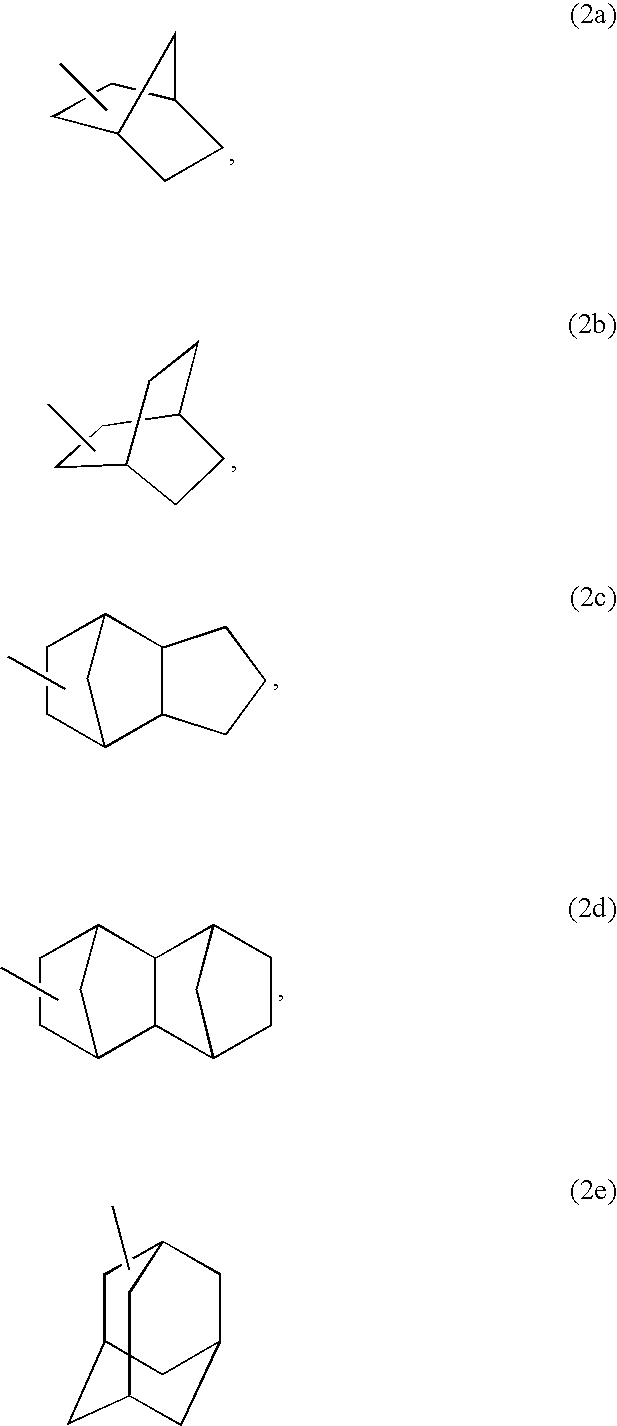
Figure 3
Abstract
Description
TECHNICAL FIELD
[0001] The present invention relates to an acrylic polymer and a radiation-sensitive resin composition and, particularly, to a radiation-sensitive resin composition suitable as a chemically-amplified resist useful for microfabrication utilizing various types of radiation, for example, deep ultraviolet rays such as a KrF excimer laser or ArF excimer laser, X-rays such as synchrotron radiation, or charged particle rays such as electron beams, as well as to an acrylic polymer utilized in the composition. BACKGROUND ART
[0002] In the field of microfabrication represented by the manufacture of integrated circuit elements, lithographic technology enabling microfabrication with a line width of about 200 nm or less using an ArF excimer laser (wavelength: 193 nm), F2 excimer laser (wavelength: 157 nm), and the like has been demanded in order to achieve higher integration in recent years. As a radiation-sensitive resin composition applicable to the excimer laser radiation, a n...
Examples
example 1
[0078]
[0079] A monomer solution was prepared by dissolving 53.93 g (50 mol %) of compound (5-1), 10.69 g (10 mol %) of compound (5-2), and 35.38 g (40 mol %) of compound (5-3) in 200 g of 2-butanone, and further adding 5.58 g of dimethyl 2,2′-azobis(2-methylpropionate). A 1,000 ml three-necked flask was charged with 100 g of 2-butanone and nitrogen gas was purged into the flask for 30 minutes. After nitrogen purge, the flask was heated to 80° C. while stirring and the above monomer solution was added dropwise using a dropping funnel over three hours. The polymerization reaction was carried out for six hours after initiation of dropping. After completion of polymerization, the polymer solution was cooled with water to 30° C. or lower and poured into 2,000 g of methanol. White precipitate produced was collected by filtration. The white powder collected by filtration was washed twice with 400 g of methanol in a slurry state, filtered again, and dried at 50° C. for 17 hours to obtain a ...
example 2
[0080]
[0081] A monomer solution was prepared by dissolving 52.50 g (50 mol %) of compound (6-1), 10.41 g (10 mol %) of compound (6-2), and 37.09 g (40 mol %) of compound (6-3) in 200 g of 2-butanone, and further adding 5.44 g of dimethyl 2,2′-azobis(2-methylpropionate). A 1,000 ml three-necked flask was charged with 100 g of 2-butanone and nitrogen gas was purged into the flask for 30 minutes. After nitrogen purge, the flask was heated to 80° C. while stirring and the above monomer solution was added dropwise using a dropping funnel over three hours. The polymerization reaction was carried out for six hours after initiation of dropping. After completion of polymerization, the polymer solution was cooled with water to 30° C. or lower and poured into 2,000 g of methanol. White precipitate produced was collected by filtration. The white powder collected by filtration was washed twice with 400 g of methanol in a slurry state, filtered again, and dried for 17 hours at 50° C. to obtain a ...
example 3
[0082]
[0083] A monomer solution was prepared by dissolving 53.88 g (50 mol %) of compound (7-1), 10.78 g (10 mol %) of compound (7-2), and 35.34 g (40 mol %) of compound (7-3) in 200 g of 2-butanone, and further adding 5.58 g of dimethyl 2,2′-azobis(2-methylpropionate). A 1,000 ml three-necked flask was charged with 100 g of 2-butanone and nitrogen gas was purged into the flask for 30 minutes. After nitrogen purge, the flask was heated to 80° C. while stirring and the above monomer solution was added dropwise using a dropping funnel over three hours. The polymerization reaction was carried out for six hours after initiation of dropping. After completion of polymerization, the polymer solution was cooled with water to 30° C. or lower and poured into 2,000 g of methanol. White precipitate produced was collected by filtration. The white powder collected by filtration was washed twice with 400 g of methanol in a slurry state, filtered again, and dried at 50° C. for 17 hours to obtain a ...