
Branching Device for a Pulsation Attenuation Network
Patent Information
- Authority / Receiving Office
- US · United States
- Current Assignee / Owner
- Publication Date
- 2009-04-02
- Estimated Expiration
- Not applicable · inactive patent
Smart Images
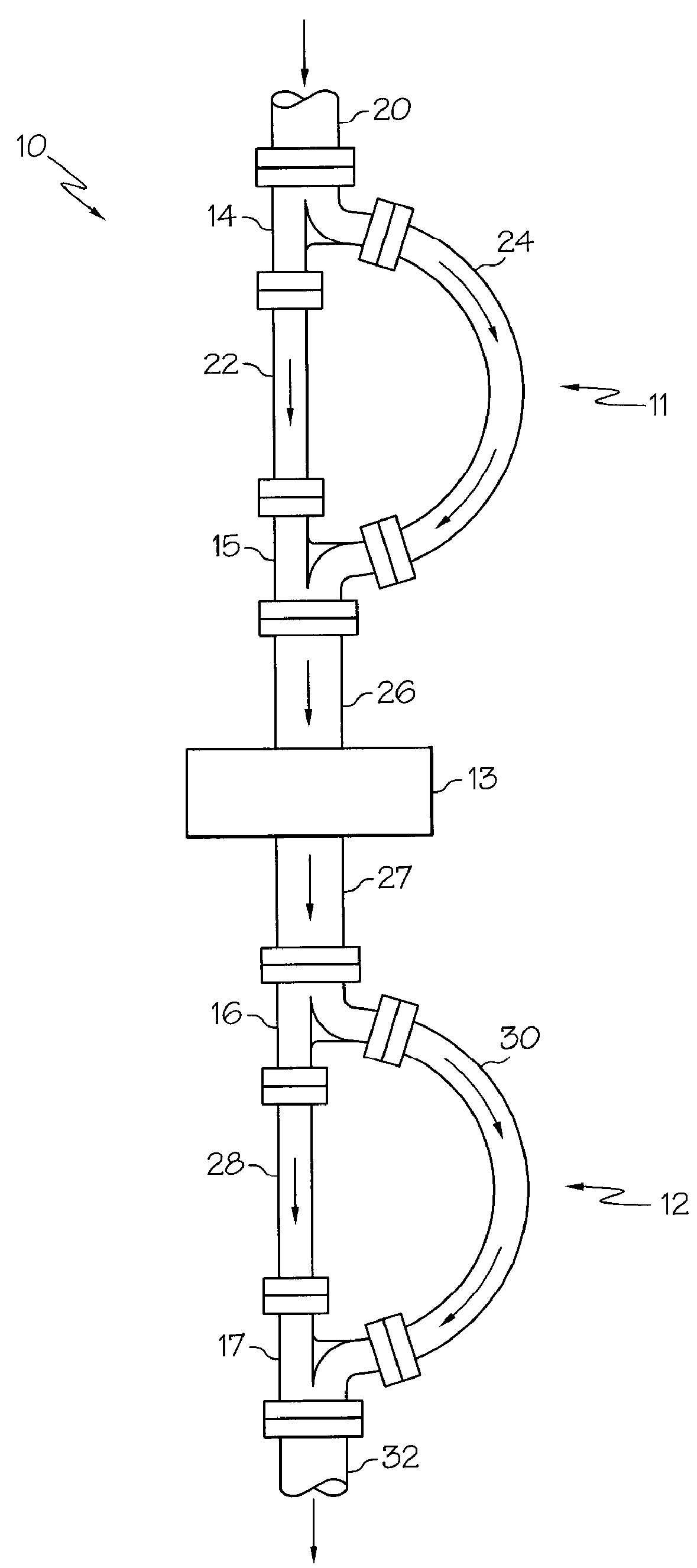
Figure 1 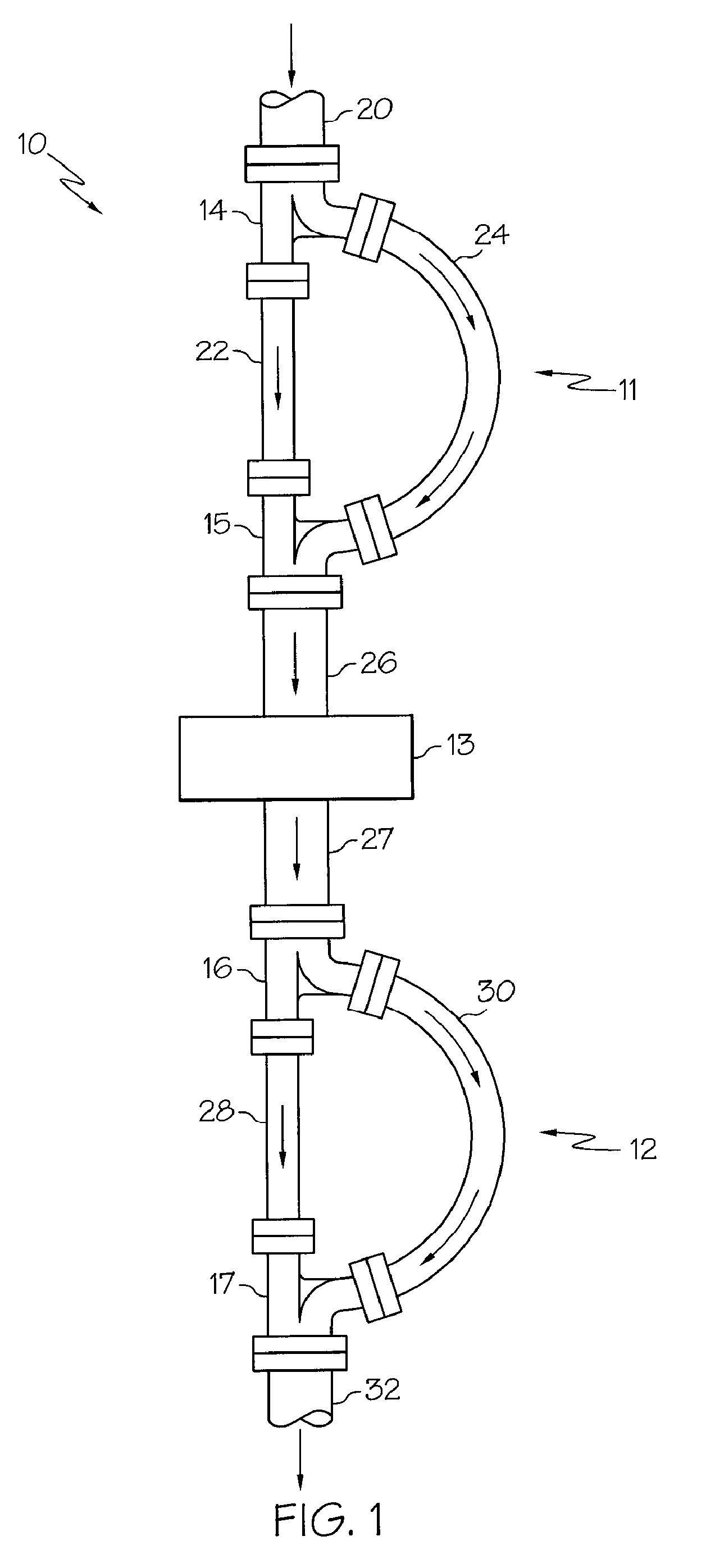
Figure 2 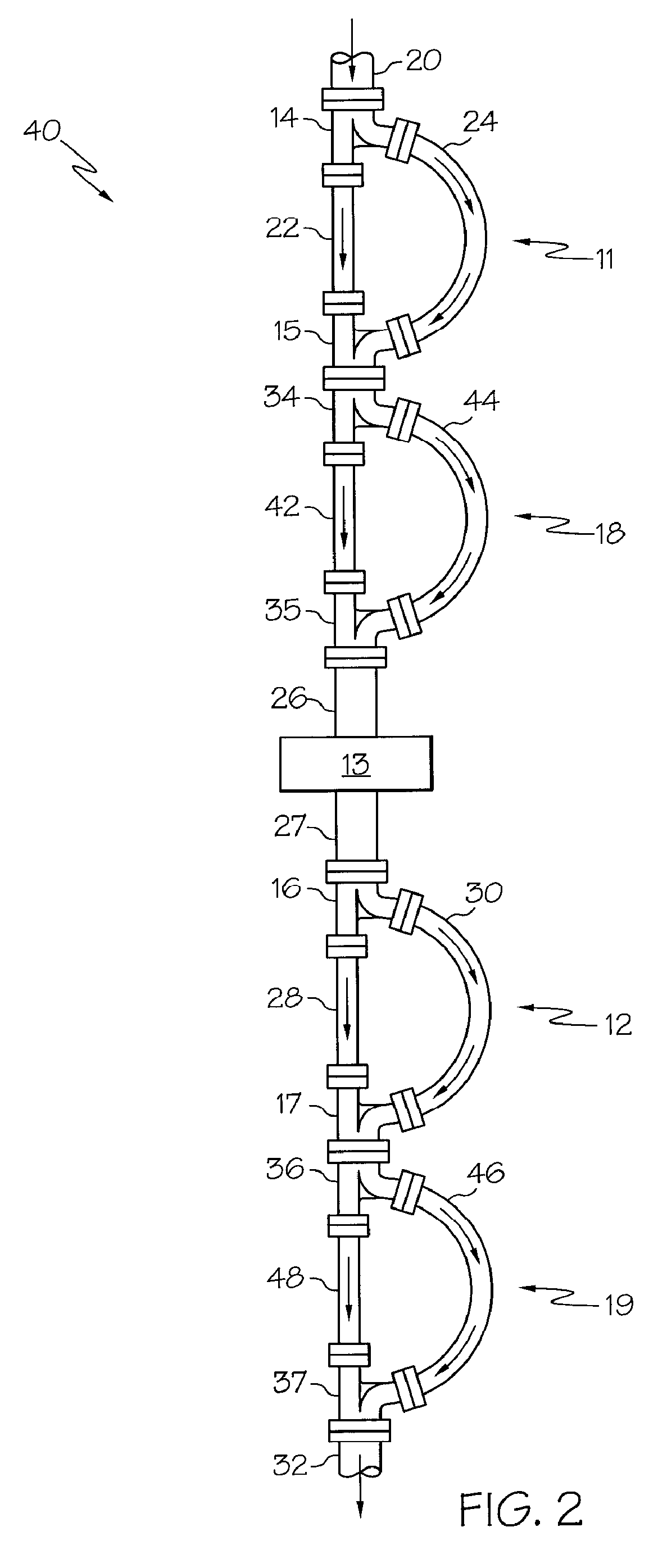
Figure 3
Abstract
Description
CROSS REFERENCE TO RELATED APPLICATION
[0001] This application claims the benefit of U.S. Provisional Application No. 60 / 976,075, filed Sep. 28, 2007.FIELD OF THE INVENTION
[0002] The present invention relates in general to the control of the flow of pressurized fluids through industrial and commercial piping systems that include one or more reciprocating (piston-type) compressor cylinders, and in particular to a branching device for aiding in controlling pressure and flow pulsations of complex pressure waves passing through these systems without causing significant system pressure losses.BACKGROUND OF THE INVENTION
[0003] Reciprocating compressors typically include one or more pistons that “reciprocate” within a closed cylinder. They are commonly used for a wide range of applications that include, but are not limited to, the pressurization and transport of air and / or natural gas mixtures through systems that are used for gas transmission, distribution, injection, storage, processing, ref...
Examples
example case
[0058]Example Case: the application of this pulsation attenuation technology is discussed below. Finite amplitude wave compressor system simulation was used to model the current compressor system and also to design a tuned PAN system that effectively cancels the pressure pulsations with no significant pressure losses in the system.
[0059]The example case is a real two-cylinder field system configuration that has inlet scrubbers and primary and secondary pulsation bottles. Each side of a 6 in. stroke compressor has two 9.5 in. diameter double-acting cylinders that operate in parallel, but 180 degrees out of phase with each other. Two cylinders on each side of the compressor share common suction header bottles and common discharge header bottles. A finite amplitude wave simulation was conducted on this system after modeling the exact internal dimensions of the compressor cylinders, the inlet separator, suction and discharge pulsation bottles, and pipes that are currently in place. The ...