
Promoter, and a production method for l-lysine using the same
a technology of promoter and lysine, which is applied in the field of promoter and a production method for l-lysine, can solve the problems of no coryneform bacteria which are improved in the activity of ddh, and achieve the effects of improving promoter activity, increasing diaminopimelate dehydrogenase activity, and improving promoter activity
Patent Information
- Authority / Receiving Office
- US · United States
- Patent Type
- Applications(United States)
- Current Assignee / Owner
- Publication Date
- 2011-03-31
Smart Images
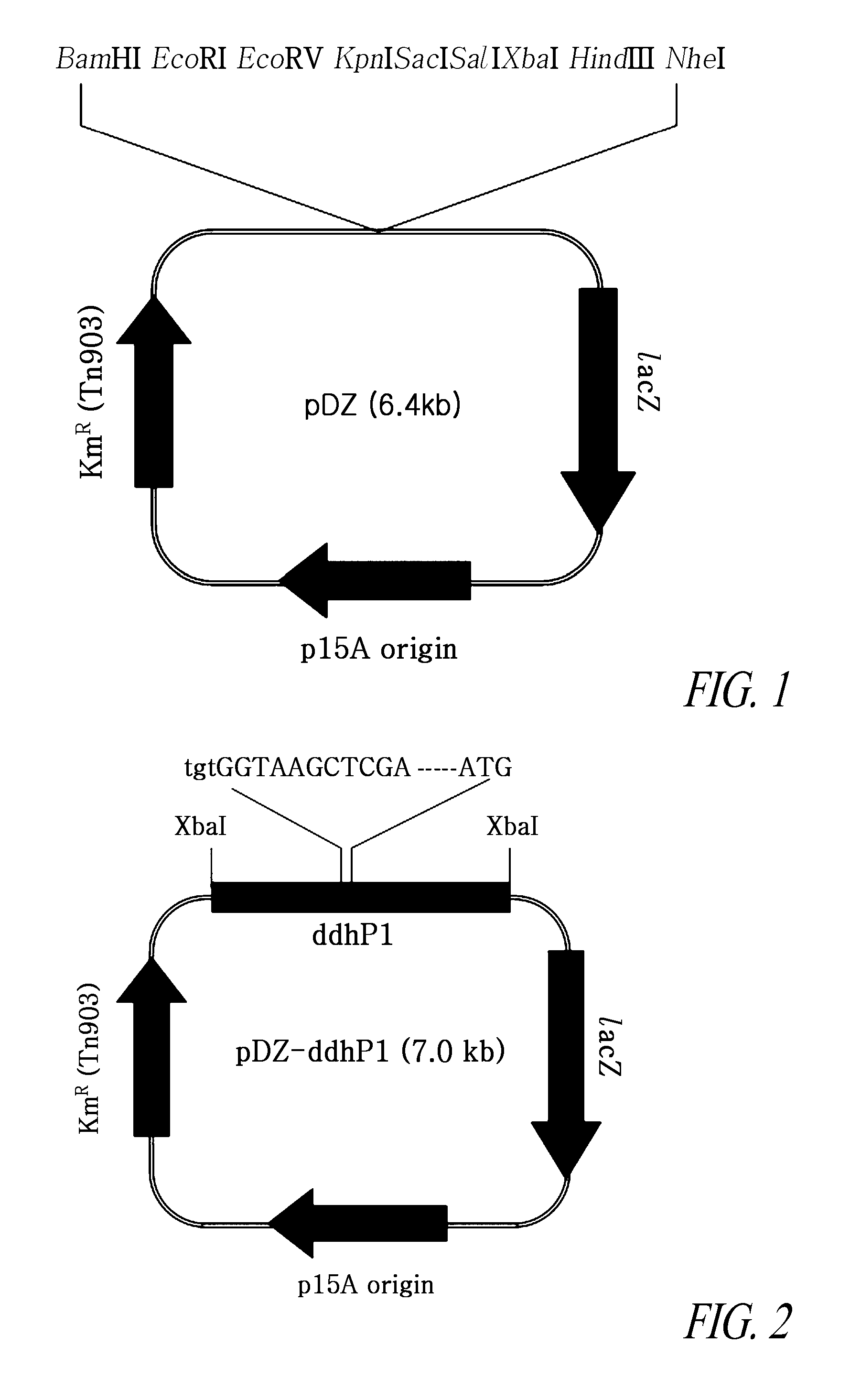
Figure 1
Abstract
Description
TECHNICAL FIELD
[0001] The present invention relates to an improved promoter and a method for producing L-lysine using the same. More particularly, the present invention relates to a nucleic acid molecule of Corynebacterium glutamicum origin, showing improved promoter activity, which is operably linked to a gene encoding diaminopimelate dehydrogenase, a vector containing the nucleic acid molecule, a transformant with the vector introduced thereinto, and a method for producing L-lysine using the transformant.BACKGROUND ART
[0002] Coryneform bacteria are traditionally industrial microorganisms which are most widely used for the production of a variety of chemical materials useful in the animal feed, medicine and food industries, including amino acids, such as L-lysine, L-threonine, L-arginine, L-threonine and glutamic acid, and nucleic acid-related materials. These microorganisms are Gram-positive and require biotin for their growth. They are divided by snapping and their poor ability to ...
Examples
example 1
Construction of Recombinant Vector Containing Improved Promoter
[0045](1) Construction of a Vector for Integration into Genome (pDZ)
[0046]In this example, pDZ, a vector to be integrated into Corynebacterium genome, was constructed on the basis of pACYC177 (New England Biolab, GenBank accession # X06402), a vector for use in E. coli.
[0047]After being treated with AcuI and BanI, the pACYC177 vector was blunt ended with a Klenow fragment. For the use as a selection marker, a lacZ gene originating from E. coli was prepared by amplifying a genomic DNA of E. coli K12 W3110 comprising the gene and its promoter through PCR, followed by treating the PCR product with T4 DNA polymerase and polynucleotide kinase to phosphorylate at 5′ end and make the opposite ends blunt, respectively. The two DNA fragments thus obtained were ligated to each other to give a circular nucleic acid molecule into which an artificially synthesized adaptor sequence containing a plurality of restriction enzyme sites w...
example 2
Introduction of the Recombinant Vector into Corynebacterium glutamicum Strains
[0054]In this example, the recombinant vector prepared above was introduced into the lysine-producing strain Corynebacterium glutamicum KFCC-10881, so that the modified ddh promoter sequence on the vector was integrated into the genome of the cell through homologous recombination with the endogenous ddh promoter on the genome.
[0055]To this end, the recombinant vector pDZ-ddhP1 containing the DNA fragment corresponding to the modified promoter sequence was transformed into Corynebacterium glutamicum KFCC10881 using an electroporation method (based on Appl. Microbiol. Biotechnol. (1999) 52:541-545), followed by selecting on a selection medium containing kanamycin in an amount of 25 mg / L the transformants in which the modified promoter was integrated into the genome through homologous recombination with the endogenous promoter.
[0056]Success in the insertion of the vector into the genome was identified by the ...
example 3
Assay of the ddh Promoter-Improved Strain for Diaminopimelate Dehydrogenase Activity
[0058]The mother strain Corynebacterium glutamicum KFCC10881 and the L-lysine-producing strain Corynebacterium glutamicum KFCC10881-ddhP1 finally prepared in Example 2 were cultured, and proteins were isolated from the cultures and assayed for diaminopimelate dehydrogenase activity, as follows.
[0059]Each of the cultures grown to the logarithm phase was inoculated into 50 mL of the following seed medium (I) to give an OD600 of 0.3, and then incubated until the optical density at 600 nm reached about 15. After being collected through centrifugation (5,000 rpm, 15 min), cell mass was washed twice with 20 mM Tris HCl (pH 8.0) and suspended in the same buffer to an optical absorbance at 610 nm of turbidity 160. Cells were disrupted for 6 min in a glass beater with glass beads added at 1.25 g / 1.5 ml of the suspension. After centrifugation (15,000 rpm, 20 min), the supernatant was quantitatively measured fo...