
Band-gap voltage generator
a voltage generator and band-gap technology, applied in the direction of electrical variable regulation, process and machine control, instruments, etc., can solve the problems of complex architectures, inability to accurately and independently adjust ptat and logarithmic terms, etc., to achieve the maximum achievable accuracy
Patent Information
- Authority / Receiving Office
- US · United States
- Patent Type
- Applications(United States)
- Current Assignee / Owner
- Publication Date
- 2012-10-11
Smart Images
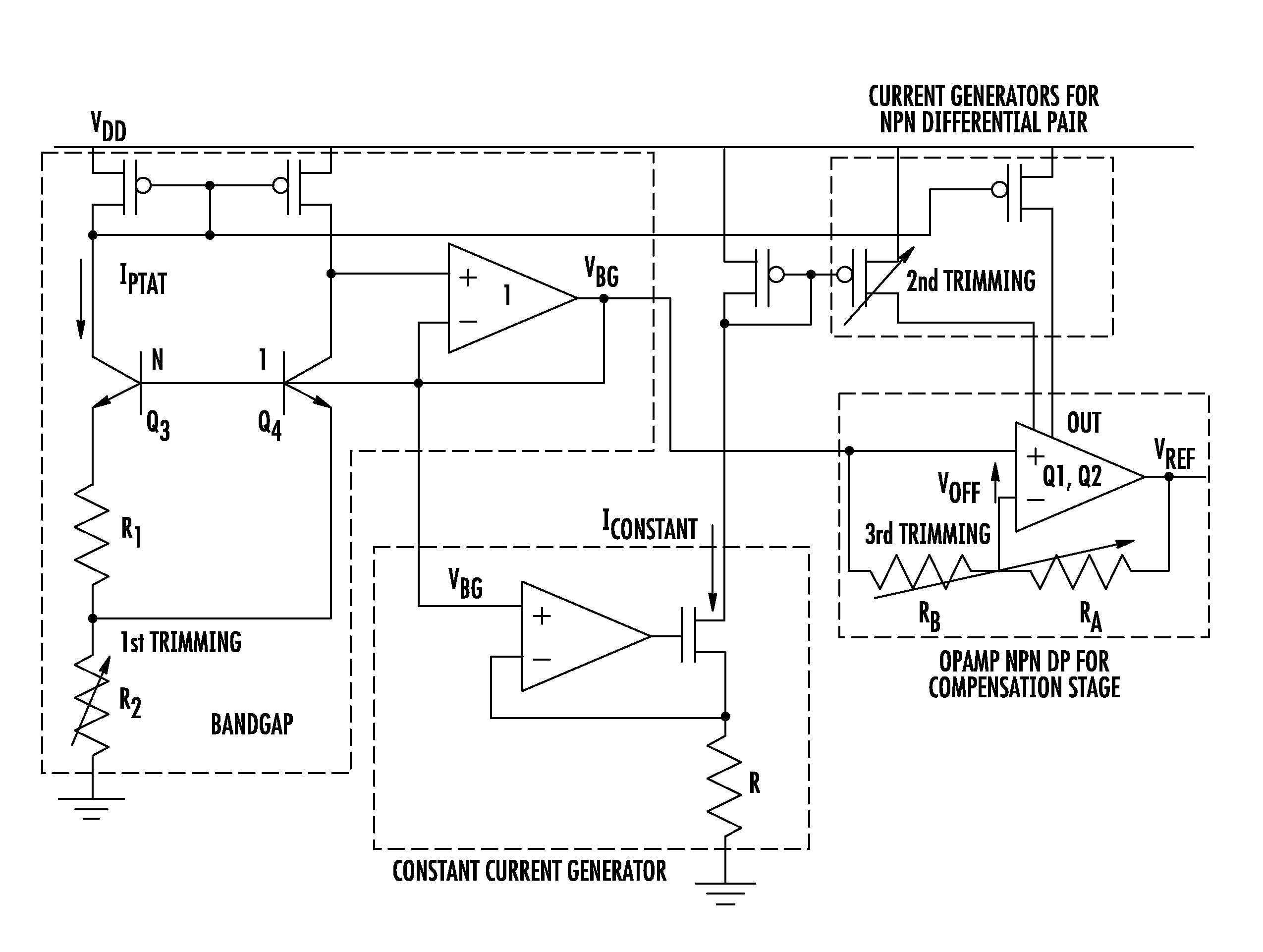
Figure 1 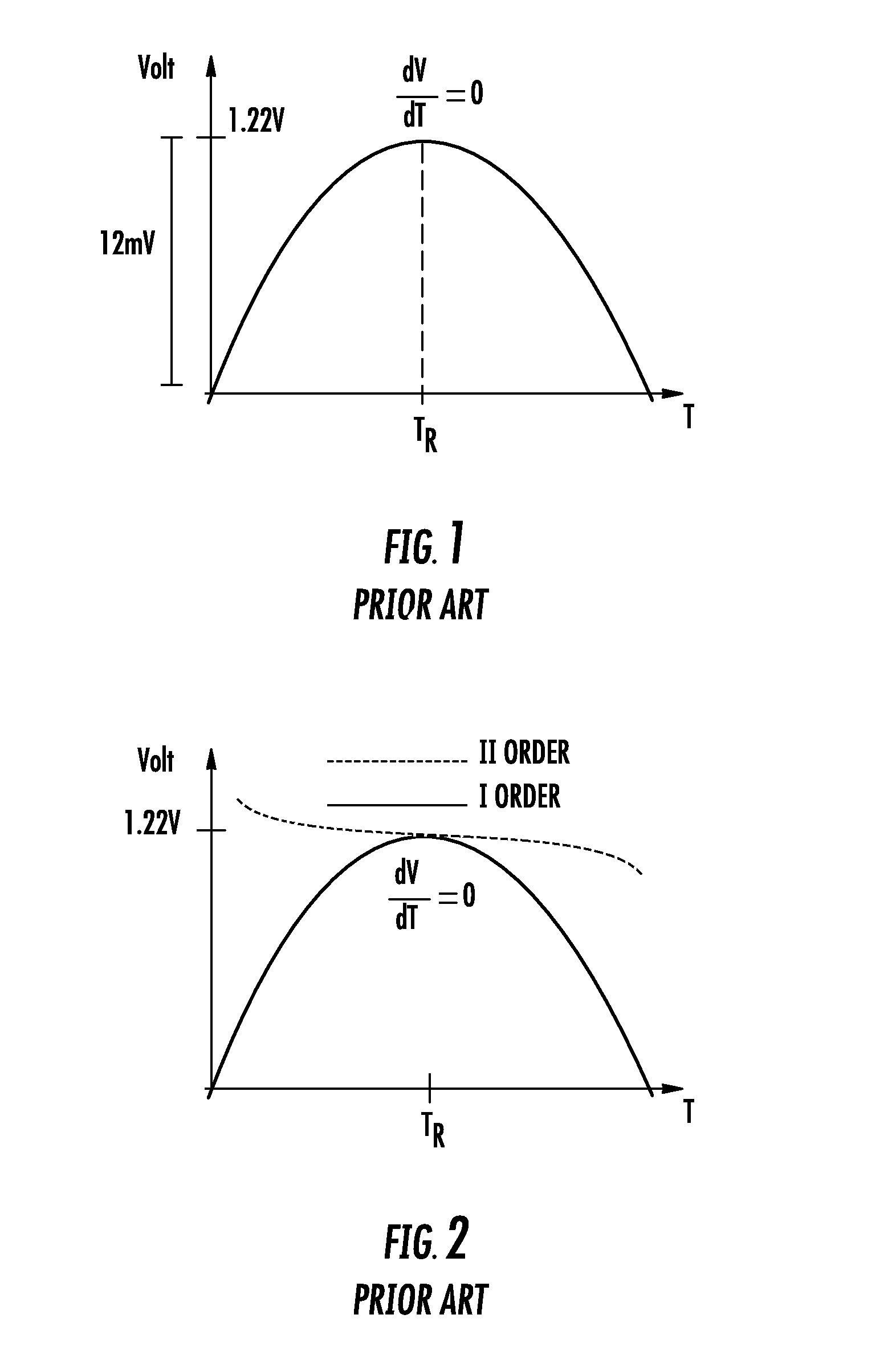
Figure 2 
Figure 3
Abstract
Description
FIELD OF THE INVENTION
[0001] The present disclosure relates to reference voltage generators and, more particularly, to a generator of a voltage variable with temperature to a bandgap voltage generator and to a related method of generating a temperature compensated bandgap voltage.BACKGROUND OF THE INVENTION
[0002] Most electronic circuits may require a stable direct current (DC) voltage reference, particularly with regard to fluctuations of working temperature for the circuits. Usually, such stable voltage reference circuits are bandgap voltage generators that are based upon the property of a bipolar transistor to produce a base-emitter voltage with well known temperature dependence.
[0003] According to a theoretical analysis in the article: Yannys P. Tsividis, “Accurate analysis of temperature effects in IC-VBE characteristics with application to bandgap reference sources”, IEEE Journal of solid-state circuits, Vol. SC-15, No. 6, December 1980, pages 1076-1084, the following equation ho...
Examples
Embodiment Construction
[0028]The term that compensates for the logarithmic addend in equation (1) is generated with a logarithmic voltage generator, an embodiment of which is shown in FIG. 5a. It essentially comprises a differential pair of transistors Q1 and Q2, which are generating the voltage logarithmically varying with temperature between the control nodes thereof. One transistor Q1 is biased with a current constant with temperature Iconstant, and the other transistor Q2 is biased with a current proportional to the absolute temperature IPTAT. As may be shown hereinafter, the current IPTAT is generated in common first-order bandgap voltage generators.
[0029]The currents Iconstant and IPTAT, together with the bias current generator IBIAS, force the two transistors Q1 and Q2 of the differential pair into a conduction state. The feedback line, that in the shown example is a MOS controlled in a conduction state by the voltage on the current terminal of Q1 not in common with the transistor Q2, provides a fr...