
Highly efficient nrf2 activators-co-releasing molecule hybrids, their use in the treatment of inflammatory or cardiovascular diseases and their process of preparation
a technology of nrf2 activators and co-releasing molecules, applied in the field of high-efficiency hybrid nrf2 activatorsco-releasing molecules, to achieve the effect of efficient co-releas
Patent Information
- Authority / Receiving Office
- US · United States
- Patent Type
- Applications(United States)
- Current Assignee / Owner
- Publication Date
- 2018-09-13
Smart Images
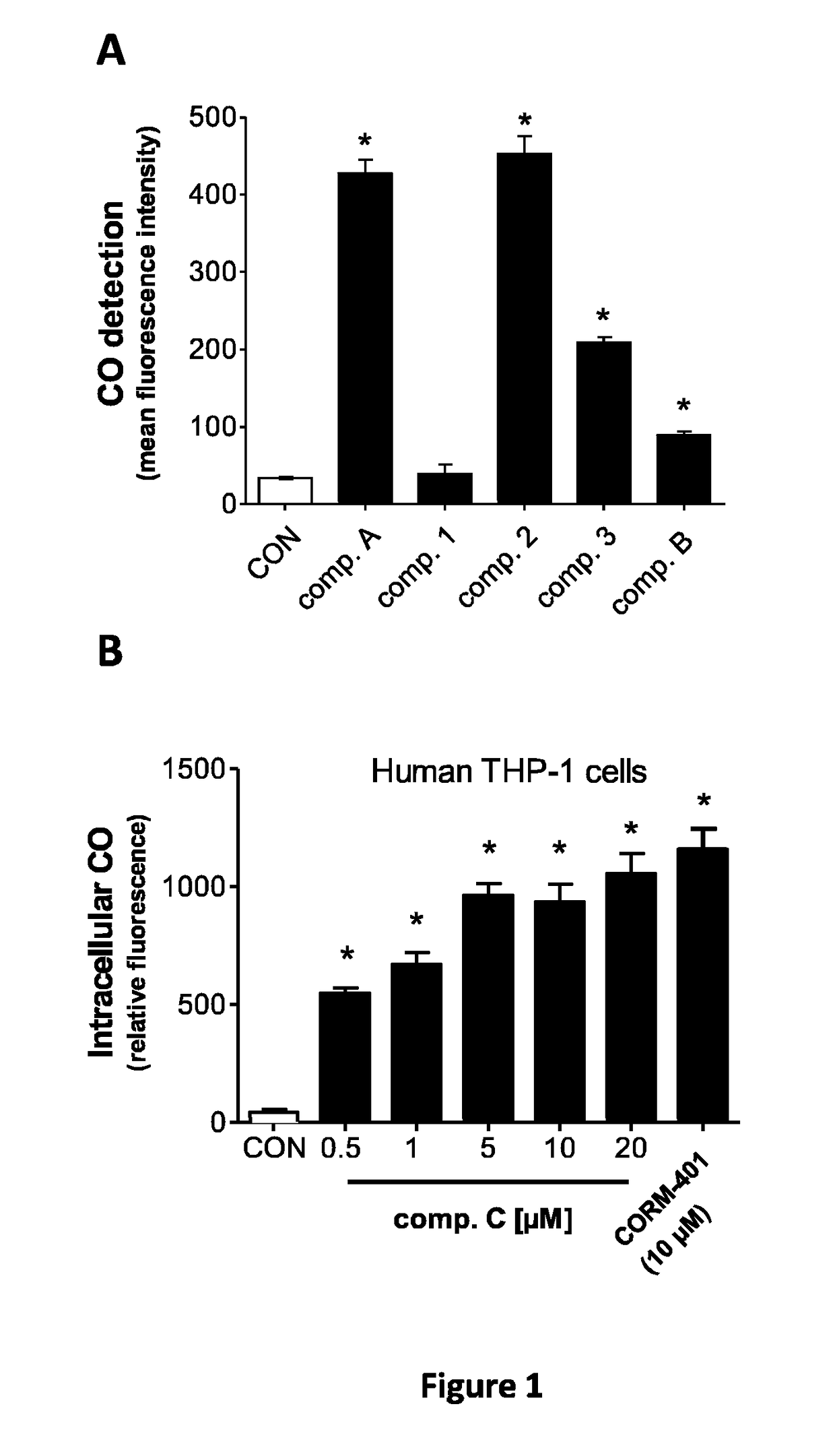
Figure 1 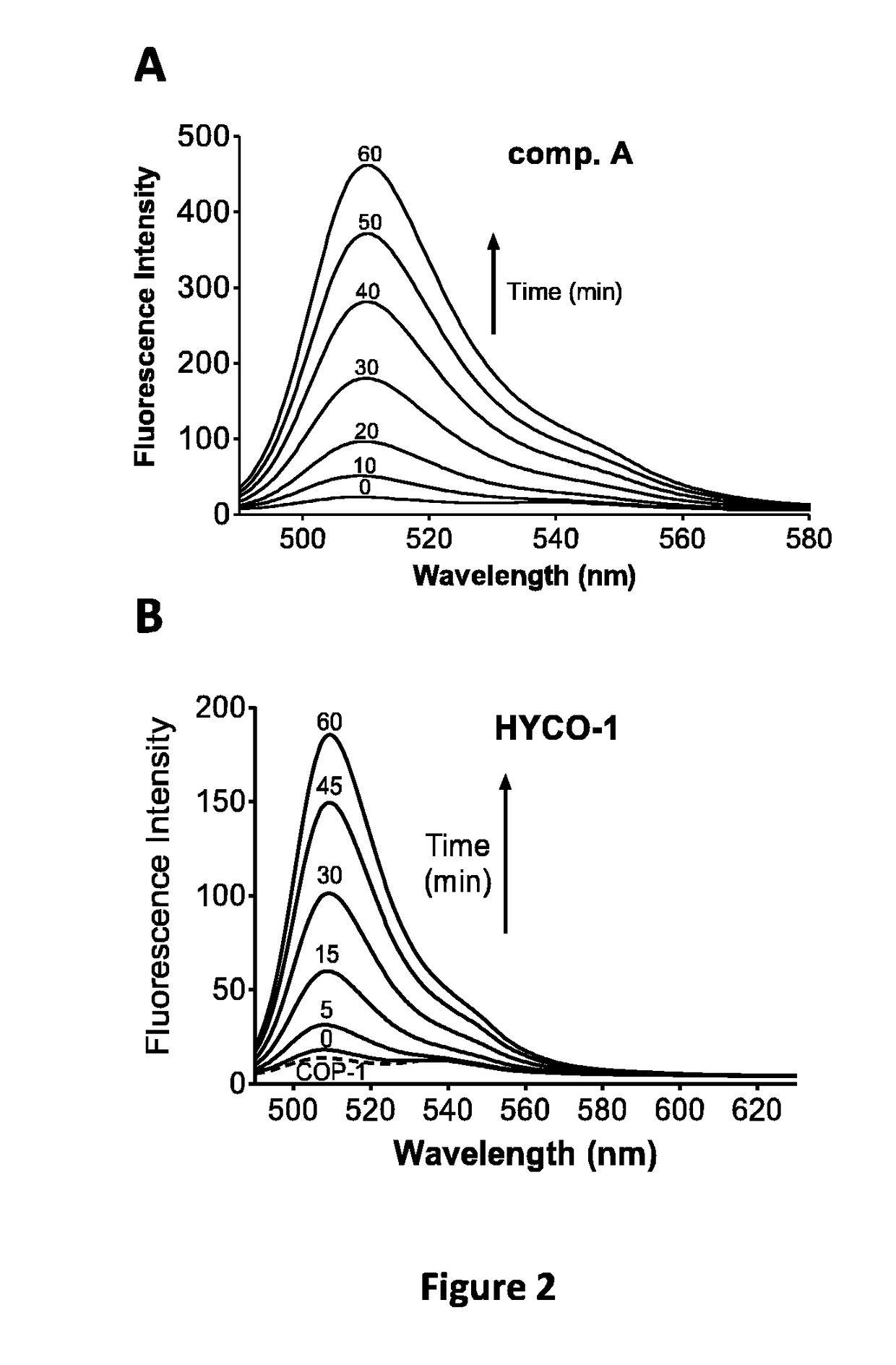
Figure 2 
Figure 3
Abstract
Description
FIELD OF THE INVENTION
[0001] The present invention relates to highly efficient hybrid Nrf2 activators-CO-releasing molecules capable of increasing HO-1 protein expression and CO release, their synthesis and their use in therapeutic applications, in particular their use in the treatment of inflammatory and cardiovascular diseases.BACKGROUND ART
[0002] The HO-1 / CO system is a significant part of the defense against the damage inflicted by a variety of stress conditions mediated by heavy metals, reactive oxygen species, lipopolysaccharide (LPS) and other inflammatory processes, thereby playing a pivotal role in the regulation of the cytoprotective and anti-inflammatory responses. CO gas administered at low doses (250 ppm) for restricted period of times has been shown to restore many of the beneficial effects of HO-1 in models of cardiovascular dysfunction, pulmonary hypertension, and inflammatory conditions such as sepsis and inflammatory bowel disease.
[0003] Because of the interest in HO-...
Examples
example 1
of Hybrids Chromone-CO-RM According to the Invention
[0175]
Step 1: Preparation of
[0176]
[0177]To a suspension of chromone-2-carboxylic acid (380 mg, 2.00 mmol, 1.0 equiv.) in acetonitrile (40 mL) were added under argon K2CO3 (332 mg, 2.40 mmol, 1.2 equiv.) and propargyl bromide solution (80 wt. % in toluene) (557 μL, 5.00 mmol, 2.5 equiv.). After 17 h of stirring at 50° C., the reaction mixture was concentrated in vacuo, then, dissolved in diethyl ether, filtered on celite and concentrated in vacuo. The resulting crude product was purified by silica gel column chromatography eluting with cyclohexane / EtOAc (75 / 25) to afford AO59 (157 mg, 0.69 mmol) as a white solid in 35% yield. 1H NMR (400 MHz, CDCl3) δ 8.20 (dd, J=8.0, 1.5 Hz, 1H), 7.75 (ddd, J=8.7, 7.2, 1.7 Hz, 1H), 7.62 (d, J=8.5 Hz, 1H), 7.46 (m, 1H), 7.17 (s, 1H), 4.99 (d, J=2.5 Hz, 2H), 2.60 (t, J=2.5 Hz, 1H). 13C NMR (100 MHz, CDCl3) δ 178.18, 159.90, 155.94, 151.37, 134.86, 126.03, 125.78, 124.44, 118.78, 115.41, 76...
example 2
of Hybrids Caffeic Acid-CO-RM According to the Invention
Compound B:
[0180]
Step 1: Preparation of
[0181]
[0182]To a solution of 3,4-dimethoxycinnamic acid (208 mg, 1.00 mmol, 1.0 equiv.) in acetonitrile (17 mL) were added, at 20° C. and under argon, potassium carbonate (152 mg, 1.10 mmol, 1.1 equiv.) and propargyl bromide solution (80 wt. % in toluene) (123 μL, 1.10 mmol, 1.1 equiv.). After 17 h of stirring at 70° C., the reaction mixture is filtered and concentrated in vacuo. The crude is dissolved in Et2O / NaHCO3 (sat) and the aqueous layer is extracted by Et2O. The resulting organic layers are washed with brine, dried on MgSO4, filtered and concentrated in vacuo. This resulting crude product was purified by flash silica gel column chromatography eluting with cyclohexane / EtOAc (80 / 20) to afford AO281 (214 mg, 0.87 mmol) as a white solid in 87% yield. 1H NMR (400 MHz, CDCl3) δ 7.68 (d, J=15.9 Hz, 1H), 7.11 (dd, J=8.3, 2.0 Hz, 1H), 7.05 (d, J=1.9 Hz, 1H), 6.87 (d, J=8.3 Hz, 1H), 6.33 (d,...
example 3
t of CO-Release by Compounds of the Invention
Assessment of CO-Release in COP-1 Fluorescence Assay by Compounds a, B and C:
[0195]The release of CO from hybrids was assessed using COP-1, a fluorescent probe sensitive to CO. The fluorescence intensity of COP-1 (2 μM, Δex=475 nm) in buffer was measured in a cuvette to obtain a background fluorescence spectrum and spectra were then recorded immediately after addition of 50 μM tested compounds. The mean fluorescence intensity (MFI) of 3 independent reading was calculated using the fluorescence intensity values recorded at 507 nm after 60 min.
[0196]The results are presented in FIG. 1.
[0197]As shown by these results, all compounds of the invention release carbon monoxide whereas the curcumin derivative according to WO 2012 / 076696 (data not shown) and the compound 1, diindolylmethane derivative, do not.
[0198]From the measurements shown in FIG. 1A, all compounds with the exception of diindolylmethane derivative liberated CO, albeit in differe...