
Conditional execution via content addressable memory and parallel computing execution model
a technology of content addressable memory and execution model, applied in the field of parallel computing, can solve the problems of not being particularly successful or efficient in extracting parallelism in this way, the limit of such conventional computing technology is being reached, and the feature size continues to shrink, so as to achieve the effect of greater computational speed
Patent Information
- Authority / Receiving Office
- US · United States
- Patent Type
- Patents(United States)
- Current Assignee / Owner
- Publication Date
- 2010-04-27
Smart Images
Figure 1 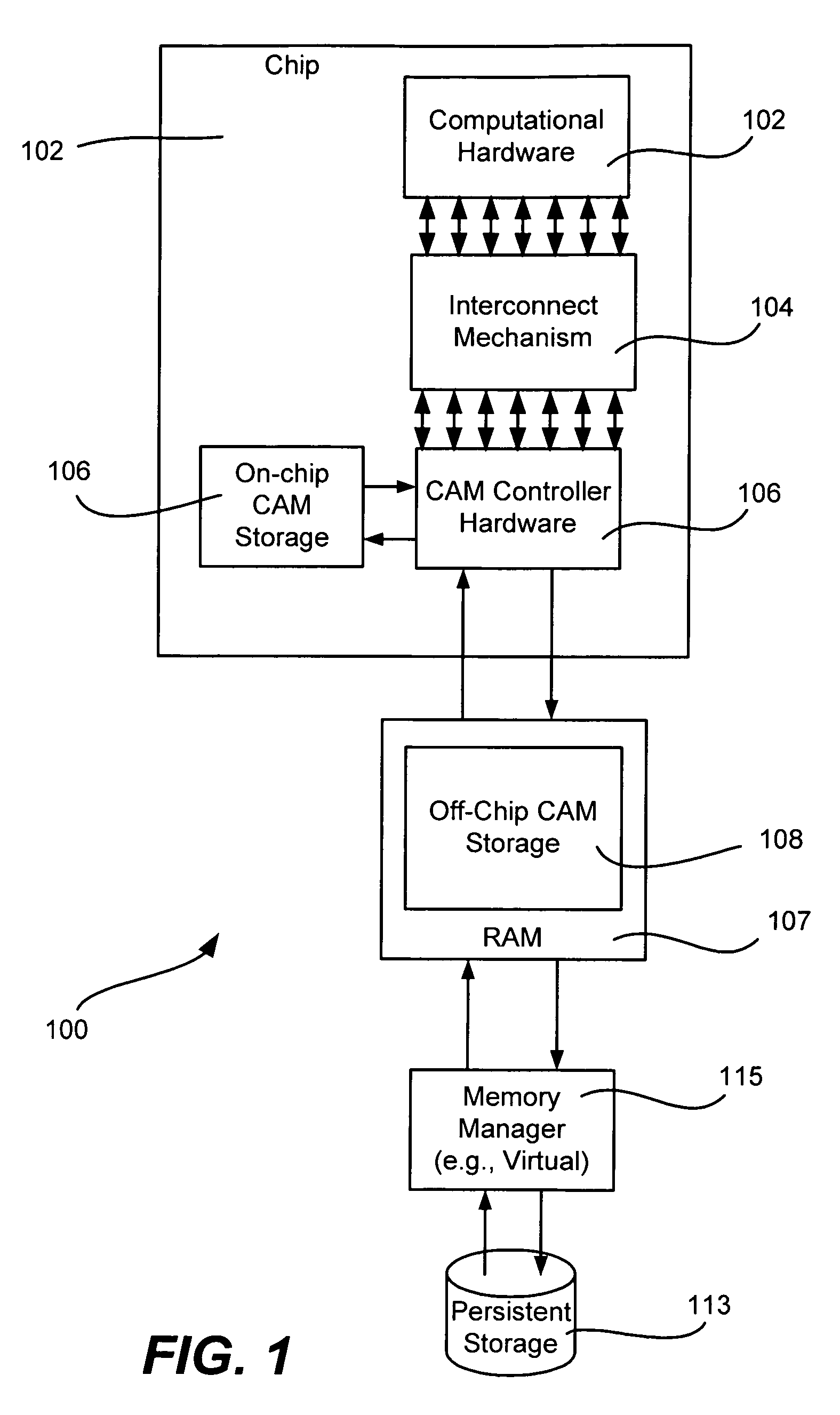
Figure 2 
Figure 3
Abstract
Description
CROSS-REFERENCE TO RELATED APPLICATIONS
[0001] The present application is related to U.S. patent application Ser. No. 11 / 143,060 entitled “Content Addressable Memory Architecture”, and U.S. patent application Ser. No. 11 / 143,307 entitled “Execution Model for Parallel Computing,” both assigned to the assignee of the present invention, filed concurrently herewith and herein incorporated by reference in their entireties.FIELD OF THE INVENTION
[0002] The invention relates generally to computer systems, processors and memory, and more particularly towards parallel computing.BACKGROUND
[0003] For a considerable time, computer program developers and users have been able to benefit from advances in technology that have shrunk silicon feature sizes. As the size of the devices (e.g., microprocessors and memory) that can be created grows smaller, the devices become faster, cheaper and more densely packed. The effect of these advances has allowed contemporary computing to continue to use a control dr...
Examples
Embodiment Construction
Content Addressable Memory (CAM) Architecture
[0045]The content addressable memory (CAM) architecture of the present invention is generally aimed at providing a platform for performing relatively demanding computational tasks in a way that is easy to program, has a practical implementation and can be applied to general purpose problems. There are a wide variety of computing problems and tasks that are amenable to parallelization, such as graphics, speech processing, artificial intelligence, simulation and modeling, biological synthesis, data mining, data processing, databases, server applications, and so forth. Many of these applications are well known and are the domain of supercomputers.
[0046]Notwithstanding, the present invention is not limited to any particular data processing applications. In general, while one described example architecture of the present invention attempts to address some or all of the above-identified problems and tasks, the CAM architecture may be scaled dow...