
Cross-linked copolymer containing phosphorylcholine monomer and cosmetic composition containing same
Patent Information
- Authority / Receiving Office
- US · United States
- Current Assignee / Owner
- Publication Date
- 2015-07-21
Smart Images
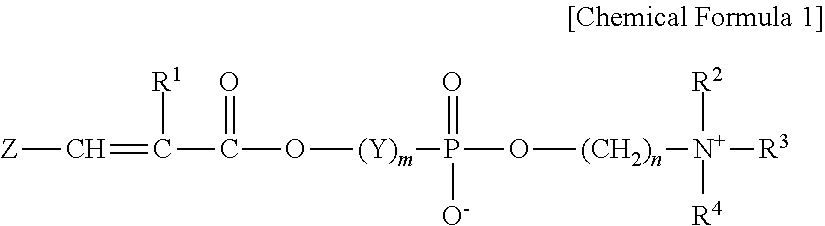
Figure 1 
Figure 2 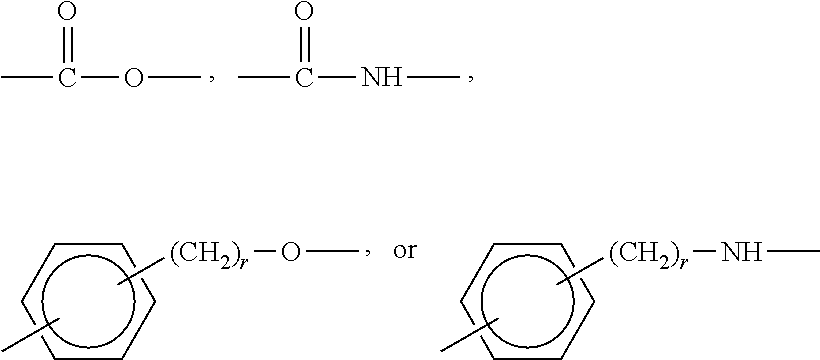
Figure 3
Abstract
Description
CROSS-REFERENCE TO RELATED APPLICATIONS
[0001] This application is the United States national phase under 35 U.S.C. §371 of International Application No. PCT / KR2011 / 008989 filed Nov. 23, 2011, entitled “Cross-Linked Copolymer Containing Phosphorylcholine Monomer and Cosmetic Composition Containing Same”, and claims priority under 35 U.S.C. §119(a)-(d) to Korean Patent Application Nos. 10-2011-0001978, filed on Jan. 7, 2011, and 10-2011-0122960 filed on Nov. 23, 2011 in the Korean Intellectual Property Office, the disclosures of which are hereby incorporated by reference in their entirety.TECHNICAL FIELD
[0002] The present invention relates to a cross-linked copolymer containing a phosphorylcholine monomer, a cosmetic composition containing the same, and a cosmetic material containing the cosmetic composition.
[0003] In more detail, the present invention relates to a cross-linked copolymer prepared using α,β-ethylenically unsaturated monomer, a phosphorylcholine monomer having a specific s...
Examples
preparation example 2
Preparation of Copolymer
[0053]1200 g of an organic solvent obtained by mixing cyclohexane and ethylacetate with each other at a weight ratio of 50:50, 100 g of acrylic acid, and 1 g of MPC were put into a reactor, and then the reactant was stirred so as to be dissolved while slowly raising a temperature in the reactor to 60° C., followed by purging the reactor with nitrogen for 30 minutes. In addition, separately, 3 g of trimethylolpropane diallyl ether as a cross-linking agent and 0.04 g of Vazo 52 (Dupont) as a polymerization reaction initiator were dissolved in the 10 g of the organic solvent obtained by mixing cyclohexane and ethylacetate with each other at the weight ratio of 50:50, and put into the reactor when the temperature of the reactor approached at 60° C., followed by performing a polymerization reaction for hours. After the polymerization reaction was terminated, the filtered reaction product was put into a vacuum evaporator to remove the organic solvent at 90° C., the...
preparation example 3
Preparation of Copolymer
[0054]1200 g of a benzene organic solvent, 100 g of acrylic acid, and 10 g of MPC were put into a reactor, and then the reactant was stirred so as to be dissolved while slowly raising a temperature in the reactor to 80° C., followed by purging the reactor with nitrogen for 30 minutes. In addition, separately, 1.0 g of trimethylolpropane diallyl ether as a cross-linking agent and 0.2 g of azobisisobutyronitrile (AIBN) as a polymerization reaction initiator were dissolved in the 10 g of the benzene organic solvent, and put into the reactor when the temperature of the reactor approached at 80° C., followed by performing a polymerization reaction for 10 hours. After the polymerization reaction was terminated, the filtered reaction product was put into a vacuum evaporator to remove the organic solvent at 90° C., thereby obtaining a copolymer as white powder. Transparency of the obtained copolymer was 88%, and a 0.5 weight % aqueous solution of the copolymer had a ...
preparation example 4
Preparation of Copolymer
[0055]1,400 g of an organic solvent obtained by mixing cyclohexane and ethylacetate with each other at a weight ratio of 50:50, 100 g of acrylic acid, and 20 g of MPC were put into a reactor, and then the reactant was stirred so as to be dissolved while slowly raising a temperature in the reactor to 70° C., followed by purging the reactor with nitrogen for 30 minutes. In addition, separately, 3 g of trimethylolpropane diallyl ether as a cross-linking agent and 0.01 g of azobisisobutyronitrile (AIBN) as a polymerization reaction initiator were dissolved in the 5 g of the organic solvent obtained by mixing cyclohexane and ethylacetate with each other at the weight ratio of 50:50, and put into the reactor when the temperature of the reactor approached at 70° C., followed by performing a polymerization reaction for 10 hours. After the polymerization reaction was terminated, the filtered reaction product was put into a vacuum evaporator to remove the organic solve...