Method for terminal random access to cellular wireless communication system and group identifier generation method
What is AI technical title?
AI technical title is built by Patsnap AI team. It summarizes the technical point description of the patent document.
A random access, cellular wireless technology, applied in wireless communication, radio/induction link selection arrangement, communication between multiple stations, etc. Computing group identification and other issues
Active Publication Date: 2008-02-20
ZTE CORP
View PDF0 Cites 22 Cited by
Summary
Abstract
Description
Claims
Application Information
AI Technical Summary
This helps you quickly interpret patents by identifying the three key elements:
Problems solved by technology
Method used
Benefits of technology
Problems solved by technology
However, in practical applications, for example, the terminal may not know the SFN of the target cell in advance during the handover process, which makes it impossible to calculate the group identity. In order to obtain the SFN of the target cell, additional delay and system processing are often required, such as reading system messages, Because SFN is usually broadcast in system messages
Another shortcoming is that in the actual wireless communication system, the configuration of the random access channel is flexible and changeable, so it is difficult to specify a fixed time range that makes the group identity unique
If the time range is notified by means of system message broadcast, for example, the flexibility of system configuration may be increased, but it also means that the terminal needs to read this parameter every time it initiates a random access request, and system message broadcast The cycle is often relatively long, so it will increase the time for the terminal to access the cell
Another problem is that using the absolute position method in the frequency domain will lead to redundant information bits of the group ID, because generally speaking, not all uplink radio resources will be set as random access resources in a TTI; and, if If the uplink random access channel adopts a method similar to frequency hopping, the absolute position will change with time, thus increasing the complexity of group identification coding and the probability of error
Method used
the structure of the environmentally friendly knitted fabric provided by the present invention; figure 2 Flow chart of the yarn wrapping machine for environmentally friendly knitted fabrics and storage devices; image 3 Is the parameter map of the yarn covering machine
View more
Image
Smart Image Click on the blue labels to locate them in the text.
Viewing Examples
Smart Image
Click on the blue label to locate the original text in one second.
Reading with bidirectional positioning of images and text.
Smart Image
Examples
Experimental program
Comparison scheme
Effect test
Embodiment 01
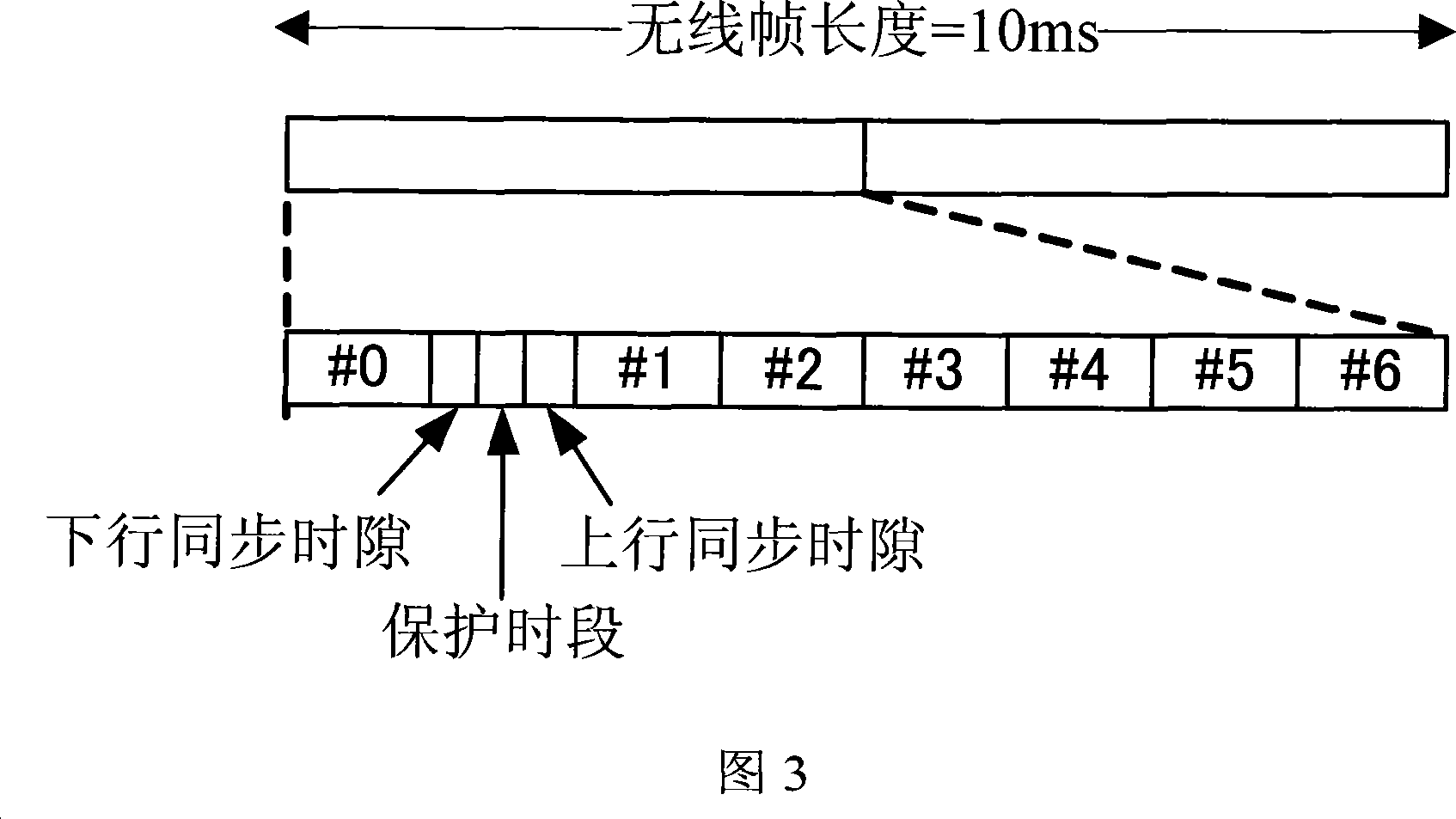
[0065] Embodiment 01: Type 1 frame structure, applied in FDD, the random access slot period is 10ms or more, such as 20ms
[0066] The relative serial number of position T=0
[0067] RA-RNTI=0,16
[0068] The absolute number of position T = the subframe number where the random access slot is located, such as 0 or 5 or 9 RA-RNTI = (0, 16) or (5, 21), or (9, 25)
Embodiment 02
[0069] Embodiment 02: Type 1 frame structure, applied in FDD, the random access slot period is 5ms Relative sequence number of position T=0,1
[0070] RA-RNTI=0, 1, 16, 17
[0071] The absolute number of position T = the subframe number where the random access slot is located, such as (0, 5) or (1, 6) or (2, 7) or (3, 8) or (4, 9)
[0072] RA-RNTI=(0, 5, 16, 21) or (1, 6, 17, 22) or (2, 7, 18, 23) or (3, 8, 19, 24) or (4, 9, 20 , 25)
Embodiment 03
[0073] Embodiment 03: Type 1 frame structure, applied to FDD, the random access slot period is 1 ms Relative sequence number of position T = 0, 1, 2, 3, 4, 5, 6, 7, 8, 9
[0074] RA-RNTI=0~9, 16~25
[0075] Absolute number of position T = 0, 1, 2, 3, 4, 5, 6, 7, 8, 9
[0076] RA-RNTI=0~9, 16~25
the structure of the environmentally friendly knitted fabric provided by the present invention; figure 2 Flow chart of the yarn wrapping machine for environmentally friendly knitted fabrics and storage devices; image 3 Is the parameter map of the yarn covering machine
Login to View More
PUM
Login to View More
Abstract
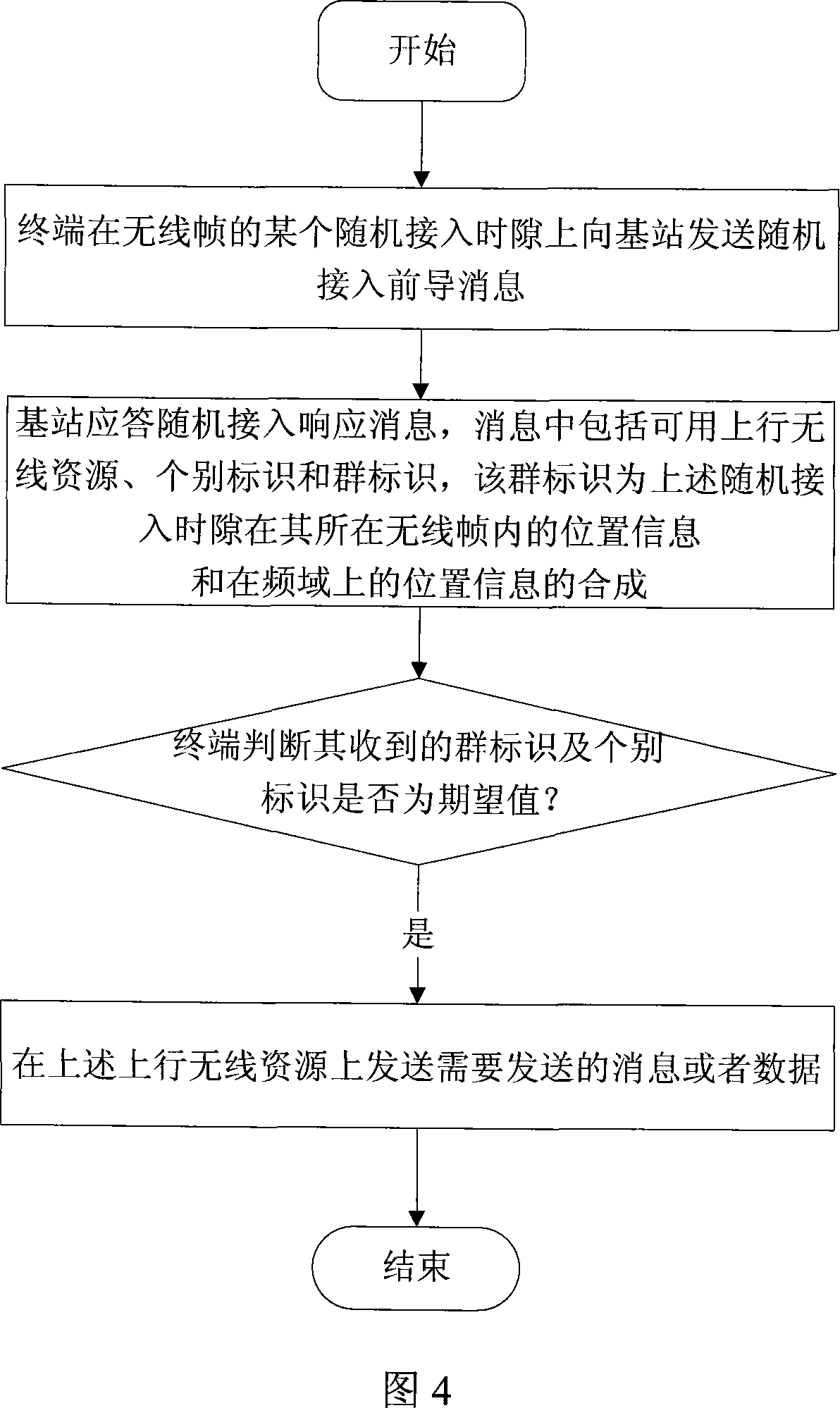
The utility model relates to a method for random access of terminal to cellular wireless communication system and creating group identifier, comprising following steps: a random time slot with a terminal in a wireless frame sends random access fronting information to a base station; the base station combines location information in the random time slot of the wireless frame and a frequency domain into a group identifier, adds the group identifier with a individual identifier into responding information, and sends the information to the terminal; the terminal judges if the group identifier and the individual identifier of random receiving information are expected value, if does, the terminal sends information and message to the base station on the uplink wireless resource. The utility model has the advantages that the group identifier that the random access responding information can be identified without SFN reading, which is important for random access during switching process, and the method is available for any configuration of the random access time slot.
Description
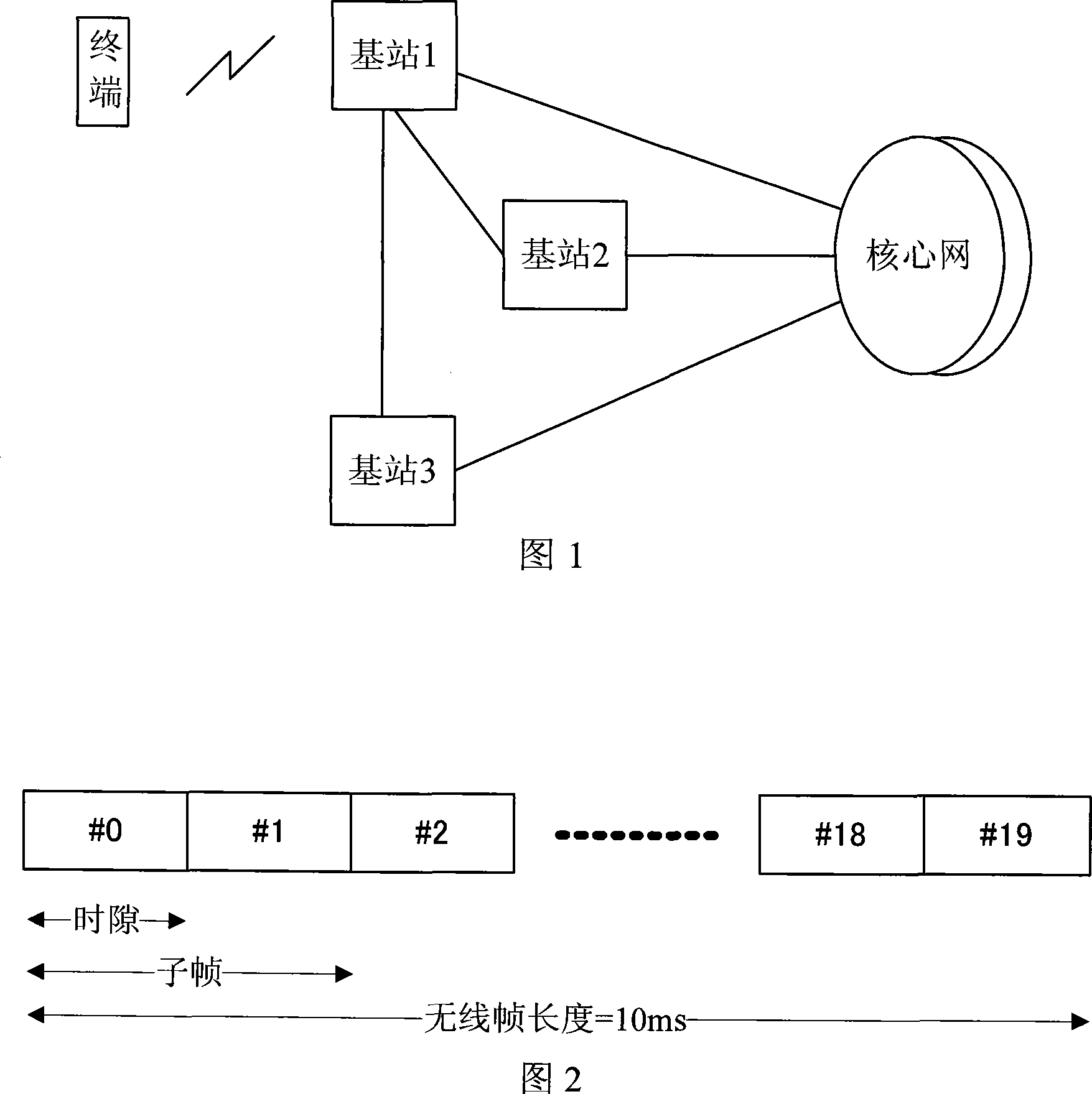
technical field [0001] The invention relates to a cellular wireless communication system, in particular to a method for a terminal to randomly access the cellular wireless communication system and a method for generating a group identifier. Background technique [0002] As shown in Figure 1, the cellular wireless communication system is mainly composed of terminals, base stations and core network. A network composed of base stations is called a radio access network (Radio Access Network, RAN), and is responsible for access layer affairs, such as management of radio resources. There may be physical or logical connections between base stations according to actual conditions, such as base station 1 and base station 2 or base station 3 in FIG. 1 . Each base station can be connected to one or more core network nodes (Core Network, CN). The core network is responsible for non-access stratum affairs, such as location updates, and is the anchor of the user plane. A terminal refer...
Claims
the structure of the environmentally friendly knitted fabric provided by the present invention; figure 2 Flow chart of the yarn wrapping machine for environmentally friendly knitted fabrics and storage devices; image 3 Is the parameter map of the yarn covering machine
Login to View More
Application Information
Patent Timeline
Application Date:The date an application was filed.
Publication Date:The date a patent or application was officially published.
First Publication Date:The earliest publication date of a patent with the same application number.
Issue Date:Publication date of the patent grant document.
PCT Entry Date:The Entry date of PCT National Phase.
Estimated Expiry Date:The statutory expiry date of a patent right according to the Patent Law, and it is the longest term of protection that the patent right can achieve without the termination of the patent right due to other reasons(Term extension factor has been taken into account ).
Invalid Date:Actual expiry date is based on effective date or publication date of legal transaction data of invalid patent.


 Login to View More
  Login to View More