Unlock instant, AI-driven research and patent intelligence for your innovation.

Method of synchronization and receiving end apparatus

A technology of receiving end and receiving antenna, applied in the directions of space transmit diversity, electrical components, orthogonal multiplexing system, etc., can solve the problems of underutilization of multi-antenna, synchronization accuracy of MIMO-OFDM system not reaching optimal performance, etc.

Active Publication Date: 2008-06-25
TD TECH COMM TECH LTD
View PDF0 Cites 12 Cited by
  • Summary
  • Abstract
  • Description
  • Claims
  • Application Information

AI Technical Summary

Problems solved by technology

The diversity combination performed in the maximum ratio combination method does not fully utilize the advantages of multiple antennas, so that the synchronization accuracy of the MIMO-OFDM system does not reach the optimal performance

Method used

the structure of the environmentally friendly knitted fabric provided by the present invention; figure 2 Flow chart of the yarn wrapping machine for environmentally friendly knitted fabrics and storage devices; image 3 Is the parameter map of the yarn covering machine
View more

Image

Smart Image Click on the blue labels to locate them in the text.
Viewing Examples
Smart Image
  • Method of synchronization and receiving end apparatus
  • Method of synchronization and receiving end apparatus
  • Method of synchronization and receiving end apparatus

Examples

Experimental program
Comparison scheme
Effect test

Embodiment 1

[0071] In this embodiment, in order to ensure smooth synchronization of the MIMO-OFDM system, before the system starts to work, the time domain synchronization sequence after the IFFT transformation of the sending end is saved in the receiving end. figure 2 A flow chart of the synchronization method in this embodiment is shown.

[0072] see figure 2 , in step 201, the sending end performs IFFT transformation on the synchronization sequence, and sends it to the receiving end.

[0073] This step is the initial operation of MIMO-OFDM system synchronization, and the purpose of performing IFFT transformation on the synchronization sequence stored by the transmitting end is to convert the synchronization sequence from a frequency domain signal to a time domain signal. In this embodiment, assuming that the length of the synchronization sequence is N / 2, the synchronization sequence can be expressed as: C={C(k), k=0, 1, ..., N / 2-1}, and carried on even subcarriers of OFDM symbols. ...

Embodiment 2

[0119] In this embodiment, before the system starts working, the sending end and the receiving end also store the same synchronization sequence. The difference from Embodiment 1 is that in this embodiment, after determining the position of the search window, precise fine timing estimation is performed for each receiving antenna, and then the receiving antenna with the smallest fine timing precise estimation value is selected as the fine timing selection antenna. image 3 A flow chart of the synchronization method in this embodiment is shown. see image 3 , the synchronization method in this embodiment includes:

[0120] In steps 301-302, the sending end performs inverse fast Fourier transform (IFFT) on the synchronous sequence and sends it to the receiving end; after receiving the signals from the sending end through multiple receiving antennas, the receiving end calculates all The autocorrelation characteristic value and energy statistical value corresponding to the receive...

the structure of the environmentally friendly knitted fabric provided by the present invention; figure 2 Flow chart of the yarn wrapping machine for environmentally friendly knitted fabrics and storage devices; image 3 Is the parameter map of the yarn covering machine
Login to View More

PUM

No PUM Login to View More

Abstract

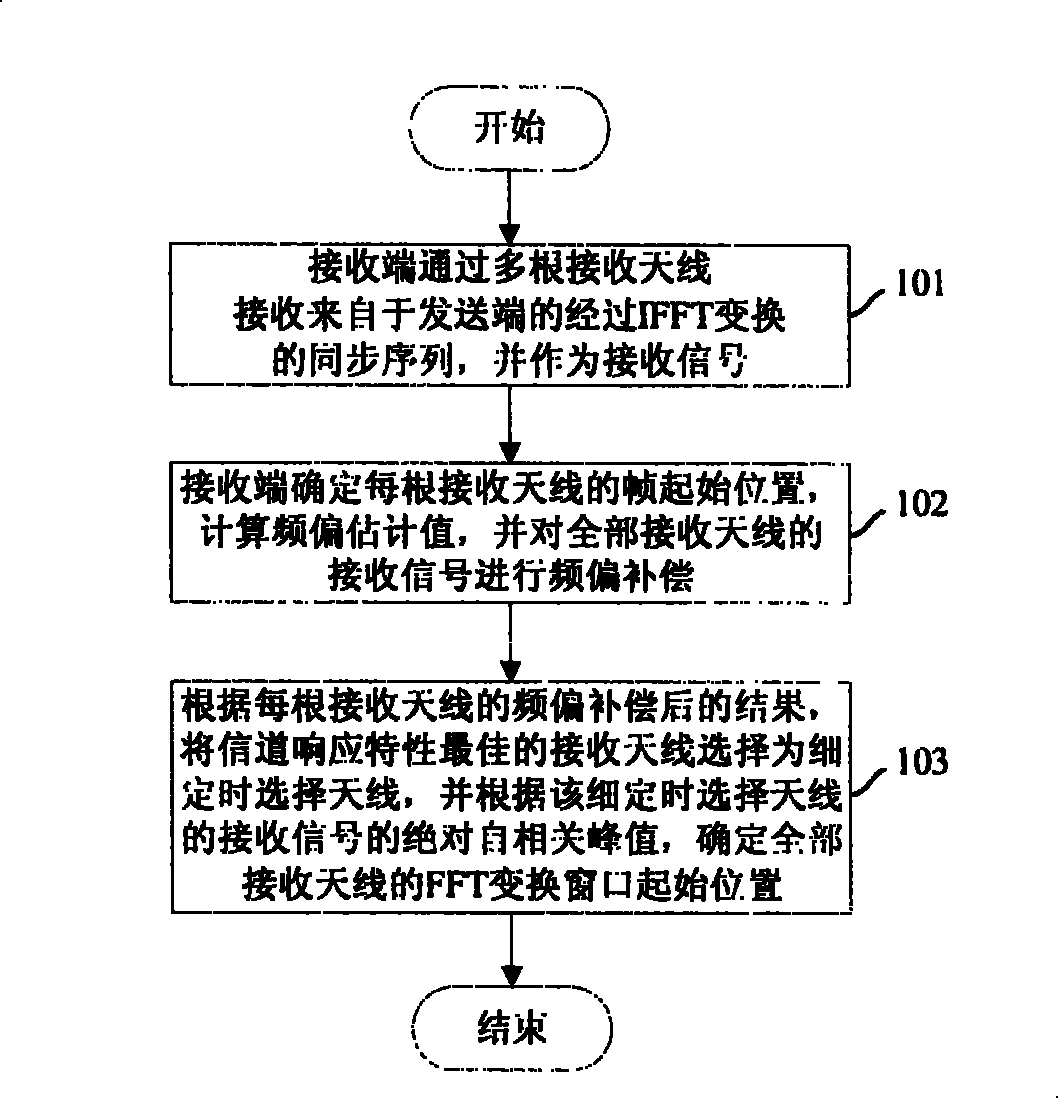
The invention discloses a synchronization method which comprises the following steps: A. a receiving end receives a synchronous sequence processed by IFFT transformation from a transmitting end through a plurality of receiving antennas as a received signal. B. the receiving end determines the frame starting positions of all the receiving antennas, calculates the estimated value of frequency deviation and compensates the frequency deviation of all the antennas. C. the receiving antenna with premium response performance is selected as a fine timing selected antenna according to the results of the antennas after being compensated for frequency deviation, and the starting position information of the FFT windows of all the receiving antennas is determined according to the absolute self-correlation peak value of a signal received by the fine timing selected antenna. The invention also discloses a receiving end device for synchronization, and the device comprises a plurality of receiving antennas, a rough synchronization module, a frequency deviation estimation and compensation module, and a fine timing module. The technical proposal of the invention can improve the synchronization precision effectively.

Description

technical field [0001] The present invention relates to Multiple Input and Multiple Output (MIMO, Multiple Input and Multiple Output) technology, in particular to a system synchronization method and receiving end equipment based on MIMO and Orthogonal Frequency Division Multiplexing (OFDM, Orthogonal Frequency Division Multiplexing) technology. Background technique [0002] OFDM technology is a multi-carrier transmission technology, which divides the channel into several orthogonal sub-channels, converts high-speed data streams into parallel low-speed sub-data streams, and modulates them on each sub-channel for transmission. Signals on orthogonal sub-channels in an OFDM system can be separately demodulated by the receiving end, which can reduce inter-carrier interference (ICI, Inter-Carrier Interference) between sub-channels and efficiently utilize spectrum resources. Since the total bandwidth is divided into several narrowband subcarriers, when the bandwidth of each subchan...

Claims

the structure of the environmentally friendly knitted fabric provided by the present invention; figure 2 Flow chart of the yarn wrapping machine for environmentally friendly knitted fabrics and storage devices; image 3 Is the parameter map of the yarn covering machine
Login to View More

Application Information

Patent Timeline
no application Login to View More
Patent Type & Authority Applications(China)
IPC IPC(8): H04L27/26H04J11/00H04B7/04
Inventor 张建华刘光毅赵浩冯冲张平
Owner TD TECH COMM TECH LTD