
Electricity saving method for TD-SCDMA terminal
A code division multiple access and time division synchronization technology, applied in the field of power saving of TD-SCDMA terminals, to achieve the effect of power saving air interface performance
- Summary
- Abstract
- Description
- Claims
- Application Information
AI Technical Summary
Problems solved by technology
Method used
Image

Examples
Embodiment Construction
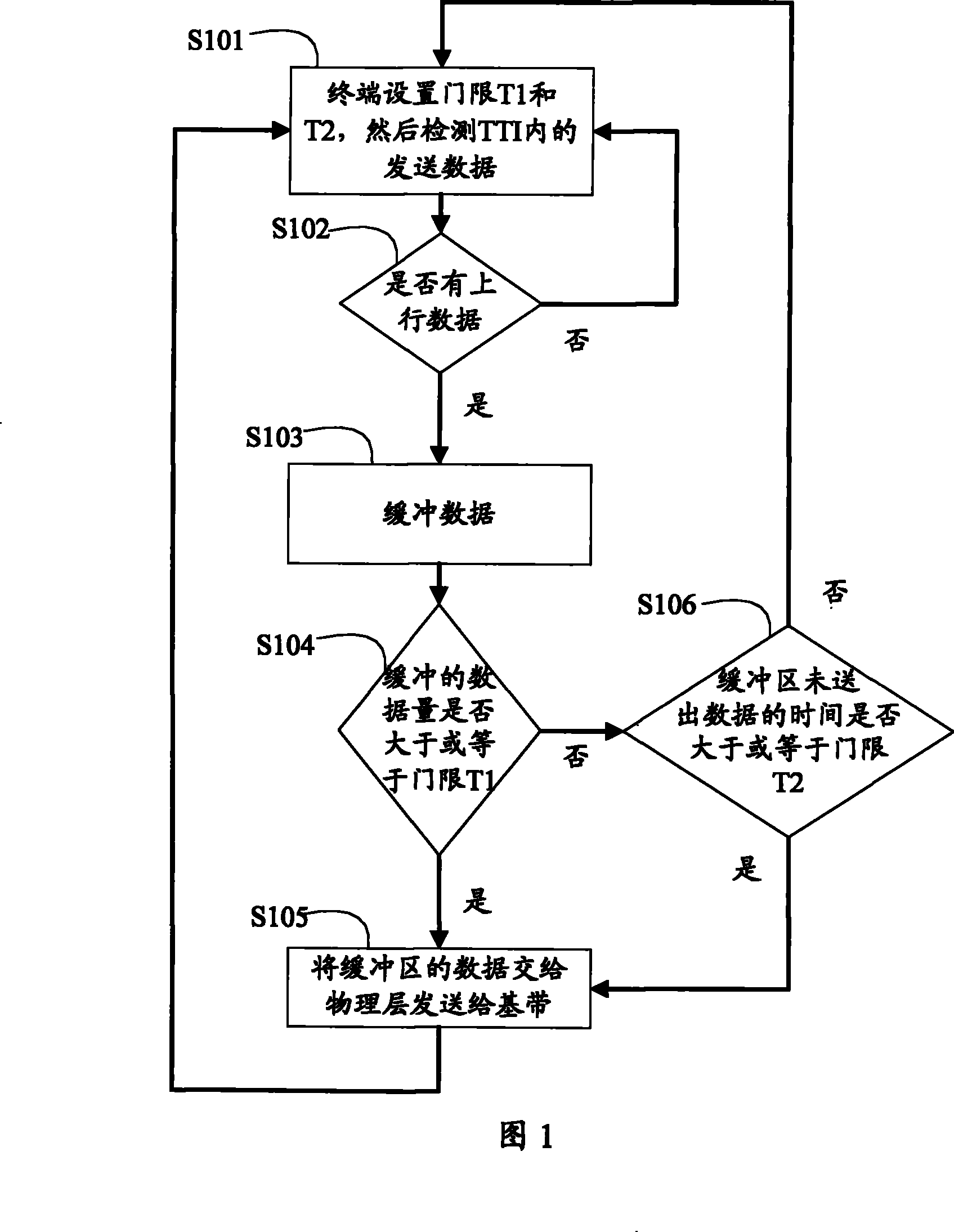
[0021] The solution of the invention is to perform proper buffer processing between the source of the original rate (that is, the TD-SCDMA terminal) and the baseband processing, complete the buffering and flow control of the uplink original data, and then send it to the baseband.
[0022] In the present invention, a threshold is set on the TD-SCDMA terminal, and when the buffered uplink original data reaches the threshold, the data is sent to the baseband. The threshold can be the amount of data at the full rate of N TTIs (transmission time intervals), where N is an integer greater than or equal to 1. When the cached upstream raw data does not reach the threshold, the data is always cached and sent to the baseband rate is 0. In addition, in order to guarantee the QoS requirements of delay and jitter, a timer can be set, and when the accumulated time of the buffered uplink raw data reaches the time set by the timer, even if the above threshold is not reached, the cached The up...
PUM
 Login to View More
 Abstract
Description
Claims
Application Information
 Login to View More