
Kit for distinguishing colorectal adenomas from colorectal cancer
A technology for colorectal cancer and rectal adenoma, applied in the field of kits for distinguishing colorectal adenoma and colorectal cancer, can solve the problems of lack of molecular markers and the early detection rate of colorectal cancer is less than 40%
- Summary
- Abstract
- Description
- Claims
- Application Information
AI Technical Summary
Problems solved by technology
Method used
Image

Examples
Embodiment 1
[0026] Embodiment 1, the construction of the kit for distinguishing colorectal adenoma and colorectal cancer
[0027] 1. Establishment of Molecular Model
[0028] 1. Blood collection, lipid molecule extraction and detection
[0029] 1) Research object
[0030] All samples were collected from May 2007 to May 2010. The samples came from the Second Artillery General Hospital of the PLA, Beijing Hospital, and the Second Affiliated Hospital of Peking University. Blood from fasting patients was taken in the morning for pretreatment. This project was approved by the Institutional Review Board, and all subjects signed informed consent.
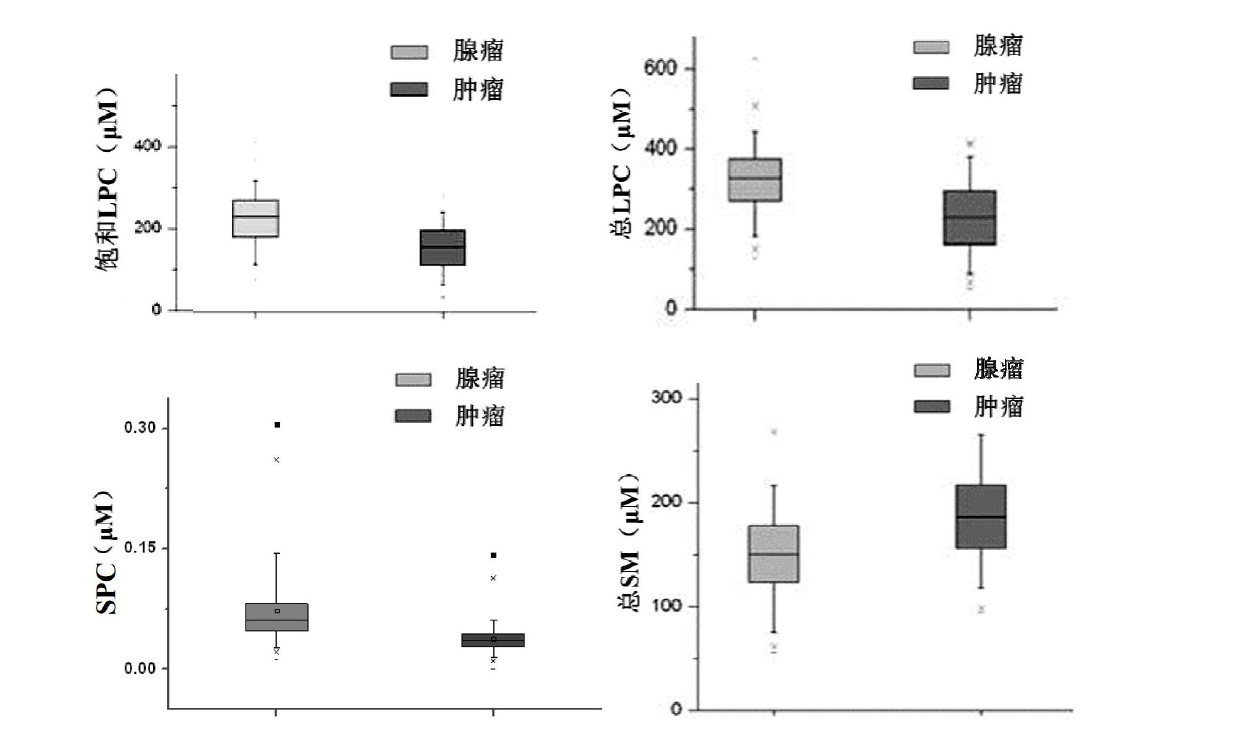
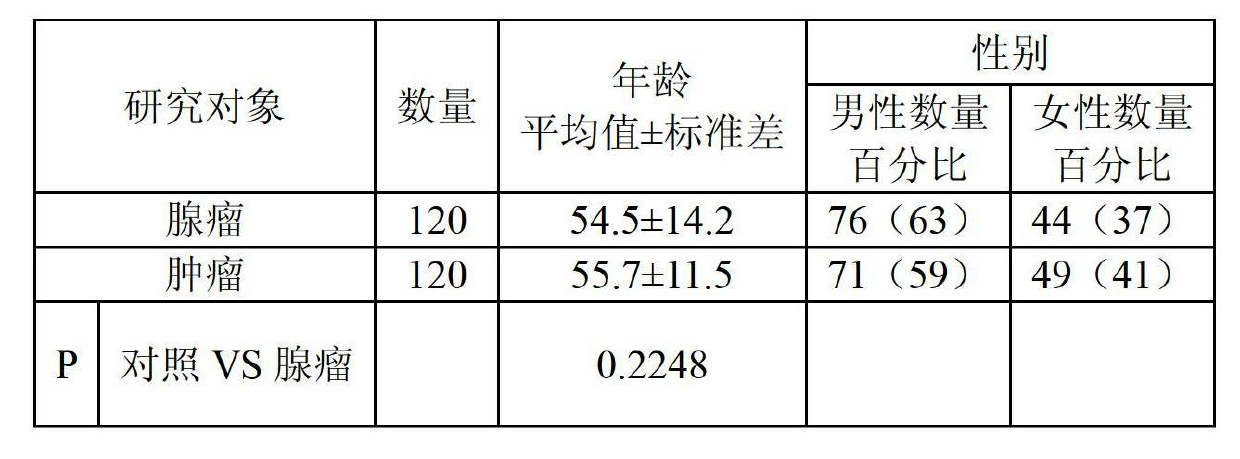
[0031] Table 1 summarizes the basic information of the research subjects: 240 subjects were all Chinese, 61% were male (147 / 240), and the proportion of male in patients with colorectal adenoma and colorectal cancer was 63% % and 59%. The ages of adenoma patients and tumor patients were: 54.5+14.2 and 55.7+11.8, respectively, and there was no sign...
Embodiment 2
[0066] Example 2, the application of the kit for distinguishing colorectal adenoma and colorectal cancer
[0067] 1. Sensitivity and specificity detection for distinguishing colorectal adenoma from colorectal cancer
[0068] Blood from 120 colorectal adenomas (all clinically identified) and 120 patients with colorectal cancer (all clinically identified and diagnosed) were collected; in vitro plasma preparation, lipid Class extraction, liquid chromatography-mass spectrometer detection, obtain the content of SPC, 16:0SM, 18:0SM, 14:0LPC, 16:0LPC, 18:0LPC, 20:0LPC and 22:0LPC in plasma;
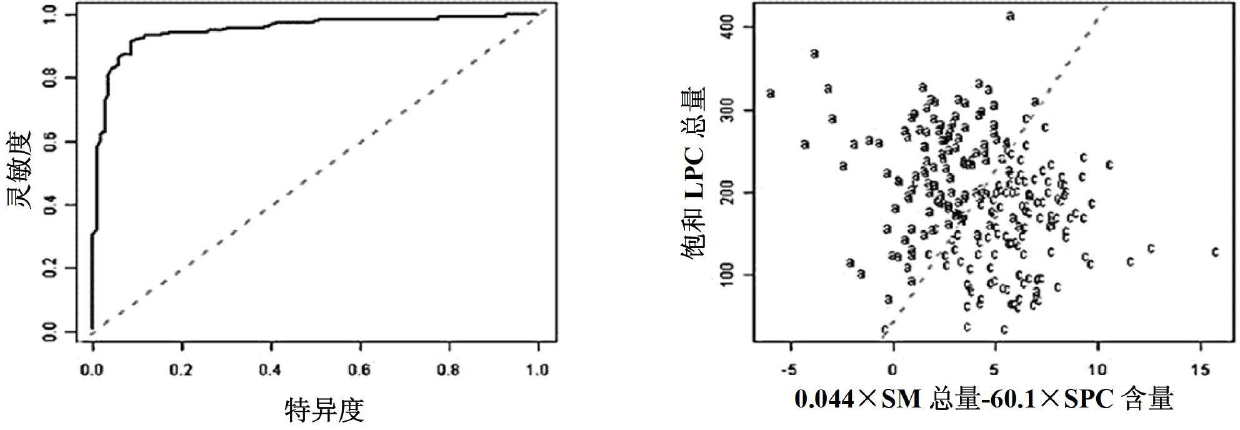
[0069] Take 0.044×SM total amount-60.1×SPC content as the abscissa, take the saturated LPC total amount as the ordinate, and use the formula of the model [0.044×SM total amount-60.1×SPC content-0.027×saturated LPC total amount=-1.06] Draw a straight line and make a graph.
[0070] The result is as figure 2 As shown in the right figure, the plasma 0.044×SM total amount – 60.1×SPC content in t...
PUM
 Login to View More
 Abstract
Description
Claims
Application Information
 Login to View More