
Method and device realizing PVLAN through OpenFlow protocol
An openflow protocol and purpose technology, applied in the communication field, can solve the problems of large main VLAN MAC table, decreased forwarding rate, lack of application layer connection flow monitoring, etc.
- Summary
- Abstract
- Description
- Claims
- Application Information
AI Technical Summary
Problems solved by technology
Method used
Image

Examples
example 1
[0040] Example 1: Uplink unicast packets of isolated VLAN
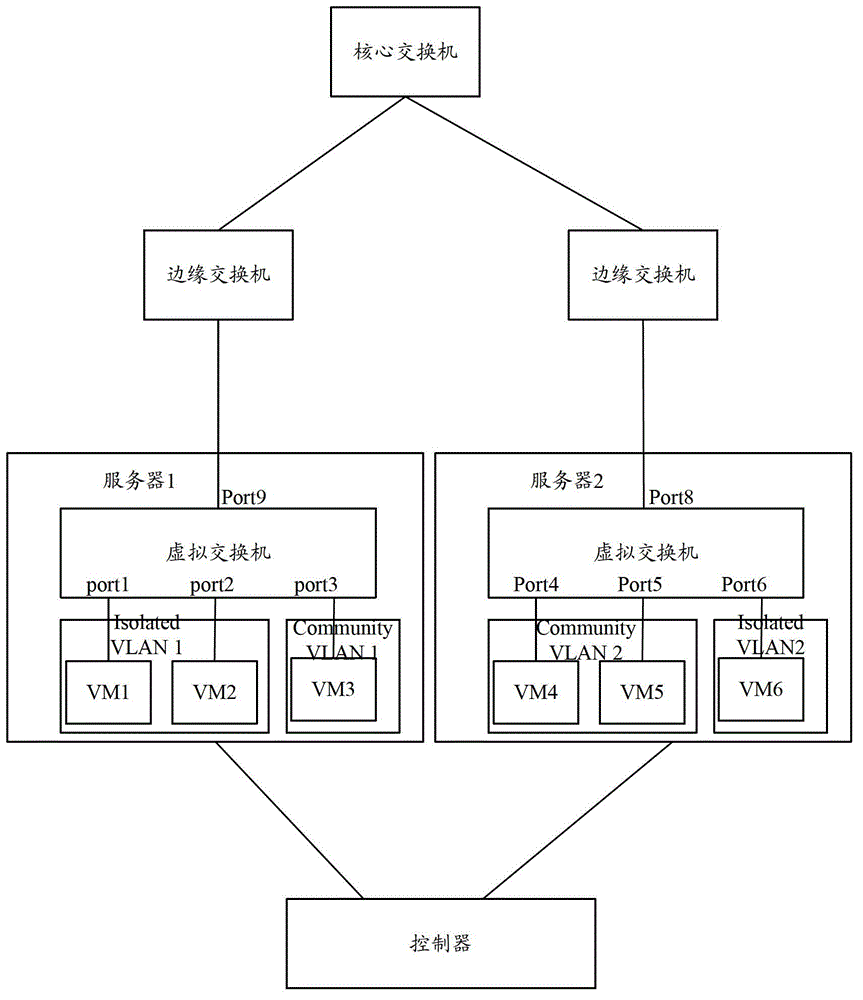
[0041] When the message is a unicast message in which the sub-VLAN to which the ingress port belongs is an isolated VLAN, if the VDSs to which the ingress port and the destination port respectively belong are different, construct a first flow table; otherwise, discard the unicast message Wherein, the packet header field of the first flow table includes the ingress port and the destination MAC, and the action field includes setting the VLAN as the main VLAN and forwarding through the uplink port.
[0042] In this example, when the OpenFlow controller receives a unicast packet sent by the server and the source port of the sub-VLAN belongs to the isolated VLAN, the port in the isolated VLAN can only communicate with ports other than the VDS where it is located. , cannot communicate with any port in the isolated VLAN or Community VLAN in the same VDS, so after determining that the destination port of the unicast message d...
example 2
[0048] Example 2: Uplink unicast packets of Community VLAN
[0049] When the message is a unicast message in which the sub-VLAN to which the ingress port belongs is a Community VLAN, if the respective sub-VLANs to which the ingress port and the destination port belong are the same Community VLAN in the same main VLAN, or the ingress port Different from the VDS to which the destination ports belong respectively, construct a second flow table; otherwise, discard the unicast message; wherein, the packet header field of the second flow table includes the ingress port and destination MAC, and the action field includes Set the VLAN as the main VLAN and forward it through the uplink port.
[0050] Here, the ingress port and destination MAC address in the delivered flow table are the contents contained in the Header Fields, and the egress port and the set primary VLAN are the contents contained in the Action. Wherein, the outgoing port is the port number of the VEPA switch connected ...
example 3
[0053] Example 3: Downlink unicast packets of isolated VLAN / Community VLAN
[0054] When the message is a unicast message whose ingress port is an uplink port, construct a third flow table, the header field of the third flow table includes the ingress port and destination MAC, and the action domain includes forwarding through the destination port .
[0055] In the flow table delivered in this example, the Header Fields can include the inbound port number, primary VLAN ID, source MAC address, and destination MAC address, and the Action includes the forwarded outbound port number. Wherein, the inbound port number is the uplink port receiving the unicast message, that is, the port number connecting the VEPA switch to the edge switch, and the outbound port number is the port corresponding to the destination MAC address of the unicast message.
[0056] Since the uplink unicast packets of isolated VLAN and community VLAN are filtered according to their characteristics at the sendin...
PUM
 Login to View More
 Abstract
Description
Claims
Application Information
 Login to View More