A Fragile Digital Watermarking Method for Stereo Image Pixel Tampering Location

A stereoscopic image and digital watermarking technology, applied in image data processing, image data processing, instruments, etc., can solve the problems of rare fragile watermarking methods, and the transparency and effectiveness of stereoscopic images need to be further improved.

CN104361547BActive Publication Date: 2017-10-24广州方维知识产权运营有限公司
3 Cites 0 Cited by

Patent Information

Authority / Receiving Office
CN · China
Patent Type
Patents(China)
Current Assignee / Owner
Publication Date
2017-10-24

Smart Images

  • Figure 1
    Figure 1
  • Figure 2
    Figure 2
  • Figure 3
    Figure 3
Patent Text Reader

Abstract

The invention discloses a fragile digital watermarking method for tampering and positioning stereoscopic image pixels. At the digital watermarking embedding end, the masking characteristic of binocular visual perception of human eyes, that is, the distortion that can be detected by both eyes, is used to guide the embedding of digital watermarking, so that the stereoscopic image Transparency and watermark embedding capacity have reached a good balance, and according to the high five-bit image information of the left and right viewpoints and the binocular just distortion model as the input of the MD5 hash function to generate a feature watermark image, and then use an adaptive method to embed the watermark information into In the left and right viewpoints of the stereoscopic image, through the above process, the security of the digital watermarking technology is guaranteed; in the process of tampering and positioning, the high five-bit feature watermark information of the attacked stereoscopic image is extracted, and then the watermark information of the attacked stereoscopic image is extracted , comparing the two types of watermark information to initially determine the tampering location, and then using the parallax information to further enhance the accuracy of the tampering location, which can effectively authenticate the authenticity and integrity of the stereoscopic image content.
Need to check novelty before this filing date? Find Prior Art

Description

technical field

[0001] The invention relates to a digital watermarking technology, in particular to a fragile digital watermarking method for tampering and positioning stereoscopic image pixels. Background technique

[0002] Stereoscopic images are becoming more and more popular because they can provide depth information to bring people a more real new visual experience. At the same time, the application requirements of the market also promote the rapid development of stereoscopic image processing technology. With the continuous development of computer networks and communication technologies, attackers can easily copy, modify, edit, and tamper with stereoscopic images, making the content of these high-end resources questionable. How to locate and authenticate the tampering of stereoscopic image content has become an urgent problem to be solved.

[0003] As a kind of information hiding technology, digital watermark technology provides a new solution for multimedia content au...

Examples

Embodiment Construction

[0059] The present invention will be further described in detail below in conjunction with the accompanying drawings and embodiments.

[0060] Since the stereoscopic image embedded with the watermark is finally perceived by human eyes, in order to maintain the transparency of the stereoscopic image, the present invention proposes a fragile digital watermarking method for tampering and locating the pixels of the stereoscopic image. The Binocular Just-Noticeable-Difference (BJND) model guides the embedding of stereo image digital watermark, so that the transparency and capacity of the watermark are well balanced.

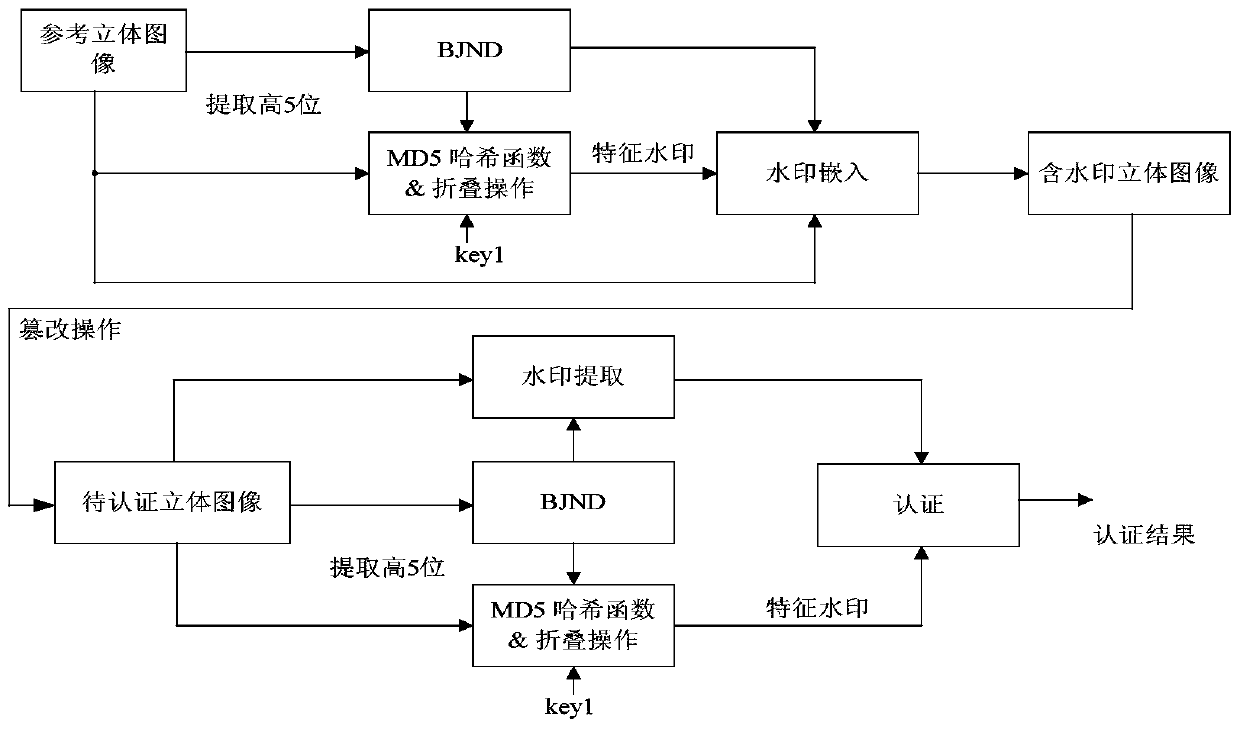
[0061] A fragile digital watermarking method for tampering and positioning of stereoscopic image pixels proposed by the present invention, its overall realization block diagram is as follows figure 1 As shown, it includes the following steps:

[0062] ①-1, order represents the left view image of the reference stereo image, so that Represents the right view image ...