Lithium secondary battery and nonaqueous electrolyte
What is AI technical title?
AI technical title is built by Patsnap AI team. It summarizes the technical point description of the patent document.
A non-aqueous electrolyte, secondary battery technology, used in high-output lithium secondary batteries and long-life fields, can solve the problem of not being able to obtain output
Active Publication Date: 2015-05-27
MITSUBISHI CHEM CORP +1
View PDF49 Cites 11 Cited by
Summary
Abstract
Description
Claims
Application Information
AI Technical Summary
This helps you quickly interpret patents by identifying the three key elements:
Problems solved by technology
Method used
Benefits of technology
Problems solved by technology
However, sufficient output cannot be obtained yet, and further improvement is required
Method used
the structure of the environmentally friendly knitted fabric provided by the present invention; figure 2 Flow chart of the yarn wrapping machine for environmentally friendly knitted fabrics and storage devices; image 3 Is the parameter map of the yarn covering machine
View more
Image
Smart Image Click on the blue labels to locate them in the text.
Viewing Examples
Smart Image
Click on the blue label to locate the original text in one second.
Reading with bidirectional positioning of images and text.
Smart Image
Examples
Experimental program
Comparison scheme
Effect test
preparation example Construction
[0797] The method for producing the above-mentioned amorphous carbonaceous material is not particularly limited as long as it does not exceed the scope of the present invention, and various methods can be mentioned. In the production of amorphous carbon, one heat treatment step is necessary, but the heat treatment may be divided into two or more times, and it is also preferable to perform various treatments before and after the heat treatment and / or in the middle of the heat treatment. The various treatments include pulverization, classification, and the above-mentioned crosslinking treatment, etc., and the pulverization and classification treatment may be performed at any one of the before, after, and intermediate stages of the heat treatment as long as it is in a solid state. The crosslinking treatment is preferably performed before or during the heat treatment. By performing these treatments, the specific surface area of the negative electrode active material can be contr...
Embodiment
[1988] Hereinafter, although an Example and a comparative example are given and this invention is demonstrated more concretely, this invention is not limited to these Examples unless the summary of this invention is exceeded.
[1989] Positive electrode[1][Positive electrode active material]
[1990] The types and physical properties of positive electrode active materials used in the following Examples and Comparative Examples are as follows.
[1991] Positive electrode [1] Table 1
[1992] [Table 1]
[1993]
[1994] Positive electrode [1] In Table 1, as the physical properties of the positive electrode active material, BET specific surface area, average primary particle size (measured by SEM), median particle size d 50 , Determination of tap density.
[1995] [Positive electrode active material A]
[1996] The positive electrode active material A is a lithium transition metal composite oxide synthesized by the method shown below, with the composition formula LiMn 0.3...
Embodiment 2
[2024] It carried out similarly to positive electrode [1] Example 1 except having made electrolytic solution contain 0.3 mass % of trimethylsilyl methanesulfonate instead of hexamethylcyclotrisiloxane. The results of the battery evaluation are shown in Table 2 of the positive electrode [1].
the structure of the environmentally friendly knitted fabric provided by the present invention; figure 2 Flow chart of the yarn wrapping machine for environmentally friendly knitted fabrics and storage devices; image 3 Is the parameter map of the yarn covering machine
Login to View More
PUM
Property
Measurement
Unit
face spacing
aaaaa
aaaaa
face spacing
aaaaa
aaaaa
density
aaaaa
aaaaa
Login to View More
Abstract
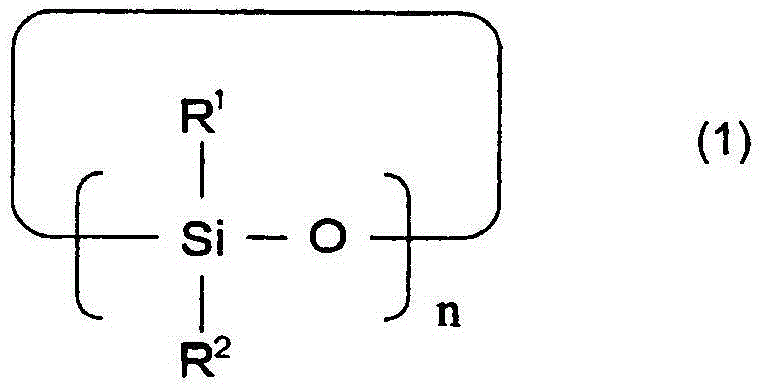
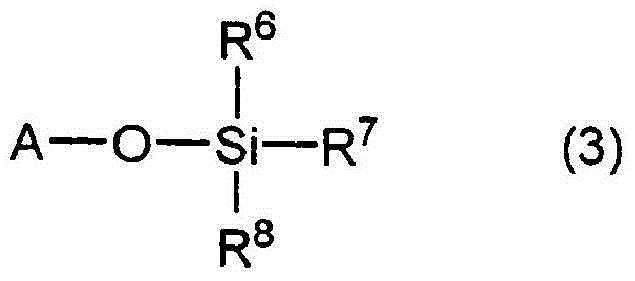
A lithium secondary battery comprising: a positive electrode and a negative electrode which each has a specific composition and specific properties; and a nonaqueous electrolyte which contains a cyclic siloxane compound represented by general formula (1), fluorosilane compound represented by general formula (2), compound represented by general formula (3), compound having an S-F bond in the molecule, nitric acid salt, nitrous acid salt, monofluorophosphoric acid salt, difluorophosphoric acid salt, acetic acid salt, or propionic acid salt in an amount of 10 ppm or more of the whole nonaqueous electrolyte. This lithium secondary battery has a high capacity, long life, and high output. [In general formula (1), R 1 and R 2 are an organic group having 1-12 carbon atoms and n is an integer of 3-10. In general formula (2), R 3 to R 5 are an organic group having 1-12 carbon atoms; x is an integer of 1-3; and p, q, and r each are an integer of 0-3, provided that 1‰ p+q+r‰ 3. In general formula (3), R 6 to R 8 are an organic group having 1-12 carbon atoms and symbol A is a group constituted of H, C, N, O, F, S, Si, and / or P.]
Description
[0001] This application is a divisional application of the application with the filing date of October 19, 2006, the application number of 201010242620.8, and the title of the invention "Lithium secondary battery and non-aqueous electrolyte used therein". technical field [0002] The present invention relates to a lithium secondary battery and a non-aqueous electrolytic solution used therein, more specifically, to a non-aqueous electrolytic solution for a lithium secondary battery containing specific components, and a non-aqueous electrolytic solution having a specific composition and physical properties capable of occluding and releasing lithium. positive and negative electrodes, and particularly lithium secondary batteries excellent in low-temperature discharge characteristics and high in capacity, long life, and high output, and nonaqueous electrolytic solutions used therein. Background technique [0003] In recent years, along with the miniaturization of electronic equipm...
Claims
the structure of the environmentally friendly knitted fabric provided by the present invention; figure 2 Flow chart of the yarn wrapping machine for environmentally friendly knitted fabrics and storage devices; image 3 Is the parameter map of the yarn covering machine
Login to View More
Application Information
Patent Timeline
Application Date:The date an application was filed.
Publication Date:The date a patent or application was officially published.
First Publication Date:The earliest publication date of a patent with the same application number.
Issue Date:Publication date of the patent grant document.
PCT Entry Date:The Entry date of PCT National Phase.
Estimated Expiry Date:The statutory expiry date of a patent right according to the Patent Law, and it is the longest term of protection that the patent right can achieve without the termination of the patent right due to other reasons(Term extension factor has been taken into account ).
Invalid Date:Actual expiry date is based on effective date or publication date of legal transaction data of invalid patent.


 Login to View More