A method for avoiding congestion of network equipment and network equipment
What is AI technical title?
AI technical title is built by Patsnap AI team. It summarizes the technical point description of the patent document.
A technology for network equipment and congestion avoidance, applied in the field of communications, which can solve problems such as reduced throughput of network equipment
Active Publication Date: 2018-04-20
HUAWEI TECH CO LTD
View PDF6 Cites 0 Cited by
Summary
Abstract
Description
Claims
Application Information
AI Technical Summary
This helps you quickly interpret patents by identifying the three key elements:
Problems solved by technology
Method used
Benefits of technology
Problems solved by technology
[0005] Embodiments of the present invention provide a network device congestion avoidance method and a network device, which are used to solve the problem that in the prior art, after a network device receives a series of messages, it uses a random discrete packet loss method to discard the series of messages. The problem of reduced throughput of the network devices caused by packet processing
Method used
the structure of the environmentally friendly knitted fabric provided by the present invention; figure 2 Flow chart of the yarn wrapping machine for environmentally friendly knitted fabrics and storage devices; image 3 Is the parameter map of the yarn covering machine
View more
Image
Smart Image Click on the blue labels to locate them in the text.
Viewing Examples
Smart Image
Click on the blue label to locate the original text in one second.
Reading with bidirectional positioning of images and text.
Smart Image
Examples
Experimental program
Comparison scheme
Effect test
Embodiment 1
[0140] The method for network congestion avoidance provided in this embodiment includes the following steps:
[0141] Step 1. When the length of the currently used storage queue is between the first threshold 20 and the second threshold 120, the network device determines whether to perform packet loss processing on the packets belonging to the same data flow in the currently used storage queue.
[0142] Specifically, this step includes:
[0143] (1) Obtain the random numbers of the packets in the above four TCP streams.
[0144] For example, at this time, the random numbers of the packets in the above four TCP flows are the random discard probabilities of the packets in the above four TCP flows. Further, it is assumed that the random discard probability of the above 30 messages is ai, where i represents the number of the message, 1≤i≤30; ai represents the random discard probability of the i-th message, 0≤ ai≤1.
[0145] (2) Determine the current first threshold.
[0146] E...
Embodiment 2
[0165] In this embodiment, if the length of the current storage queue is between the first threshold 20 and the second threshold 120, then the network device determines whether it is necessary to perform packet loss processing on the packets in the above four TCP streams by using another One way to achieve. In this embodiment, only the differences from Embodiment 1 are listed, and other parts may refer to the description in Embodiment 1, and details are not repeated here.
[0166] Specifically, the alternative steps of step 1 in Embodiment 1 may be:
[0167] Step 1. When the length of the currently used storage queue is between the first threshold 20 and the second threshold 120, the network device determines whether to perform packet loss processing on the packets belonging to the same data flow in the currently used storage queue.
[0168] Specifically, this step includes:
[0169] (1) Obtain the random numbers of the above 4 TCP streams.
[0170] For example, at this tim...
the structure of the environmentally friendly knitted fabric provided by the present invention; figure 2 Flow chart of the yarn wrapping machine for environmentally friendly knitted fabrics and storage devices; image 3 Is the parameter map of the yarn covering machine
Login to View More
PUM
Login to View More
Abstract
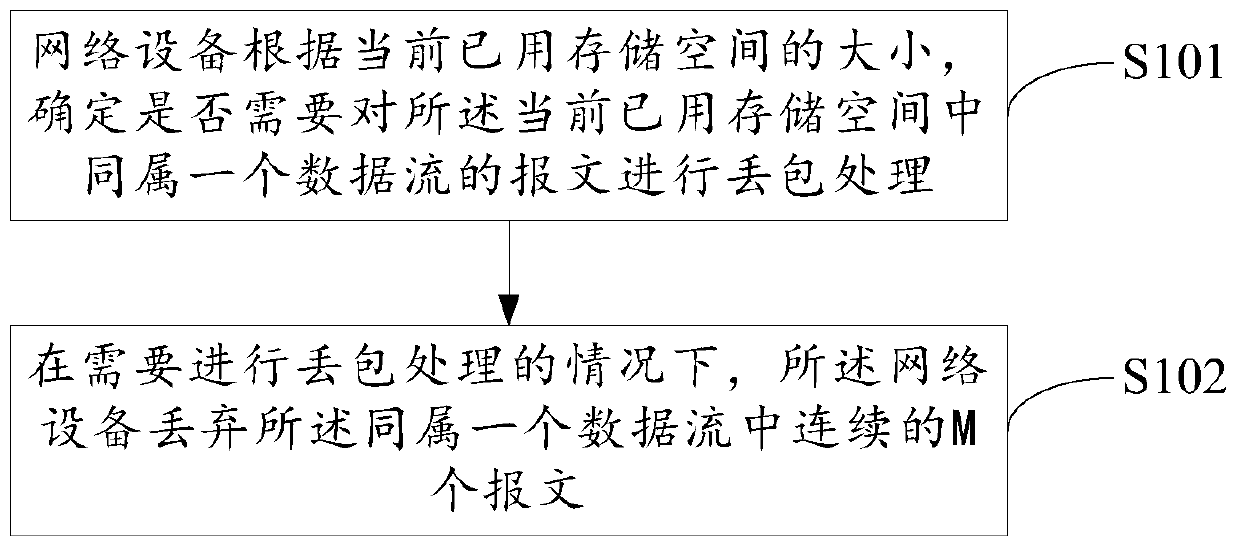
The invention discloses a network device congestion avoidance method and a network device, which are used to solve the problem that in the prior art, after a network device receives a series of messages, it uses a random discrete packet loss method to process the series of messages. The problem caused by the reduced throughput of the network device. The method includes: the network device determines whether to discard packets belonging to the same data flow in the currently used storage space according to the size of the currently used storage space; wherein, the packets belonging to the same data flow The number of messages is N, and N≥2; when packet lossprocessing is required, the network device discards consecutive M messages belonging to the same data flow, where 1≤M≤N.
Description
technical field [0001] The invention relates to the communication field, in particular to a network equipment congestion avoidance method and network equipment. Background technique [0002] In a communication network, a network device receives a message sent by a sender, and forwards the message to a receiver. However, when the number of packets sent by the sender is large, the network device will be congested. Network device congestion avoidance is to monitor the usage of the storage space in the network device. When the congestion tends to intensify, some messages in the storage space will be discarded actively, and the data flow in the network device will be adjusted to relieve the congestion. The problem of network equipment congestion. [0003] In the current technology, the above-mentioned problems are generally solved by using a random early detection (Random Early Detection, RED for short) algorithm, a weighted random early detection (WRED for short) algorithm, an...
Claims
the structure of the environmentally friendly knitted fabric provided by the present invention; figure 2 Flow chart of the yarn wrapping machine for environmentally friendly knitted fabrics and storage devices; image 3 Is the parameter map of the yarn covering machine
Login to View More
Application Information
Patent Timeline
Application Date:The date an application was filed.
Publication Date:The date a patent or application was officially published.
First Publication Date:The earliest publication date of a patent with the same application number.
Issue Date:Publication date of the patent grant document.
PCT Entry Date:The Entry date of PCT National Phase.
Estimated Expiry Date:The statutory expiry date of a patent right according to the Patent Law, and it is the longest term of protection that the patent right can achieve without the termination of the patent right due to other reasons(Term extension factor has been taken into account ).
Invalid Date:Actual expiry date is based on effective date or publication date of legal transaction data of invalid patent.


 Login to View More
  Login to View More