
Picture projection display method
A display method and photo technology, applied in the field of photo projection, can solve problems such as slow photo projection speed, and achieve the effects of improving projection speed and user projection experience, enhancing projection fluency, and increasing projection success rate
- Summary
- Abstract
- Description
- Claims
- Application Information
AI Technical Summary
Problems solved by technology
Method used
Image

Examples
Embodiment Construction
[0011] The embodiments of the present invention will be described in detail below with reference to the accompanying drawings, but the present invention can be implemented in many different ways defined and covered by the claims.
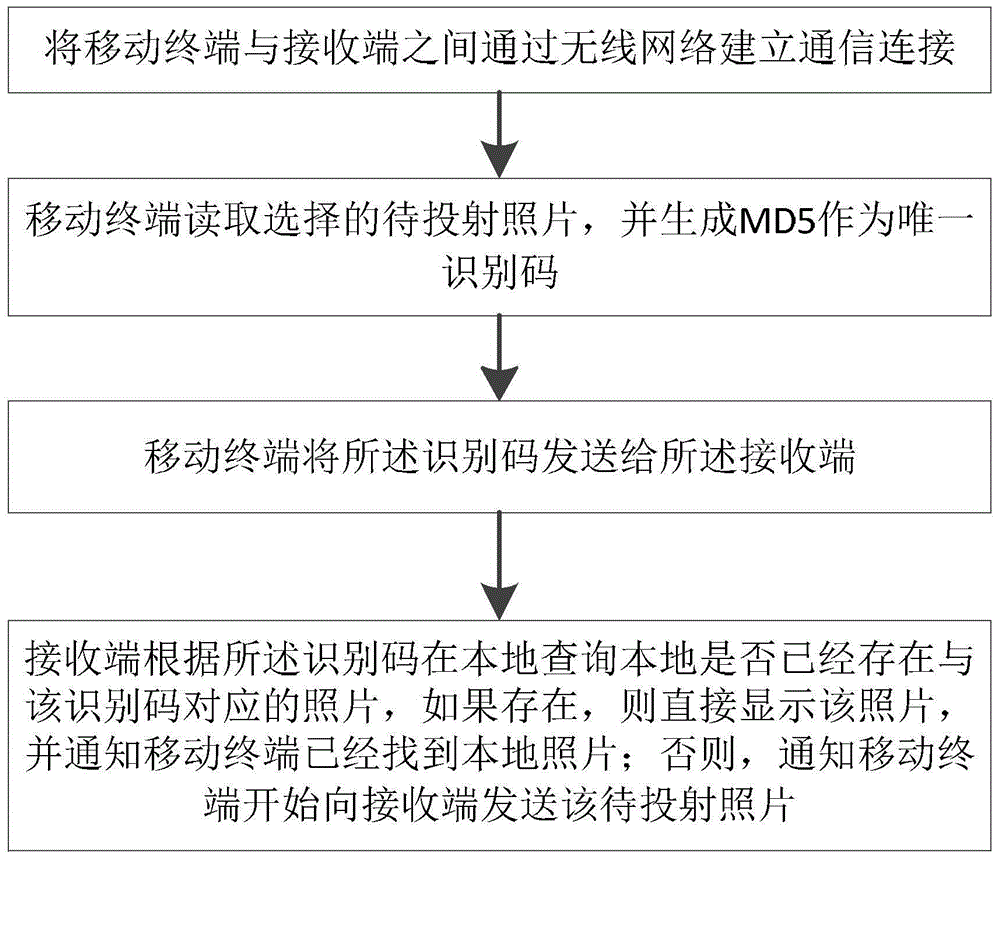
[0012] Please refer to figure 1 , the present invention provides a photo projection display method, comprising: establishing a communication connection between a mobile terminal and a receiving terminal through a wireless network; the mobile terminal reads the selected photo to be projected, and generates an MD5 value as a unique identification code; The terminal sends the identification code to the receiving end; the receiving end inquires locally according to the identification code whether there is a photo corresponding to the identification code locally, and if so, directly displays the photo and notifies the mobile terminal that the photo has been found local photo; otherwise, notify the mobile terminal to start sending the photo to be projecte...
PUM
 Login to View More
 Abstract
Description
Claims
Application Information
 Login to View More