
Fluorophosphate optical glass
An optical glass, fluorophosphate technology, applied in optics, optical components, instruments, etc., can solve the problems of chemical stability, insufficient thermal stability, processing performance, easy to produce crystallization and stripes, poor thermal stability of glass, etc. To achieve good chemical stability, excellent thermal stability, excellent special dispersion effect
- Summary
- Abstract
- Description
- Claims
- Application Information
AI Technical Summary
Problems solved by technology
Method used
Image



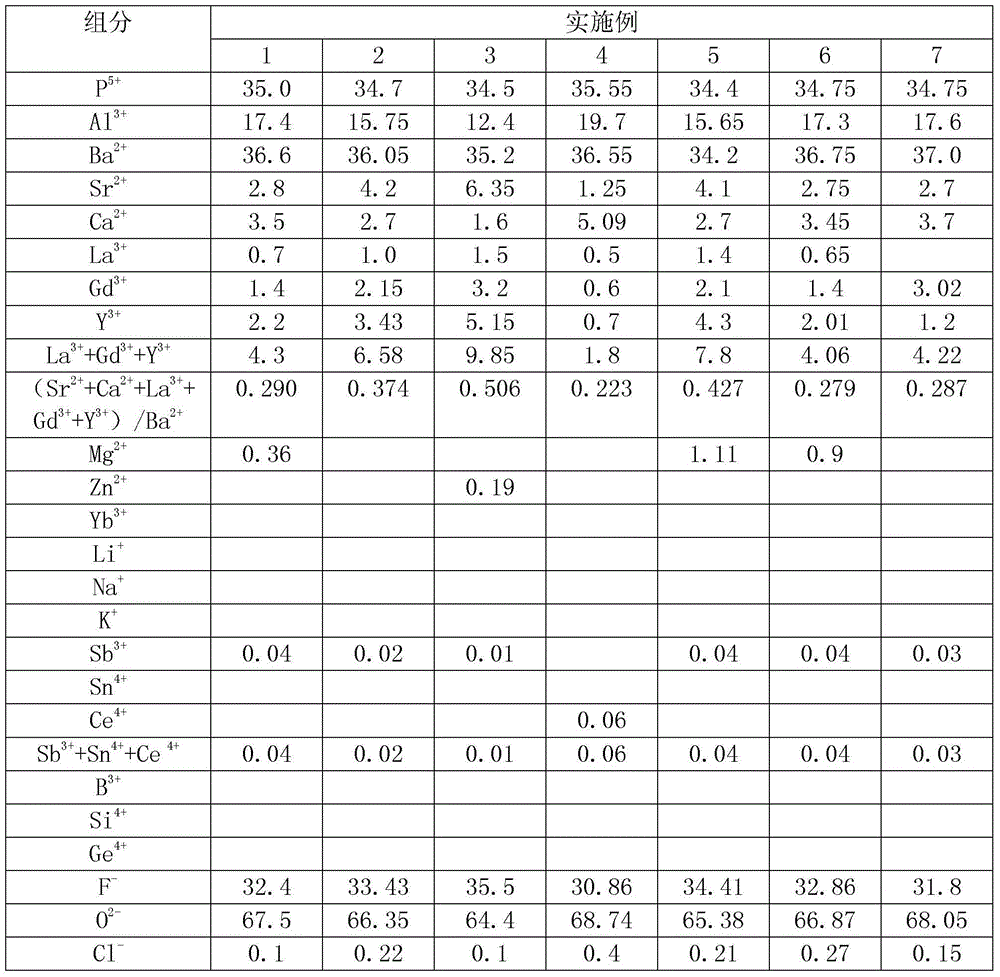
Examples
Embodiment Construction
[0024] The role of each composition and the scope-limiting role of the present invention are explained below.
[0025] It should be noted that in this specification, each cationic component and the total content of cationic components are represented by "cation percentage", and each anion component and the total content of anion components are represented by "anion percentage". "Cation percentage" refers to the percentage of a certain cationic component in the total cationic content, and "anion percentage" refers to the percentage of a certain anionic component in the total anionic content. The aforementioned contents are molar contents.
[0026] P 5+ It is a composition constituting the glass network. When the content is less than 30%, the stability of the glass is poor, and when the content exceeds 40%, it is difficult to obtain the high refractive index required by the present invention. Considering from the required optical performance and chemical stability of the prese...
PUM
| Property | Measurement | Unit |
|---|---|---|
| photoelasticity | aaaaa | aaaaa |
| thickness | aaaaa | aaaaa |
| refractive index | aaaaa | aaaaa |
Abstract
Description
Claims
Application Information
 Login to View More