
A strain of Bacillus amyloliquefaciens bam22 with high efficiency in controlling clubroot of cruciferous species
A technology of amylolytic spores and Brassicaceae, applied in the direction of bacteria, microorganisms, and methods based on microorganisms, can solve the problems of poor control effects of biocontrol strains, unfavorable balance of soil flora, and unsatisfactory control effects, etc., to achieve good results Inhibitory effect, low application concentration, and low application dose
- Summary
- Abstract
- Description
- Claims
- Application Information
AI Technical Summary
Problems solved by technology
Method used
Image

Examples
Embodiment 1
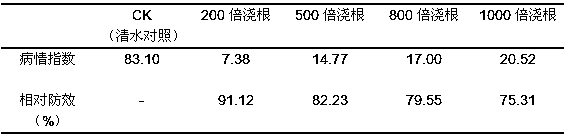
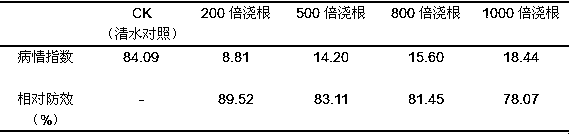
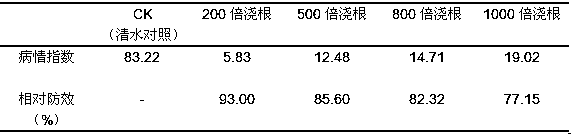
[0017] Control effect experiment of Bacillus amyloliquefaciens Bam22 on cruciferous clubroot
[0018] Experimental objects: Rapeseed, Chinese cabbage, broccoli.
[0019] After culturing Bacillus amyloliquefaciens Bam22 for 48 hours, dilute it 200 times, 500 times, 800 times, and 1000 times, and use the root watering method to water 100ml of each plant when transplanting, once every 7 days, and then again every 14 days . Note: The bacterial concentration of the undiluted bacterial solution is about 6-8×10 9 cfu / ml.
[0020] Disease classification:
[0021] Grade 0: There is no tumor in the root, and the root system develops normally;
[0022] Grade 1: 1-30% of the roots have a little tumor, with small nodular masses that are not connected to each other;
[0023] Grade 2: 31-60% of root tumors with large nodular or globular masses, interconnected;
[0024] Grade 3: 61-100% root tumors, enlarged to form spindle-shaped tumors, large tumor masses extending to hypocotyls, pla...
PUM
 Login to View More
 Abstract
Description
Claims
Application Information
 Login to View More