
A load balancing method and base station suitable for heterogeneous networks
A load balancing and base station technology, applied in the field of communication, can solve problems such as affecting the effect of load balancing, increasing air interface signaling overhead, unable to continue to adjust the number of ABS subframes, etc., to achieve improved effects, reduce air interface signaling overhead, high system The effect of capacity gain
- Summary
- Abstract
- Description
- Claims
- Application Information
AI Technical Summary
Problems solved by technology
Method used
Image

Examples
Embodiment 1
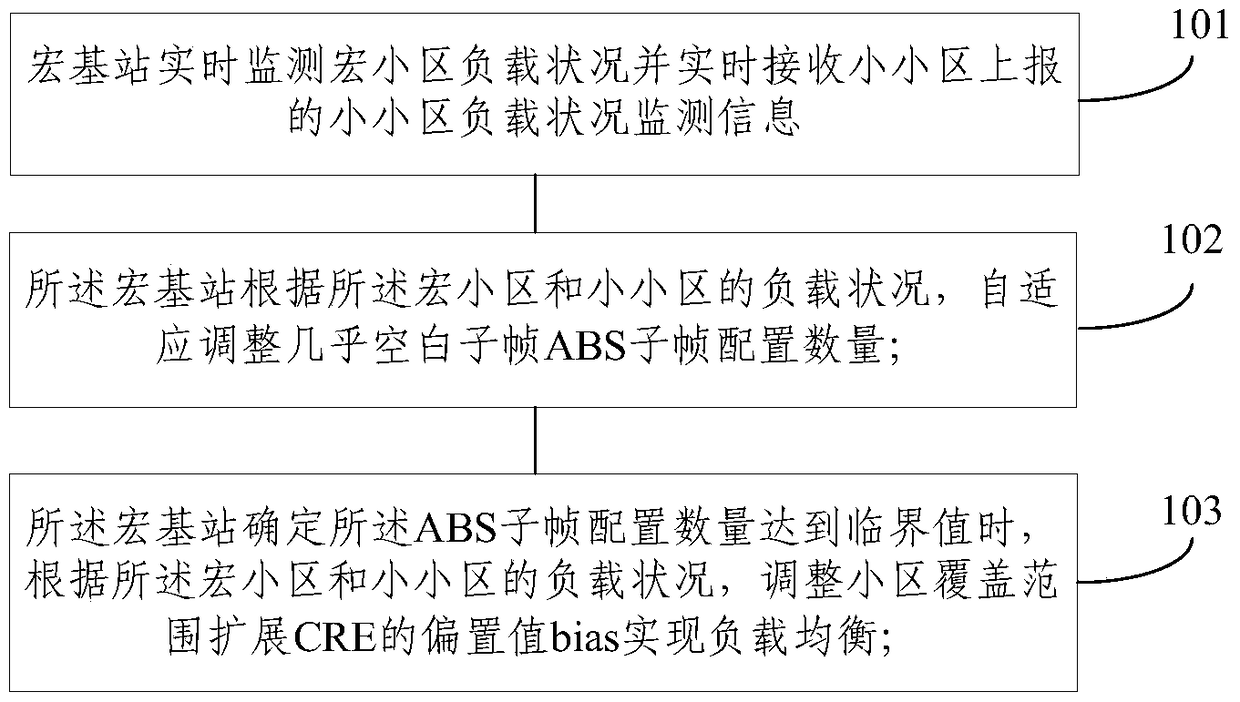
[0044] This embodiment discloses a load balancing method suitable for heterogeneous networks, such as figure 1 As shown, the method may include the following steps:
[0045] 101. The macro base station monitors the load status of the macro cell in real time and receives the load status monitoring information of the small cell reported by the small cell in real time;
[0046] 102. According to the load status of the macro cell and the small cell, the macro base station adaptively adjusts the number of almost blank subframe ABS subframe configurations, and the adaptive adjustment method can be realized by using an existing algorithm;
[0047] 103. When the macro base station determines that the number of configured ABS subframes reaches a critical value, according to the load status of the macro cell and the small cell, adjust the bias value bias of the cell coverage extension CRE to achieve load balancing;
[0048] Wherein, the critical value is determined according to the pre...
Embodiment 2
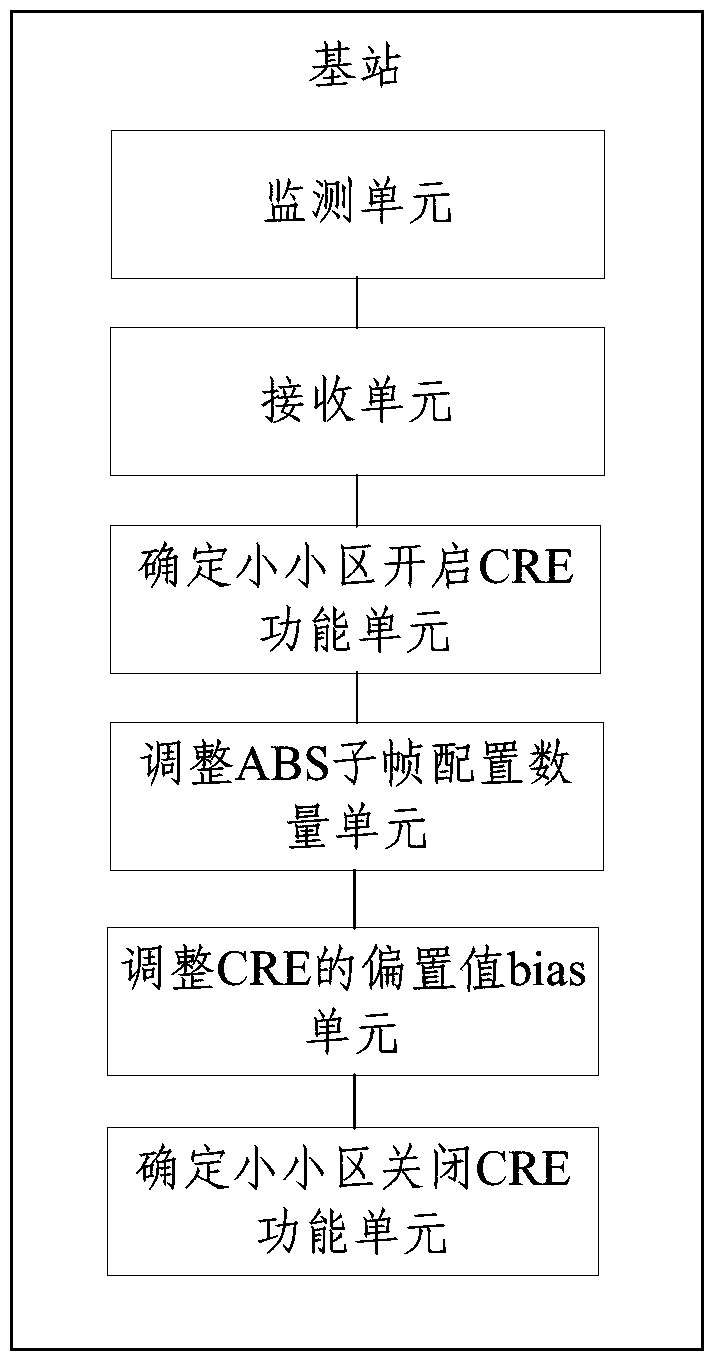
[0065] This embodiment discloses a base station suitable for load balancing of heterogeneous networks, figure 2 The base station shown is the macro base station in the foregoing method embodiment. This embodiment is only for illustration. This embodiment does not limit the composition of the unit modules in the macro base station and the arrangement of the unit modules. The base station may include:
[0066] A monitoring unit is used for real-time monitoring of the load status of the macro cell;
[0067] The receiving unit is used to receive the small cell load status monitoring information reported by the small cell in real time;
[0068] determining that the small cell activates the CRE function unit, configured to determine that the small cell activates the cell coverage extension CRE function according to the load status of the macro cell and the small cell;
[0069] The unit for adjusting the number of ABS subframe configurations is used to adaptively adjust the number ...
PUM
 Login to View More
 Abstract
Description
Claims
Application Information
 Login to View More