Efficient SYN Flood attack identification and disposal method

A technology of attack identification and disposal method, applied in the field of efficient SYNFlood attack identification and disposal, which can solve the problems of exhaustion of server-side resources, failure to receive client ACK packets for SYN+ACK packets, and inability to respond to requests, etc. Achieving the effect of low attack impact

CN106453373AInactive Publication Date: 2017-02-22北京知道未来信息技术有限公司
2 Cites 11 Cited by

Patent Information

Authority / Receiving Office
CN · China
Current Assignee / Owner
Publication Date
2017-02-22
Estimated Expiration
Not applicable · inactive patent

Smart Images

  • Figure 1
    Figure 1
Patent Text Reader

Abstract

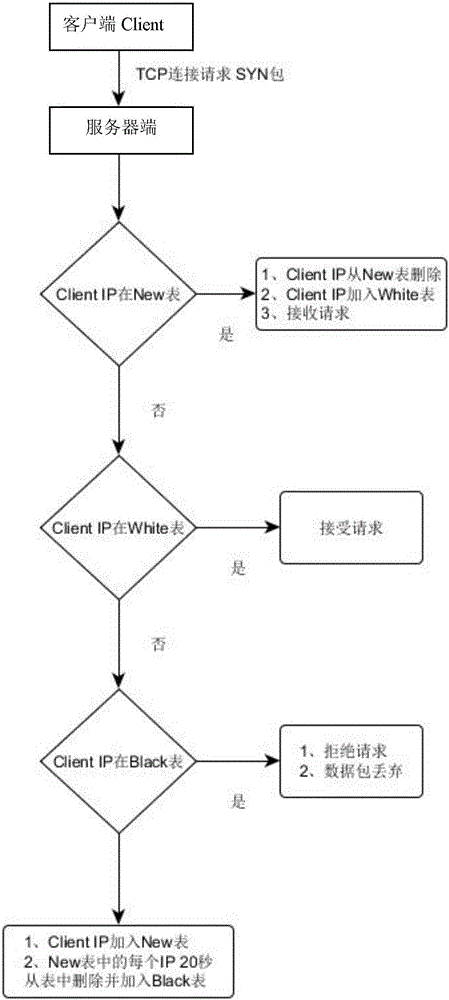
The invention discloses an efficient SYN Flood attack identification and disposal method. The method comprises the steps that: 1, a New table for storing a to-be-classified IP list, a White table for storing an IP white list and a Black table for storing an IP black list are set at a server side; 2, the server side abandons a first SYN data packet on each connection request and records a source address of each SYN data packet into the New table; and 3, the server side acquires the source address of the SYN data packet for the received SYN data packet of each connection request, transfers the source addresses into the White table if the source addresses are positioned in the New table, and directly abandons the SYN data packets if the source addresses are positioned in the Black table. The efficient SYN Flood attack identification and disposal method disclosed by the invention has an identification rate of 98%, and can minimize attack influence.
Need to check novelty before this filing date? Find Prior Art

Description

technical field

[0001] The invention relates to an efficient SYN Flood attack identification and treatment method, which belongs to the field of network technology. Background technique

[0002] SYN Flood is currently a very popular DDoS attack method. It is a method that uses TCP protocol flaws to forge a large number of TCP connection requests, so that the resources of the attacked party are exhausted (CPU exhaustion, memory shortage, bandwidth is full, etc.) attack method.

[0003] TCP is the abbreviation of Transmission Control Protocol, which is translated into Chinese as Transmission Control Protocol. TCP is a connection-oriented communication protocol that provides a stable and reliable data stream service.

[0004] TCP needs to establish a connection through a "three-way handshake":

[0005] The first handshake: the client sends a SYN packet (syn=j) to the server and enters the SYN_SEND state

[0006] The second handshake: After receiving the SYN packet sent by t...

Examples

Embodiment 1

[0033] 1. The client initiates a TCP connection establishment request to the server.

[0034] 2. The server discards the first SYN packet of the connection request and records the client IP in the SYN packet to the New table.

[0035] 3. After the timeout retransmission time is reached, the client does not receive a response from the server, and will send the connection request again.

[0036] 4. The server finds that the client IP of the connection request is in the New table, the request is passed, and at the same time, the client IP is moved from the New table to the White table.

Embodiment 2

[0038] 1. The malicious client initiates a TCP connection establishment request to the server through a forged random source IP.

[0039] 2. The server discards the first SYN packet of the connection request and records the client IP of the SYN packet into the New table.

[0040] 3. After 20 seconds, if the server finds that there is no reconnection request with the same IP, the server will move the fake source IP from the New list to the Black list.

[0041] 4. If a malicious client forges a random source IP and repeats it after a timeout of 20 seconds, the request will be directly discarded by the server.