A multi-input multi-output visible light communication system based on coefficient separation
What is AI technical title?
AI technical title is built by Patsnap AI team. It summarizes the technical point description of the patent document.
A visible light communication, multi-output technology, applied in the direction of digital transmission system, transmission system, baseband system, etc., can solve the problem of high complexity of the optimal receiver
Active Publication Date: 2019-05-31
SOUTHEAST UNIV
View PDF6 Cites 0 Cited by
Summary
Abstract
Description
Claims
Application Information
AI Technical Summary
This helps you quickly interpret patents by identifying the three key elements:
Problems solved by technology
Method used
Benefits of technology
Problems solved by technology
The transmitter of spatial light modulation is simple, but the complexity of the optimal receiver is too high
Method used
the structure of the environmentally friendly knitted fabric provided by the present invention; figure 2 Flow chart of the yarn wrapping machine for environmentally friendly knitted fabrics and storage devices; image 3 Is the parameter map of the yarn covering machine
View more
Image
Smart Image Click on the blue labels to locate them in the text.
Viewing Examples
Smart Image
Click on the blue label to locate the original text in one second.
Reading with bidirectional positioning of images and text.
Smart Image
Examples
Experimental program
Comparison scheme
Effect test
Embodiment 1
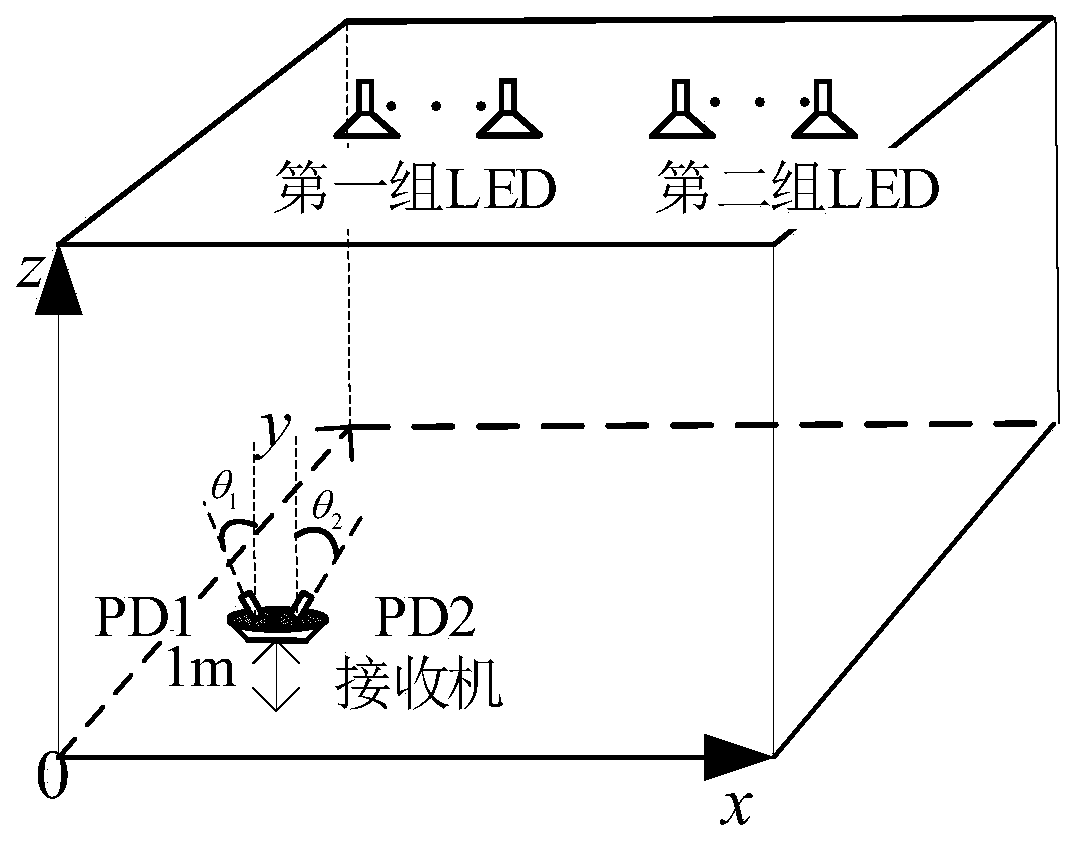
[0131] Assuming that the transmitter has 2 LEDs, the first group and the second group have 1 LED respectively, and the coordinates of the two LEDs are (1.5, 3, 6) and (4.5, 3, 6) respectively. The coordinates of the two PDs at the receiving end are (2.5,3,1) and (2.6,3,1) respectively, θ 1 =θ 2 =π / 4.
[0132] Such as Figure 4 As shown, the bit error rate performance of different modes includes the positive and negative coefficient separation mode of the present invention based on bipolar 16-PAM, where parameter B=2; and the 2×2 MIMO mode based on DC bias 4-PAM, two of which are Independent DC bias 4-PAM data is sent, the receiver uses the least mean square error algorithm; based on the DC bias 16-PAM diversity method, in which two LEDs send the same DC bias-based 16-PAM signal; Unipolar 8-PAM spatial light modulation method, in which 1 bit information is modulated to the index of the LED, and the receiver uses maximum likelihood detection.
[0133] From Figure 4 It can be seen t...
Embodiment 2
[0135] Assuming that the transmitter has 4 LEDs, the first group and the second group have 2 LEDs respectively, and the coordinates of the 4 LEDs are (1.2, 3, 6), (2.4, 3, 6), (3.6, 3, 6), (4.8,3,6). Within each LED group, the optical power is equally distributed. The coordinates of the two PDs at the receiving end are (2.5,3,1) and (2.6,3,1) respectively, θ 1 =θ 2 =π / 6, M PNS =64. Figure 5 Described is the bit error rate performance of the positive and negative coefficient separation method in the present invention under different parameter B values. It can be seen that the optimal parameter B designed by the present invention can achieve better bit error rate performance.
[0136] It can be seen from the above embodiments that the LEDs at the transmitting end of the present invention are divided into two groups. The first group emits the positive part of the bipolar pulse amplitude modulation signal, and the second group emits the negative part of the bipolar pulse amplitude...
the structure of the environmentally friendly knitted fabric provided by the present invention; figure 2 Flow chart of the yarn wrapping machine for environmentally friendly knitted fabrics and storage devices; image 3 Is the parameter map of the yarn covering machine
Login to View More
PUM
Login to View More
Abstract
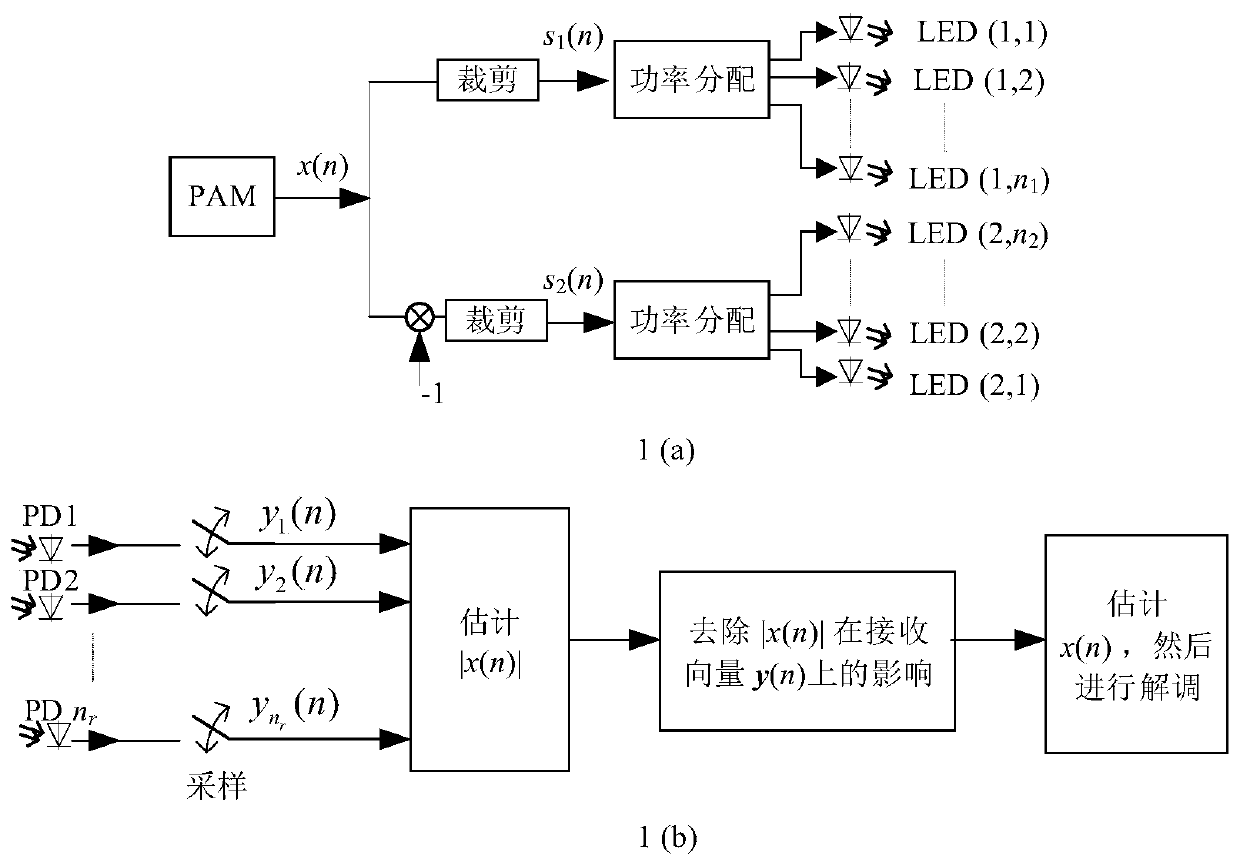
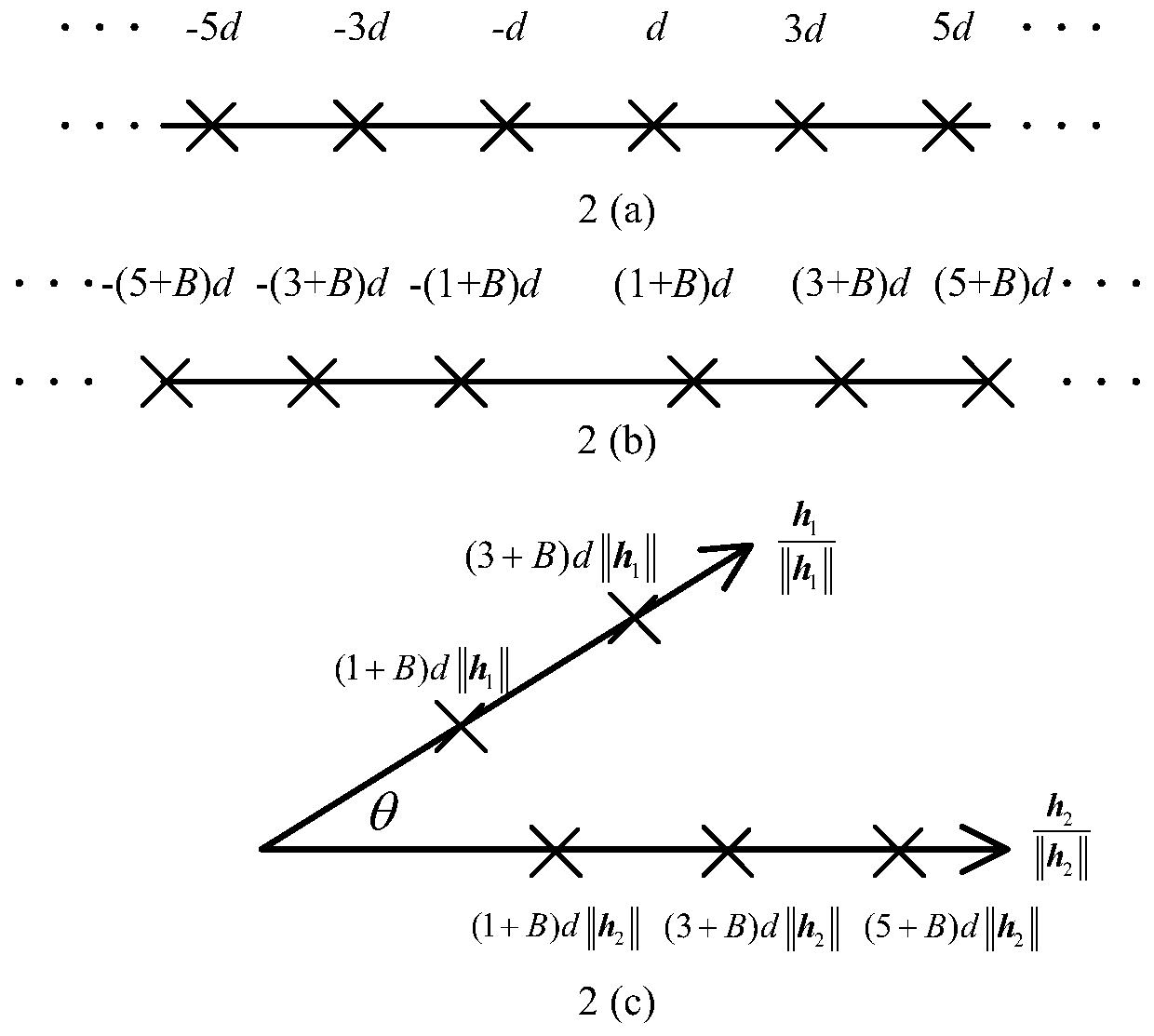
The invention discloses a multi-input multi-output visible light communication system based on coefficient separation. At a transmitting end, LEDs are divided into two groups. The first group of LEDs transmits the positive integer part of a bipolar pulse amplitude modulation signal, and the second group of LEDs transmits the absolute value of the negative integer part of the bipolar pulse amplitude modulation signal. At a receiving end, a novel receiver with low computing complexity is utilized; the receivers utilizes the characteristic of a transmitted signal; the absolute value of the bipolar pulse amplitude modulation signal is estimated; and then the polarity of the bipolar pulse amplitude modulation signal is estimated; and finally estimation of the bipolar pulse amplitude modulation signal is finished. The multi-input multi-output visible light communication system with separated positive coefficient and negative coefficient according to the invention has advantages of low computing complexity, high performance, etc.
Description
Technical field [0001] The invention belongs to wireless communication technology, and specifically relates to a multiple-input multiple-output visible light communication system based on coefficient separation. Background technique [0002] Visible light communication has received more and more attention and is a good supplement to traditional radio frequency wireless communication. Visible light communication generally uses intensity modulation and direct detection technology, which means that the transmitted signal is a non-negative optical power signal. [0003] Multiple input and multiple output can provide space division multiplexing gain and diversity gain. Multiple input multiple output technology has been used in visible light communication systems to overcome the shortcomings of LED modulation bandwidth limitation. However, the spatial sub-channel correlation of multiple-input multiple-output visible light communication is relatively strong. The space division multiple...
Claims
the structure of the environmentally friendly knitted fabric provided by the present invention; figure 2 Flow chart of the yarn wrapping machine for environmentally friendly knitted fabrics and storage devices; image 3 Is the parameter map of the yarn covering machine
Login to View More
Application Information
Patent Timeline
Application Date:The date an application was filed.
Publication Date:The date a patent or application was officially published.
First Publication Date:The earliest publication date of a patent with the same application number.
Issue Date:Publication date of the patent grant document.
PCT Entry Date:The Entry date of PCT National Phase.
Estimated Expiry Date:The statutory expiry date of a patent right according to the Patent Law, and it is the longest term of protection that the patent right can achieve without the termination of the patent right due to other reasons(Term extension factor has been taken into account ).
Invalid Date:Actual expiry date is based on effective date or publication date of legal transaction data of invalid patent.


 Login to View More
  Login to View More