Hybrid duplex transmission method in cognitive relay network based on relay selection

A technology of cognitive relay and duplex transmission, which is applied in the field of cognitive radio, can solve problems such as not considering mixed transmission, and achieve the effect of improving the overall transmission efficiency of the system and broad application prospects

CN107248908AActive Publication Date: 2017-10-13GUILIN UNIV OF ELECTRONIC TECH
5 Cites 7 Cited by

Patent Information

Authority / Receiving Office
CN · China
Current Assignee / Owner
Publication Date
2017-10-13

Smart Images

  • Figure 1
    Figure 1
  • Figure 2
    Figure 2
  • Figure 3
    Figure 3
Patent Text Reader

Abstract

The invention discloses a hybrid duplex transmission method in a cognitive relay network based on relay selection. The cognitive relay network includes a pair of transmitter and receiver of authorized users and a pair of transmitter and receiver of unauthorized users, and potential cooperative relays made up of a plurality of idle unauthorized users. First, a potential relay maximizing the sum of end-to-end signal-to-noise ratio of authorized users and unauthorized users is selected as an optimal relay according to instantaneous channel state information. In half-duplex transmission, a relay transmission frame is divided into two equal time slots. In full-duplex transmission, a relay transmission frame is not divided into time slots. When the signal-to-noise ratio received by the relay is lower than a threshold, full-duplex transmission is employed. Otherwise, half-duplex transmission is employed. Transmission is switched between a half-duplex transmission mode and a full-duplex transmission mode according to the signal-to-noise ratio received by the relay. The advantage of full duplex in transmission capacity is utilized, and the adverse effect of self-interference on the performance of transmission capacity is weakened. Therefore, the total transmission capacity of the cognitive relay network is increased.
Need to check novelty before this filing date? Find Prior Art

Description

technical field

[0001] The present invention relates to the field of cognitive radio technology, in particular to a hybrid duplex transmission method in a cognitive relay network based on relay selection. Background technique

[0002] Today's world has entered the information society, and information and communication technology has penetrated into all aspects of people's lives. Among them, the development of wireless communication technology is changing with each passing day, and various new wireless communication systems and services are constantly emerging. This makes the available spectrum resources more and more scarce. Although new frequency bands are constantly being developed and utilized, it is still difficult for the existing available spectrum resources to meet the high-speed, high-reliability communication needs of a large number of users. The increasingly intensified contradiction between the shortage of spectrum resources and the low utilization rate has prompt...

Examples

Embodiment

[0033] A hybrid duplex transmission method in cognitive relay networks based on relay selection.

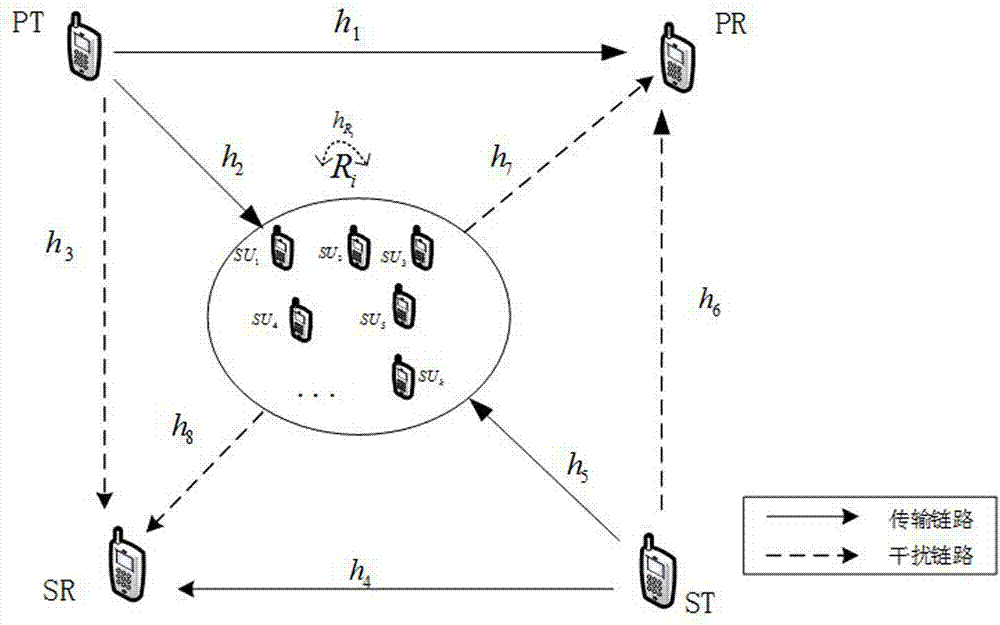
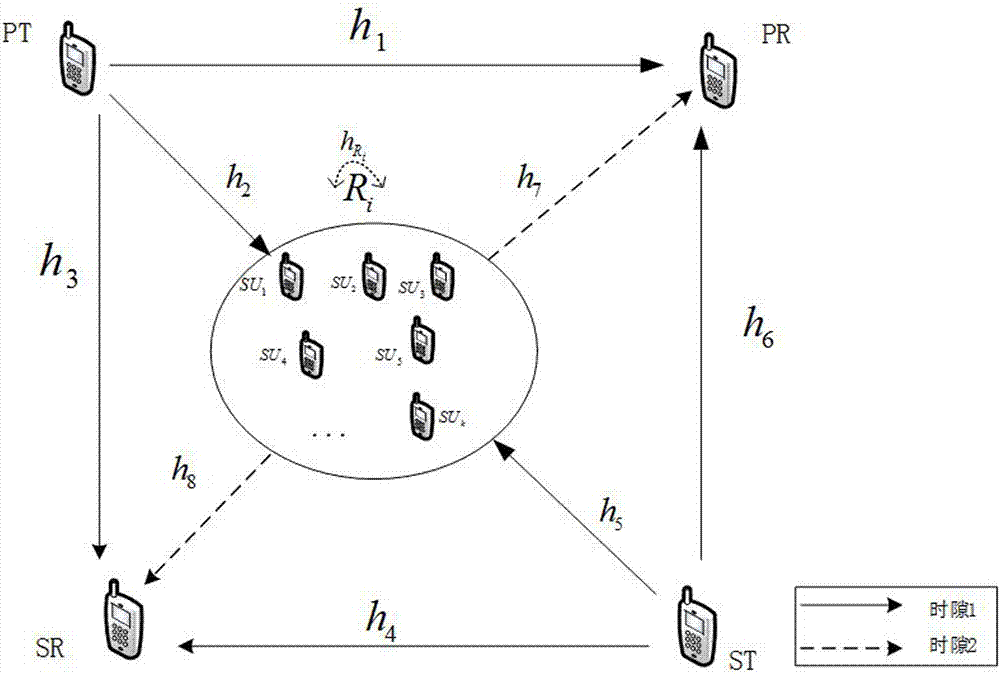
[0034] Such as figure 1 As shown, the cognitive relay network includes a pair of authorized user transmitter PT and receiver PR, a pair of unlicensed user transmitter ST and receiver SR, and a potential cooperative relay R composed of k idle unlicensed users. All nodes are full-duplex, and the cooperative relay R is equipped with a transmitting antenna and a receiving antenna and adopts the transmission and forwarding protocol for cooperative transmission, and other user nodes are equipped with only one antenna.

[0035] The wireless channels involved in the present invention are quasi-static Rayleigh block fading and additive Gaussian white noise channels. To simplify the analysis, we assume that all channel state information is constant and known within a time slot. h t(t=1.2.3.4.5.6.7.8) respectively represent PT→PR, PT→R i , PT→SR, ST→SR, ST→R i , ST → PR, R i →PR and R...